The Thief’s Journal
How Jean appears in its pages: The first-person narrator, a deliberately magnified literary version of the author who turns his outlaw past into art.
Read the character guideFrench novelist, poet, playwright, filmmaker and political writer who transformed abandonment, imprisonment, homosexuality, crime and revolt into lyrical prose and a theater of masks, ritual and unstable identities.
Jean Genet (19 December 1910 – 14 April 1986) was a French novelist, poet, playwright, essayist, filmmaker, and political writer whose transformation from abandoned child, juvenile detainee, deserter, thief, wanderer, and prisoner into one of the major literary figures of twentieth-century France became inseparable from the mythology surrounding his work. His novels and plays repeatedly invert conventional ideas of morality and beauty: thieves become saints, betrayal becomes devotion, prisons become sites of erotic or spiritual revelation, servants imitate masters, and social identities dissolve into masks and performances.
Genet wrote openly about homosexuality, prostitution, crime, imprisonment, desire, and social exclusion at a time when such material remained highly controversial. Yet the subjects that scandalized early readers were expressed in an unusually formal, lyrical French. The tension between what society considered degraded and the elevated language Genet used to describe it lies at the center of his style. Oxford's overview of his career describes this combination of highly poetic language and unapologetic treatment of homosexuality and criminality as crucial to the extraordinary speed with which he established himself as an important writer during the 1940s.
His major works include the novels Notre-Dame-des-Fleurs (Our Lady of the Flowers), Miracle de la rose (Miracle of the Rose), Pompes funèbres (Funeral Rites), Querelle de Brest, and *Journal du voleur* (*The Thief's Journal*); the plays Les Bonnes (The Maids), Haute Surveillance (Deathwatch), Le Balcon (The Balcony), Les Nègres (The Blacks), and Les Paravents (The Screens); the film Un chant d'amour; and the late political memoir Un captif amoureux (Prisoner of Love).[1]
Genet was born in Paris on 19 December 1910 to Camille Gabrielle Genet, a twenty-two-year-old domestic worker or governess. His legal birth record named no father. When Jean was seven months old, Camille surrendered him to the Assistance publique, the French public welfare system responsible for abandoned and dependent children. On 28 July 1911 he became a ward of the state and was sent away from Paris to live with foster parents Charles and Eugénie Régnier in the village of Alligny-en-Morvan, in Burgundy.[2]
Contrary to the later image of Genet as someone destined from infancy for criminality, the evidence suggests that his earliest childhood was comparatively stable. His foster family cared for him, he received a Catholic upbringing, sang in the church choir, served as an altar boy, and performed well at the local school. In 1923 he completed his primary-school certificate with good marks and reportedly ranked first in the commune. The religious imagery he absorbed during these years—saints, martyrs, sacred ritual, sin, sacrifice, transfiguration—never disappeared from his imagination even though he would ultimately turn much of that symbolism upside down.[3]
Several names belonging to children he knew in the Morvan later resurfaced in altered form in his fiction, including Culafroy and Querelle. This is characteristic of Genet's method. His books draw repeatedly from his biography, but he does not simply reproduce life. Names, encounters, crimes, desires, and memories become components of an elaborate private mythology.
His biological mother died in Paris during the influenza epidemic in 1919, when Genet was eight. He apparently grew up without knowing her. Much later, the fact of being abandoned became central to the story Genet told about himself: a child excluded from ordinary family life who would eventually make exclusion itself into a chosen identity.
Genet left his foster home in adolescence and entered a much harsher institutional world.
In October 1924, because of his strong school performance, he was sent to the École d'Alembert, an Assistance publique vocational school where he was supposed to train as a printer. He ran away after only about ten days and was eventually found in Nice. Other placements and escapes followed. After taking money while working for the blind composer René de Buxeuil, he was briefly examined at the Sainte-Anne psychiatric hospital in Paris. In March 1926, following further escapes, he spent approximately three months at the Petite Roquette prison in Paris.
On 2 September 1926, at fifteen, Genet was sent to the Mettray penal colony near Tours.[4]
Mettray became one of the foundational places of his imagination. Established in the nineteenth century as an agricultural reformatory for boys, it combined hard labor, military discipline, surveillance, hierarchy, and punishment. Genet remained there until 1929. Years later he transformed the experience in Miracle de la rose, where confinement, domination, male beauty, punishment, and desire become almost religious in their intensity.
The young Genet appears already to have been unusually responsive to language. Late in life he remembered encountering the poetry of Pierre de Ronsard around this period and being dazzled by its French. That matters because Genet would later insist that he deliberately used elegant, grammatically controlled French to address the very respectable society that had imprisoned him. He did not want simply to reproduce the language of the underworld; he wanted to appropriate the language of authority itself.
To leave Mettray before reaching his majority, Genet enlisted in the French army in March 1929.
Military service took him outside France and began another major phase of his life. In 1930 he was stationed in Syria, spending time in Beirut and Damascus. In 1931 he volunteered for service in Morocco, where he lived for roughly nineteen months, including periods at Midelt and Meknès. His first sustained encounters with the Arab world occurred through the French colonial military system—an experience that would acquire very different meaning when, decades later, he aligned himself with anticolonial and Palestinian causes.
Genet repeatedly reenlisted, apparently attracted both to travel and the enclosed male world of military life. In June 1936 he deserted.
What followed was the extraordinary wandering existence later reshaped in The Thief's Journal. Genet traveled through Spain and across Italy, Albania, Yugoslavia, Austria, Czechoslovakia, Poland, Germany, and Belgium. He lived precariously, stole, used false papers, begged, sometimes sold sex, and became involved with other thieves, deserters, hustlers, and marginal figures. The important point is not simply that these events occurred, but that Genet later transformed humiliation into legend. In The Thief's Journal, poverty, betrayal, prostitution, and theft are not apologized for; they are subjected to an almost ceremonial aesthetic transformation.
He returned to Paris in 1937. Over the following years he accumulated repeated convictions for relatively minor offenses—stealing handkerchiefs, books and other goods, falsifying documents, and offenses connected with his desertion. His legal history was complicated by overlapping cases, but by the early 1940s repeated convictions exposed him to the possibility of severe punishment as a habitual offender.[5]
Genet's emergence as a writer occurred inside this cycle of imprisonment.
During confinement at Fresnes, he began writing Notre-Dame-des-Fleurs in 1942. He also wrote the long poem *Le Condamné à mort, inspired by the executed murderer Maurice Pilorge. The Institut Mémoires de l'édition contemporaine preserves evidence that the origins of Notre-Dame-des-Fleurs* actually stretch back even earlier: a tiny notebook Genet carried in 1939 already contains the name of the novel's principal character and an early version of one of its central images.[6]
Notre-Dame-des-Fleurs is set largely within an imagined homosexual underworld of prewar Paris. Its characters—Divine, Mignon, Darling Daintyfoot, and the young murderer Notre-Dame-des-Fleurs—are simultaneously criminals, fantasies, erotic objects, saints, theatrical performers, and inventions of an imprisoned narrator.
Genet later explained that the "I" in his supposedly autobiographical work should not simply be identified with himself. It was a magnified character. This distinction is essential. Genet mined his own life relentlessly, but he was also one of the principal creators of the myth of "Jean Genet."[7]
Genet's life changed radically in 1943.
Through acquaintances in the Paris book trade, his poetry reached **Jean Cocteau**. On 15 February 1943, Genet was introduced to Cocteau at the writer's apartment at 36 rue de Montpensier, near the Palais-Royal. Cocteau was initially disturbed by Notre-Dame-des-Fleurs but quickly became convinced that Genet was an extraordinary writer and helped arrange his first publishing contract.
The timing was critical. In July 1943 Genet appeared in court after stealing an expensive edition of Verlaine's Fêtes galantes. Because of his repeated convictions, he faced the possibility of "relégation," potentially permanent confinement. Cocteau testified on his behalf and publicly declared the obscure prisoner an important writer. Genet escaped the most severe sentence.[5]
His books initially circulated in clandestine or private editions. Notre-Dame-des-Fleurs was printed in a small edition during the Occupation; Querelle de Brest and Pompes funèbres likewise appeared under unusual publishing circumstances. Because several texts circulated privately before their official editions, publication dates for early Genet works sometimes differ between bibliographies.
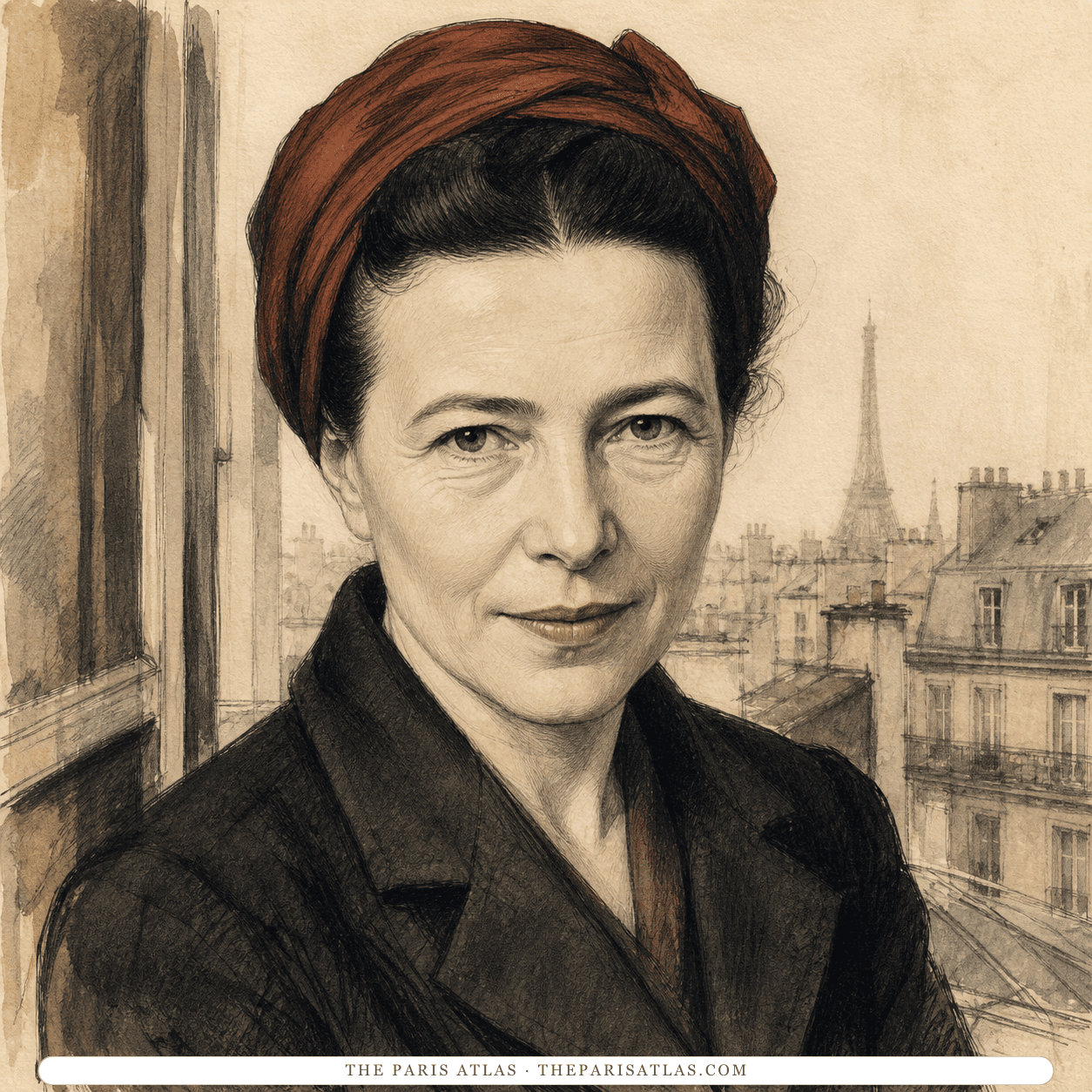
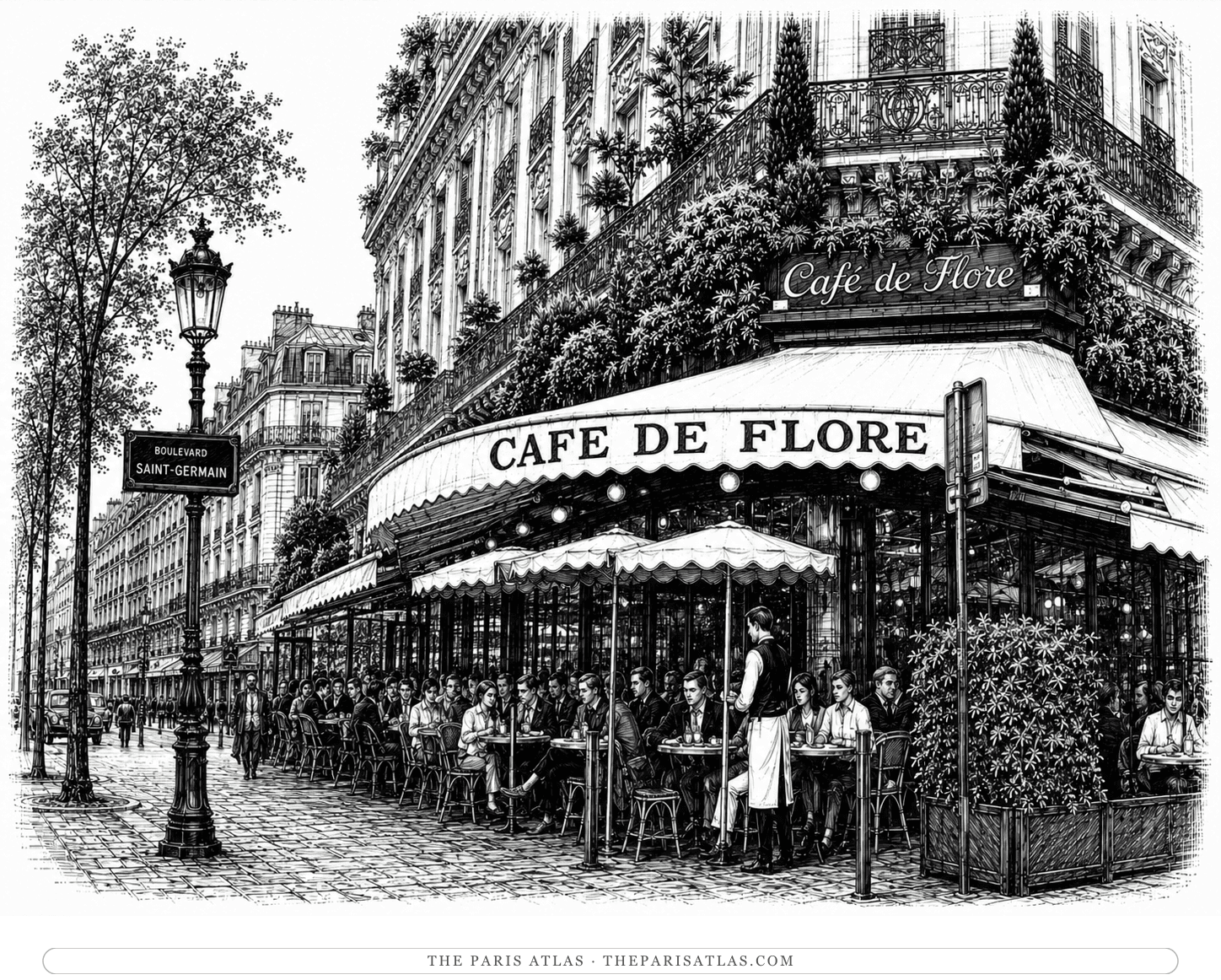
In 1944, Jean-Paul Sartre and Simone de Beauvoir read an extract from Notre-Dame-des-Fleurs in the literary journal L'Arbalète. Sartre later recalled their astonishment at the power of the writing. Genet subsequently approached Sartre at the **Café de Flore** in Saint-Germain-des-Prés, beginning another enormously important literary relationship.[8]
Genet had moved in only a few years from prison anonymity into the center of postwar Parisian intellectual life.
Genet's legal past continued to threaten him even after his literary reputation grew.
In 1948, Cocteau and Sartre prepared a petition asking French president Vincent Auriol to intervene. Signatories included an extraordinary collection of writers and artists: Pablo Picasso, André Breton, Colette, François Mauriac, Jacques Prévert, Paul Claudel, Marcel Aymé, Louis Jouvet, Jean Anouilh, and publisher Gaston Gallimard. Auriol ultimately granted Genet a presidential pardon in 1949.
By then Genet had produced his central sequence of novels: Notre-Dame-des-Fleurs, Miracle de la rose, Pompes funèbres, Querelle de Brest, and Journal du voleur. Few major writers have produced such a concentrated body of fiction in so short a period.
Genet increasingly turned from the novel toward the theater.
*Les Bonnes (The Maids) was staged in Paris in 1947 under Louis Jouvet at the Théâtre de l'Athénée*. Two servants, Claire and Solange, repeatedly perform elaborate role-playing ceremonies in which one becomes their employer, Madame, while the other becomes a servant. Identity is never stable. A character performs another character who may itself be performing another social role.
This structure became central to Genet's theater.
In *Le Balcon (The Balcony), clients in a brothel impersonate figures such as a bishop, judge, and general while revolution rages outside. Eventually the imitation of power threatens to become indistinguishable from power itself. In Les Nègres (The Blacks), race, spectacle, masks, spectatorship, and colonial authority are staged as a ritualized performance. In Les Paravents (The Screens*), Genet constructed an enormous theatrical world around colonial Algeria, revolt, betrayal, death, and fantasy. Scholarship on his drama frequently describes it as a theater of ritual, doubling, illusion, role-playing, and unstable identity.
The French premiere of Les Paravents at the Odéon in 1966 became one of the great theatrical scandals of postwar Paris. Right-wing activists and some veterans of the wars in Indochina and Algeria disrupted performances; confrontations escalated into violence. The controversy reached the French National Assembly, where culture minister André Malraux defended the principle that publicly subsidized theater should not be subjected to political censorship.
One of the most striking things about Genet is the discrepancy between his material and his language.
He writes about prisons, toilets, thieves, pimps, murderers, semen, betrayal, violence, prostitution, and humiliation in prose that can suddenly sound ceremonial, baroque, devotional, or almost classical. He repeatedly takes what the respectable world has classified as dirty and attempts to make it beautiful.
This is not simply shock for its own sake. Genet's deepest technique is inversion. If conventional morality places the saint above the criminal, Genet asks what happens if the criminal is described as a saint. If society regards betrayal as contemptible, he turns betrayal into an act that can possess its own terrifying purity. Masculinity becomes femininity; master becomes servant; actor becomes audience; reality becomes theater.
His language itself performs this transformation. Genet could incorporate criminal slang and sexual vocabulary, but he often deliberately surrounded them with elevated syntax, poetic metaphor, religious language, and formal French. As he explained late in life, he felt compelled to address respectable society in its own language—the language of the people who had judged and imprisoned him.
His theater extends the idea into physical space. Mirrors, costumes, ceremonies, masks, role-playing, and plays-within-plays continually expose identity as something performed rather than permanent.
The strongest literary influence Genet acknowledged was **Marcel Proust**. Edmund White's research identifies Proust as Genet's most important literary influence from the late 1930s onward. Like Proust, Genet uses memory less to reconstruct an objective past than to create a personal universe in which desire alters the meaning of everything remembered. The social worlds are radically different—Proust's aristocratic salons become Genet's prisons, cheap hotels, brothels, and criminal circles—but both turn memory and desire into enormous systems of interpretation.
Ronsard was important to his discovery of poetic French. Genet remembered being captivated by Ronsard as a teenager and connected that encounter with his lifelong insistence on the beauty and precision of language.
Antonin Artaud is another major point of reference, particularly for Genet's theater. Critics have debated exactly how direct the influence was, but the affinities are unmistakable: hostility toward conventional psychological realism, fascination with ceremony and ritual, theater as an event rather than simply a literary text, and the desire to affect the spectator physically and emotionally.
Catholic ritual was another deep source—not necessarily of Genet's beliefs but of his imagination. The altar boy who abandoned conventional religion retained its vocabulary of saints, sacrifice, transfiguration, martyrdom, sacred objects, confession, and ceremony.
No writer shaped Genet's public interpretation more powerfully than Jean-Paul Sartre.
What was originally intended as a preface to Genet's collected works expanded into Sartre's enormous 1952 study *Saint Genet, comédien et martyr*. Sartre interpreted Genet's life as the story of a stigmatized child who accepted society's designation of him as a thief and transformed that imposed identity into a freely created artistic destiny. Sartre described genius not as a mysterious gift but as an escape invented in desperate circumstances.
Genet's reaction was complicated. He later said that Sartre had stripped away the disguises through which he had protected himself in his own books and that the experience contributed to a period in which writing became extremely difficult. Whether Sartre alone caused the silence is debatable, but Genet's production changed radically during the 1950s: the torrent of novels ended and theater increasingly became his principal literary form.
One of Genet's most significant friendships was with **Alberto Giacometti**.
Sartre introduced the two men in 1954. Genet subsequently spent long periods sitting for Giacometti at the sculptor's tiny studio at 46 rue Hippolyte-Maindron in Montparnasse. Giacometti produced several paintings and drawings of Genet, including the important Portrait de Jean Genet of 1954–55 now in the Centre Pompidou. Their posing sessions continued for several years.
The friendship resulted in Genet's *L'Atelier d'Alberto Giacometti*, first published in 1957 and still regarded as one of the most important literary texts on the artist. Genet was fascinated by Giacometti's dusty, precarious studio and by his obsessive attempt to capture the human figure. The relationship is particularly useful for understanding Genet because he recognized in Giacometti another artist who transformed deprivation, solitude, repetition, and physical matter into beauty.
During the 1950s Genet became closely attached to Abdallah Bentaga, a young acrobat and tightrope walker. Genet encouraged his career and wrote the remarkable prose-poem Le Funambule (The Tightrope Walker) for him.
After an accident damaged Abdallah's ability to perform, his life deteriorated. He died by suicide in Paris in March 1964. The loss affected Genet profoundly. He announced that he was abandoning literature and destroyed manuscripts. Although archival research shows that he did not literally stop writing altogether, there was a dramatic reduction in major literary publication.
The writer who had spent the 1940s transforming his own private mythology into fiction increasingly turned outward.
From the late 1960s onward, Genet became increasingly involved in political causes.
He responded to May 1968 in France and became involved in protests concerning the treatment of immigrants. In 1970, at the invitation of the Black Panther Party, he traveled through the United States, speaking publicly in support of the Panthers and writing about figures including Bobby Seale, George Jackson, and Angela Davis.
Later in 1970 he traveled to Jordan expecting to spend only a short time with Palestinian fighters. Instead, he remained for roughly six months and returned to the region repeatedly. The Palestinians became the most sustained political attachment of his later life.
Genet's politics were deliberately confrontational and sometimes controversial. He was attracted to groups that positioned themselves against states, prisons, colonial systems, police power, and conventional European society. His political writing retained the same fascination with rebels, outsiders, betrayal, spectacle, masculinity, and danger that had shaped his fiction.
In September 1982, Genet was in Beirut shortly after the massacres at the Palestinian refugee camps of Sabra and Shatila. He entered Shatila after the killings and wrote *Quatre heures à Chatila (Four Hours in Shatila*), an intensely personal eyewitness response published in 1983.
The experience also helped return him to sustained literary writing.
Genet had been diagnosed with throat cancer in 1979. During the early 1980s he increasingly spent time in Morocco while returning periodically to France and the Middle East. Despite illness, he began assembling decades of memories concerning the Black Panthers and Palestinians into what became *Un captif amoureux (Prisoner of Love*).
The book is not a conventional political memoir. Chronology fractures; memories interrupt one another; people who are dead become present again; political history merges with erotic memory, dreams, images, photographs, and reflections about language. It is in many ways the culmination of Genet's entire literary method.
By late 1985 he had given the manuscript to his publisher and was correcting proofs.
Genet's relationship with Paris was not an episode in his biography. Paris was one of the principal landscapes of his entire life, from his birth and abandonment to his prisons, literary friendships, theater premieres, artistic relationships, and death.
Genet begins one of the most famous autobiographical passages of *Journal du voleur by explaining that he was born in Paris on 19 December 1910 and became a ward of the Assistance publique. When, at twenty-one, he obtained information concerning his birth, he learned his mother's name and was told that he had been born at 22 rue d'Assas*. Genet says that he went to the address and found a maternity institution there, but was unable to learn anything further.
There is, however, an important archival complication.
The detailed chronology prepared from Genet research associated with the Institut Mémoires de l'édition contemporaine and reviewed by Genet scholar Albert Dichy places his birth at the Maternité Tarnier, 89 rue d'Assas, rather than number 22.
For an encyclopedia or Paris Atlas page, the safest treatment is therefore:
*Genet himself identified 22 rue d'Assas in The Thief's Journal. Later archival scholarship places the birth at the Maternité Tarnier at 89 rue d'Assas.*
The contradiction should be preserved rather than silently choosing one address.
At seven months old, Genet was surrendered to the Hospice des Enfants Assistés on rue Denfert-Rochereau and sent from Paris to the Morvan. Thus Paris is both his birthplace and the place from which the state removed him into foster care.
Paris later became part of Genet's institutional and criminal history. As a teenager he spent time in the Petite Roquette. As an adult he experienced repeated imprisonment, including periods at La Santé and at Fresnes, just outside Paris. IMEC identifies these prison years as the period in which the obscure thief began turning himself into the writer Jean Genet.
At 36 rue de Montpensier, Genet met Jean Cocteau in February 1943. That meeting is one of the decisive literary moments of his life: Cocteau read his work, helped him find a publisher, defended him in court, and introduced the unknown prisoner-writer to literary Paris.
In 1944 Genet approached **Jean-Paul Sartre at the Café de Flore* after Sartre and Simone de Beauvoir had read his work. Genet subsequently entered their Saint-Germain circle, and Journal du voleur* would be dedicated to Sartre and "the Beaver," Beauvoir's familiar nickname.
The Théâtre de l'Athénée became another important Genet site when Louis Jouvet staged Les Bonnes there in 1947. Genet was no longer merely the scandalous author of clandestine prison books; he had entered the institutional theatrical life of Paris.
Between 1954 and 1957 Genet repeatedly visited Alberto Giacometti's studio at 46 rue Hippolyte-Maindron. He sat there for portraits during long sessions and turned the experience into L'Atelier d'Alberto Giacometti. The original studio no longer survives, but its address is securely documented.
The Odéon became part of Genet's public history in 1966 when Roger Blin's Paris production of Les Paravents provoked demonstrations, violence, police intervention, and eventually debate in the National Assembly. Few twentieth-century French writers can be tied so directly to a particular Paris theater and a national political controversy.
Genet's final Paris location survives.
During his last years he stayed at Jack's Hôtel, 19 avenue Stephen-Pichon, in the 13th arrondissement, near Place d'Italie. The hotel states that he occupied room 205 and worked there on *Un captif amoureux*. The room is still identified with him by the hotel.
Seriously ill with throat cancer, Genet was found dead in the hotel in April 1986. The Bibliothèque nationale de France's authority record gives 14 April 1986 as his official date of death and notes that the Paris civil record placed his death during the night of 13–14 April; contemporary newspaper reporting sometimes announced it as 15 April, which accounts for the differing dates found in biographies.
The circumstances are reported slightly differently in later accounts, although a fall in his hotel room is frequently mentioned. It is safest to say that Genet, already seriously ill with cancer, was found dead there rather than to state categorically that either the cancer or fall alone caused his death.
For Paris history, however, the location itself is unusually secure:
Jack's Hôtel 19 avenue Stephen-Pichon Paris 13e Room 205
It connects Genet's final months, his final book, and his death to a place that still exists.
Genet was diagnosed with throat cancer in 1979, and his health declined during the final years of his life. On 14 April 1986, at the age of seventy-five, he was found dead in room 205 of Jack's Hôtel in Paris, where he had been working on the proofs of Un captif amoureux (Prisoner of Love). Accounts of his final hours differ slightly: Genet was seriously ill with cancer and is also reported to have fallen in his hotel room shortly before his death. Because contemporary and later sources do not consistently identify a single immediate cause, it is safest to describe his death as occurring after a long illness with throat cancer rather than attributing it solely to either the cancer or the fall. He was buried in Larache, Morocco.
A few days after his death, Genet was buried not in Paris but in Larache, Morocco, in the old Spanish cemetery overlooking the Atlantic.
The setting feels appropriate to his biography without needing to romanticize it. The abandoned Parisian child who spent much of his life crossing borders, sleeping in prisons and cheap hotels, traveling through Europe and the Arab world, and refusing permanent belonging ultimately received a grave outside France.
Un captif amoureux appeared posthumously the following month.
Genet's influence extends well beyond French literature.
His theater helped reshape postwar ideas about what could occur onstage. Characters need not possess stable psychological identities; they could instead perform identities, exchange them, parody them, or become trapped inside them. The stage itself could operate as a ceremony, political structure, fantasy, brothel, prison, courtroom, or mirror.
His effect on queer writing has been equally substantial. Genet demonstrated decades before gay literature achieved mainstream acceptance that homosexuality did not need to be presented apologetically or explained as a social problem. His sexual world could be violent, comic, selfish, beautiful, degrading, sacred, criminal, and contradictory because his characters were allowed the same moral complexity traditionally granted to heterosexual characters.
Among the artists who have explicitly acknowledged him is Patti Smith, who has called The Thief's Journal the book that had the greatest influence on her own writing, particularly its mixture of autobiography and poetic fiction.
Genet also became a cultural reference beyond literature. David Bowie partly drew the title of his 1972 song "The Jean Genie" from Genet's name, even though the song's central character was primarily modeled on Iggy Pop.
Philosophers and critics repeatedly returned to him. Sartre devoted Saint Genet to him; Jacques Derrida made Genet one of the two principal figures of his 1974 book Glas; and later queer, postcolonial, theatrical, and political scholarship has continually reinterpreted his work.
Cinema provided another afterlife. Rainer Werner Fassbinder adapted Querelle de Brest as *Querelle* in 1982, one of Fassbinder's final films.
Genet is now firmly canonical—the precisely respectable fate that the younger Genet spent so much energy attacking. His plays are revived by major theaters, his manuscripts are preserved by institutions, his work has entered the Bibliothèque de la Pléiade, and scholars study the prison notebooks of a man who once wrote believing that respectable society might never permit his books to exist.
That contradiction is perhaps the most Genet-like conclusion possible.
Born in Paris on 19 December to Camille Gabrielle Genet; father legally unidentified.
At seven months old, is surrendered to the Assistance publique and placed with Charles and Eugénie Régnier in Alligny-en-Morvan.
His biological mother dies in Paris during the influenza epidemic.
Completes his primary-school certificate with strong marks.
Sent to the École d'Alembert for vocational training; escapes after approximately ten days.
After further trouble and an accusation involving stolen money, is examined at Sainte-Anne in Paris.
Imprisoned briefly at the Petite Roquette; in September is sent to the Mettray penal colony.
Leaves Mettray by enlisting in the French army.
Serves in Beirut and Damascus.
Serves in Morocco.
Deserts the army and begins an extended period of wandering through Europe.
Returns to Paris; begins accumulating convictions for theft and related offenses.
An surviving notebook contains early traces of what will become Notre-Dame-des-Fleurs.
In Fresnes prison, works on Notre-Dame-des-Fleurs and writes Le Condamné à mort.
Meets Jean Cocteau at 36 rue de Montpensier; signs his first publishing contract. Cocteau later intervenes when Genet faces severe punishment as a repeat offender.
Sartre and Beauvoir discover his writing; Genet enters their Paris intellectual circle.
Miracle de la rose appears; Genet works intensively on fiction and theater.
Les Bonnes is staged at the Théâtre de l'Athénée; Querelle de Brest and Pompes funèbres circulate in early editions.
Journal du voleur is published by Gallimard; President Vincent Auriol grants Genet a pardon following the intervention of Sartre, Cocteau, Picasso, Colette and others.
Directs his only completed film, Un chant d'amour.
Sartre publishes Saint Genet, comédien et martyr.
Meets Alberto Giacometti and begins sitting for portraits in the artist's Montparnasse studio.
Writes Le Balcon, works on Les Nègres and Les Paravents, and develops his friendship with Abdallah Bentaga.
Publishes L'Atelier d'Alberto Giacometti.
Roger Blin stages Les Nègres in Paris.
Abdallah dies by suicide. Genet declares that he is abandoning literature and destroys manuscripts.
Les Paravents opens at the Odéon in Paris, causing protests and a national controversy.
Responds publicly to May 1968 and travels to the United States during the Democratic National Convention in Chicago.
Tours the United States in support of the Black Panthers; later travels to Jordan and spends months among Palestinian fighters and refugees.
Returns repeatedly to the Middle East and writes on the Palestinians and Black political prisoners.
Jacques Derrida publishes Glas, pairing philosophical readings of Hegel and Genet.
Diagnosed with throat cancer.
In Beirut after the Sabra and Shatila massacres; writes Quatre heures à Chatila. Fassbinder's Querelle is released.
Begins sustained work on Un captif amoureux and receives the Grand Prix national des Lettres.
Delivers the manuscript of Un captif amoureux to his publisher.
Dies in room 205 of Jack's Hôtel in Paris in April while correcting the book. He is buried in Larache, Morocco. Un captif amoureux appears posthumously the following month.
How Jean appears in its pages: The first-person narrator, a deliberately magnified literary version of the author who turns his outlaw past into art.
Read the character guide
Met · 1954
Sartre introduced Genet and Giacometti in 1954; Genet sat repeatedly in the sculptor's studio, was portrayed by him, and wrote L'Atelier d'Alberto Giacometti.

Met · 1944
After Sartre and Simone de Beauvoir read his work, Genet approached Sartre at the Café de Flore and entered their Saint-Germain circle.
Met · 1944
Beauvoir and Sartre discovered Genet's writing in 1944, after which Genet joined their Paris intellectual circle and dedicated The Thief's Journal to them.

Met · 1970
The two writers sat on a panel together at the American Center for Students and Artists in Paris in 1970. A contact sheet by the photographer Jacques Robert, held at the Schomburg Center, records the occasion.

Met · 1943
Genet was introduced to Cocteau at 36 rue de Montpensier on 15 February 1943; Cocteau helped secure a publisher and defended him in court.
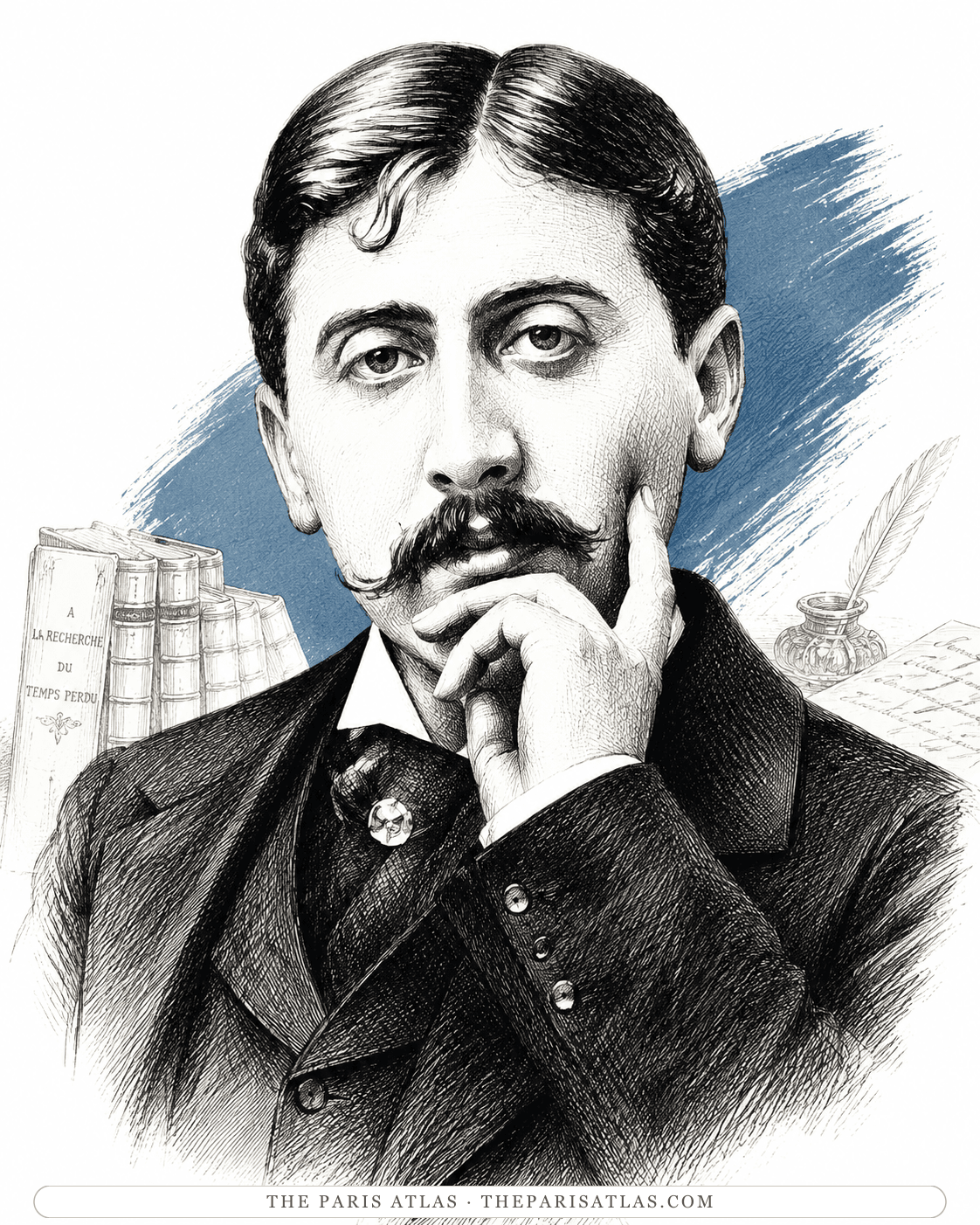
Edmund White's research identifies Proust as Genet's most important literary influence from the late 1930s onward.
Jean Genet turns theft, prisons, sex, betrayal, and wandering through Europe into a defiantly beautiful literary autobiography.
Frequented · 1944
Genet approached Jean-Paul Sartre at the Café de Flore after Sartre and Simone de Beauvoir had read his work, beginning his relationship with their Saint-Germain circle.
Met · 1954
Sartre introduced Genet and Giacometti in 1954; Genet sat repeatedly in the sculptor's studio, was portrayed by him, and wrote L'Atelier d'Alberto Giacometti.
Met · 1944
After Sartre and Simone de Beauvoir read his work, Genet approached Sartre at the Café de Flore and entered their Saint-Germain circle.
Met · 1944
Beauvoir and Sartre discovered Genet's writing in 1944, after which Genet joined their Paris intellectual circle and dedicated The Thief's Journal to them.
Met · 1970
The two writers sat on a panel together at the American Center for Students and Artists in Paris in 1970. A contact sheet by the photographer Jacques Robert, held at the Schomburg Center, records the occasion.
Met · 1943
Genet was introduced to Cocteau at 36 rue de Montpensier on 15 February 1943; Cocteau helped secure a publisher and defended him in court.
Influenced by · 1938
Edmund White's research identifies Proust as Genet's most important literary influence from the late 1930s onward.
The sources below include biographies, scholarly essays, interviews, and primary materials that informed this page. They reflect both the historical record and ongoing critical conversations about Jean Genet and their work.


Scholarly overview of Genet's literary career, politics, Black Panther work, Palestinian engagement, and critical reception.

The BnF authority record supplies Genet's official birth and death information and explains the civil-record date of death.

General literary biography covering Genet's fiction, drama, film, style, and major career chronology.
Detailed chronology based on an IMEC exhibition and reviewed by Genet scholar Albert Dichy, including childhood, institutions, addresses, and publication history.
IMEC presentation of Genet's early notebooks and the prison origins of *Notre-Dame-des-Fleurs*.
Genet's own account in *Journal du voleur* of his birth information and visit to 22 rue d'Assas.
BnF account of Sartre's *Saint Genet, comédien et martyr* and its interpretation of Genet's life and writing.
The principal archival record for Genet's manuscripts, correspondence, prison writing, theater, political work, and final papers.
BnF exhibition record for Sartre and Genet, their Café de Flore meeting, and the literary relationship that followed.
Museum record for Giacometti's portrait of Genet and the friendship and studio sittings behind it.
Institutional account of Genet's *L'Atelier d'Alberto Giacometti* and his response to the sculptor's studio and work.
Official record of André Malraux's 1966 parliamentary defense of *Les Paravents* and freedom from political censorship.
The Odéon's history of Roger Blin's 1966 production, protests, violence, and national controversy.
The surviving hotel's record of Genet's room 205, his work on *Un captif amoureux*, and his final Paris residence.
Review of Edmund White's biography documenting Proust's importance to Genet and his literary development.
Scholarly study of Genet's theater as ritual, doubling, illusion, role-playing, and unstable identity.
Collection of Genet's political texts and interviews concerning the Black Panthers, Palestinians, prisons, and revolt.
Publication record for Genet's eyewitness response “Four Hours in Shatila.”
Patti Smith identifies *The Thief's Journal* as the greatest influence on her own writing.
Music-history account of the Genet reference in David Bowie's title “The Jean Genie.”
Primary source for Genet's autobiographical account and the rue d'Assas birthplace claim.
Archival photograph documenting Genet and James Baldwin together at the American Center in Paris in 1970.
These references anchor the page in the documented record and in the scholarly conversations around Jean Genet. Every claim on this page traces back to one or more of the works listed here.
 Explore more resources