Dutch painter and etcher who worked in Leiden and Amsterdam and never traveled outside the Dutch Republic. He made about 300 etchings and roughly eighty self-portraits, trained some twenty-five painters, and was declared insolvent in 1656.
In images
Details
Lived
1606–1669
Born
15 July 1606
Birthplace
Leiden, Dutch Republic
Birth name
Rembrandt Harmenszoon van Rijn
Died
4 October 1669 · aged 63
Place of death
Amsterdam, Dutch Republic
Nationality
Dutch
Profession
Painter and etcher
Major works
The Anatomy Lesson of Dr Nicolaes Tulp, The Night Watch, Bathsheba at Her Bath, The Syndics, The Jewish Bride, Self-Portrait with Two Circles
Married
Saskia van Uylenburgh · 1634–1642
Partner
Geertje Dircks · about 1642–1649Hendrickje Stoffels · 1649–1663
Children
Rumbartus van Rijn (1635–1636), Cornelia van Rijn (baptized July 1638), Cornelia van Rijn (baptized July 1640), Titus van Rijn (1641–1668), Cornelia van Rijn (baptized 1654)
Roles
PainterPrintmaker
Also known as
Rembrandt · Rembrandt Harmenszoon van Rijn
About Rembrandt van Rijn
Dutch painter and etcher, best known for The Night Watch and about eighty self-portraits
Rembrandt Harmenszoon van Rijn (1606–1669) was a Dutch painter, etcher and teacher of painters. He was born in Leiden, the ninth of a miller's ten children, and was taken out of the University of Leiden after a few months to be apprenticed to a painter instead.[1][2] He learned the trade from Jacob van Swanenburg in Leiden and then from Pieter Lastman in Amsterdam, and by his early twenties he was running his own workshop and taking pupils.[1]
He moved to Amsterdam in 1631 and became the city's most sought-after portrait painter.[1] The Anatomy Lesson of Dr Nicolaes Tulp made his name there in 1632, and The Night Watch, finished in 1642, is the largest of his paintings that survives.[3][4] He married Saskia van Uylenburgh in 1634 and buried three of their four children before she died in 1642.[5] Two women shared the rest of his life: Geertje Dircks, whom he later helped to have shut up in a house of correction, and Hendrickje Stoffels, whom the Amsterdam church council summoned in 1654 for living with him unmarried.[6][7]
He earned a great deal and spent more. In 1656 he applied for cessio bonorum, the Amsterdam procedure that handed a debtor's goods to his creditors and kept him out of prison, and the house and the collection were sold.[1][8] He kept painting to the end. He died on 4 October 1669 and was buried four days later in a rented grave in the Westerkerk whose position nobody wrote down.[9]
Born in Leiden, the ninth child of a miller
Rembrandt Harmenszoon van Rijn was born in Leiden, in the Dutch Republic, on 15 July 1606.[1][2] His father, Harmen Gerritsz van Rijn, was a miller; his mother, Neeltgen Willemsdr van Zuytbrouck, was a baker's daughter.[1][2] The Leiden Collection catalogue counts him the ninth of their ten children, and the National Gallery of Art in Washington calls him the youngest son.[1][2] Either way, nobody expected him to take over the mill.[2]
The family had money enough to educate a son they did not need in the business. Rembrandt spent seven years at the Leiden Latin School, which gave him Latin and the classical stories he would spend his life painting.[2] In 1620, at fourteen, his parents enrolled him at the University of Leiden, possibly for theology.[2]
He lasted a few months. Jan Orlers, the Leiden burgomaster who wrote the first short life of Rembrandt in 1641, says the boy had no natural inclination for study and wanted to paint.[2] His parents took him out of the university in 1621 and apprenticed him to a painter in the town.[2] He was fifteen.
Two teachers, and the Italy he never saw
His first master was Jacob Isaacsz van Swanenburg, a Leiden painter who lived from 1571 to 1638.[1][10] Rembrandt was in his shop about three years.[1][10] Very little about those years is documented, and no surviving painting from them carries his name.
The teacher who mattered was the second one. In 1624 or 1625 Rembrandt went to Amsterdam and spent about six months with Pieter Lastman, who lived from 1583 to 1633.[1][8] Lastman painted stories: scenes from the Bible and from ancient history, crowded into the front of the picture, with the figures gesturing at each other so a viewer could read what was happening. Six months was short, and it set the subject matter of Rembrandt's next fifteen years.
Lastman had been to Italy. He reached Rome around 1603 and was back in Amsterdam by early March 1607, and while he was there he saw the new paintings of Caravaggio and Annibale Carracci and worked in the circle of Adam Elsheimer.[11] He also taught Jan Lievens, from 1617 to 1621, so what he had seen in Rome reached two teenagers who never went there themselves.[11]
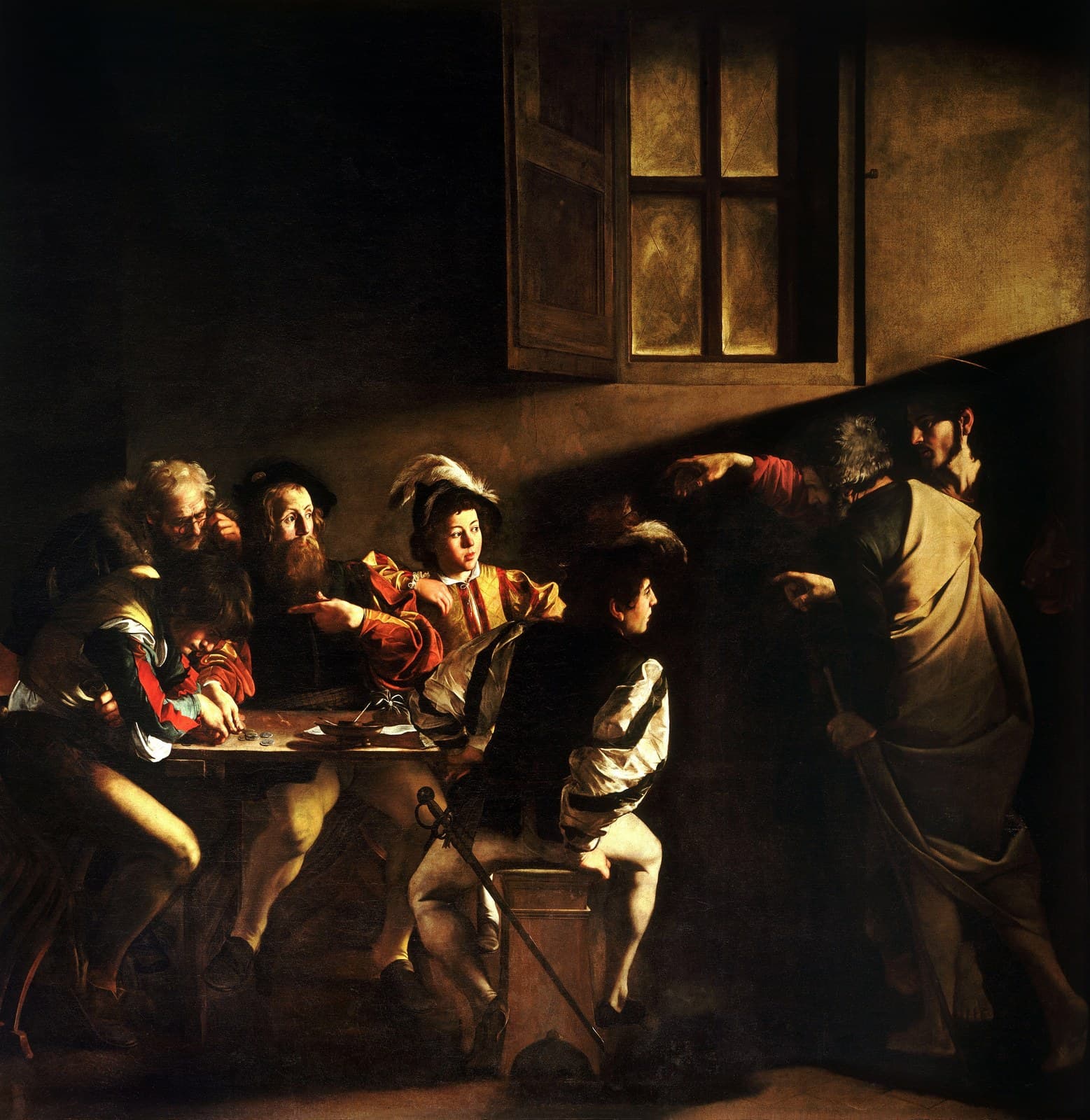
Rembrandt never went to Italy, and no document puts him in front of a painting by Caravaggio.[8] What reached the Dutch Republic were prints, and painters who had made the trip: Gerrit van Honthorst of Utrecht spent 1610 to 1620 in Rome and came home the best known of the Dutch followers of Caravaggio.[12] The National Gallery in London dates the result in Rembrandt's own work to the 1630s, when he began building a face out of patches of light and shadow rather than lighting one side and shading the other.[8] Staying home was a decision: ambitious young Dutch painters were told to go south, and Rembrandt held that he could learn what he needed from the art already in his own country.[8]
The Leiden workshop, Jan Lievens, and Constantijn Huygens
Around 1625 Rembrandt came back to Leiden and set up on his own, sharing a workshop with Jan Lievens, who was a year younger and had trained with Pieter Lastman before him.[1][8] The Leiden Collection catalogue describes their pictures of the later 1620s as closely correlated, which is the polite way of saying that telling them apart is still difficult.[1] Rembrandt began teaching almost at once: Gerrit Dou came to him in 1628, when Rembrandt was twenty-two and Dou was fifteen.[1]
The visitor who brought them work was Constantijn Huygens, secretary to the Stadholder Frederik Hendrik and the man who placed the court's art commissions.[13] He saw the two young painters in Leiden around 1629 and wrote about them in the autobiography of his youth, composed in 1631.[13] Rembrandt's gift, he said, lay in the lifelike expression of feeling and in inventions taken from life.[13]
Huygens then described one picture at length, Rembrandt's Judas returning the thirty pieces of silver, painted in 1629.[13] He called the kneeling figure contorted in pitiful hideousness, unlike anything he had seen, and concluded that this beardless young man had surpassed the painters of Italy and of antiquity.[13] Eric Jan Sluijter points out what Huygens was praising: the willingness to paint ugliness in order to make a scene convincing.[13]
Commissions from The Hague began in 1627.[1] The largest was a set of scenes from the Passion of Christ for Frederik Hendrik, which took years to deliver.[1] In 1639 the court paid 1,200 guilders for The Entombment and The Resurrection, and in 1646 the prince paid 2,300 guilders for The Adoration of the Shepherds and The Circumcision.[1]
Amsterdam, Hendrick Uylenburgh, and The Anatomy Lesson
In 1631 Rembrandt moved to Amsterdam, the richest port in northern Europe and a city full of people who wanted their portraits painted.[1] He went under contract to the art dealer Hendrick Uylenburgh: he would paint portraits of Amsterdam citizens and run the workshop Uylenburgh liked to call his academy.[1] He lodged in the dealer's house at Jodenbreestraat 2 from 1632 and worked for him until 1635.[1][5]
His first large public commission came in 1632, from the surgeons.[3] The Amsterdam surgeons' guild had held public dissections since 1555, in the anatomy theater in the Waag on the Nieuwmarkt, where students and paying spectators watched the guild's praelector lecture over a body.[3] The lessons could run for days, and were held in the cold months to keep down the smell.[3] Every few years the guild paid a painter to record one.[3]
Nicolaes Tulp, who lived from 1593 to 1674, had been appointed praelector in 1628.[3] In 1632 he had himself painted with seven guild members who contributed to the fee.[3] Rembrandt was twenty-five and had been in the city a year. The body on the table was that of Adriaen Adriaensz, known as Aris Kindt, a thief sentenced to death for robbery and hanged on 31 January 1632.[3]
Three earlier anatomy pieces hung in the guild's rooms, and all three lined the sitters up in a row looking out at the viewer.[3] Rembrandt broke the row. He put Tulp on the right in a niche that reads almost like a throne, stacked the surgeons into a pyramid on the left, and gave each man a different thing to look at.[3] Tulp is shown opening the corpse's forearm and lifting the tendons with forceps, which is not how a dissection began: anatomists opened the abdomen first. The Mauritshuis suggests that Tulp wanted to be shown as Andreas Vesalius had been shown on the title page of De humani corporis fabrica in 1543, holding a dissected arm.[3]
An X-radiograph found something else. Where the corpse's right hand now lies, Rembrandt first painted a stump: Aris Kindt had lost the hand to an earlier conviction.[3] A hand was added over paint layers not built to carry one, and those layers have grown transparent with age, so it is now a slightly different color from the arm.[3] The Mauritshuis reads the original stump as evidence that Rembrandt was at the dissection.[3]
The painting is oil on canvas, 169.5 by 216.5 centimeters, signed at the top center “Rembrant. fv: 1632”.[3] It belonged to the guild and then to the surgeons' widows' fund, which put it up for public sale in 1828.[3] King William I stopped the sale by royal decree, had the Dutch State buy it for 32,000 guilders, and sent it to the Mauritshuis in The Hague.[3]
The Anatomy Lesson of Dr Nicolaes Tulp, 1632, oil on canvas, 169.5 by 216.5 cm (Mauritshuis, The Hague, inv. 146). Painted for the Amsterdam surgeons' guild when Rembrandt was twenty-five, and signed at the top centre “Rembrant. fv: 1632”. (Rembrandt van Rijn, The Anatomy Lesson of Dr Nicolaes Tulp, 1632 (Mauritshuis, The Hague), via Wikimedia Commons · Public domain)
Saskia van Uylenburgh, four children, and the house on the Breestraat
Saskia van Uylenburgh was baptized in Leeuwarden on 2 August 1612, the youngest of eight children.[5] Her father, Rombertus Rommertsz Uylenburgh, was burgomaster of Leeuwarden.[5] Her mother died when Saskia was six and her father when she was eleven, and at sixteen she moved in with her sister Hiskia at Sint Annaparochie.[5] She was a cousin of the dealer Hendrick Uylenburgh.
In the spring of 1633 two painters from the Leeuwarden branch of her cousin's business went to visit the master's studio in Amsterdam, and Saskia van Uylenburgh went with them.[5] She and Rembrandt were engaged on 5 June 1633.[5] Under a silverpoint drawing he made of her that summer he wrote the words “my housewife”.[5]
They married on 22 June 1634 at Sint Annaparochie in Friesland.[5] Saskia was twenty-one and Rembrandt twenty-seven, and his mother sent her consent in a letter from Leiden rather than attend.[5] Saskia was the only Uylenburgh daughter who did not marry a university man, and her Frisian relatives later called her only a painter's wife.[5]
Four children were born in the eight years of the marriage, and three of them died in infancy.[5]
Rumbartus, named after Saskia's father, buried in the Zuiderkerk on 15 February 1636 at two months old.[5]
Cornelia, named after Rembrandt's mother, baptized on 22 July 1638 and buried three weeks later.[5]
A second Cornelia, baptized on 29 July 1640, who lived two weeks.[5]
Titus, named after Saskia's dead sister Titia, baptized on 22 September 1641, the only one to reach adulthood.[5]
In 1638 Saskia's relatives in Friesland accused her of squandering her inheritance.[5] Rembrandt answered that he and Saskia were abundantly well off, and offered the house as proof.[5] On 5 January 1639 he signed the deed for a large house at Jodenbreestraat 4, then the Sint Anthoniesbreestraat.[14][5] The price was 13,000 guilders, payable in installments, and he never finished paying it.[14] He lived and worked there for nineteen years; it is now the Museum Het Rembrandthuis.[15]
Saskia was probably dying of tuberculosis when she had her will drawn up on 5 June 1642.[5] She made Titus her sole heir and gave Rembrandt the income from her estate on one condition: that he did not remarry.[5] She died nine days later, on 14 June 1642, aged twenty-nine, and was buried on 19 June in the Oude Kerk.[5] That clause shaped the rest of his private life, and he never married again.
The Night Watch
The painting everybody calls The Night Watch is properly titled Officers and other civic guardsmen of District II in Amsterdam, under the command of Captain Frans Banninck Cocq and Lieutenant Willem van Ruytenburch.[4] Rembrandt worked on it between 1639 and 1642 for the great hall of the Kloveniersdoelen, one of the city's civic guard headquarters.[1] It is oil on canvas and 379.5 by 453.5 centimeters, the size of a wall, and the Leiden Collection catalogue puts his fee at roughly 100 guilders from each of the eighteen officers in it.[4][1]
A militia portrait was a group picture paid for by the men in it, and the convention was a row of faces in good clothes. Rembrandt painted an order being given. Banninck Cocq, in black with a red sash, is telling van Ruytenburch, in pale yellow, to march the company out.[4] A guardsman in red loads a musket on the left, pikes go up at conflicting angles, and a drummer beats at the right with a dog barking at his feet. A small girl in gold, the company's mascot, has a dead chicken hanging at her waist.[4] The Rijksmuseum's claim for the picture is that it was the first group portrait in which the sitters are doing something rather than posing.[4]
It is not a night scene. The guardsmen are marching in daylight, and the Rijksmuseum calls the nickname a misinterpretation that stuck.[16] Nor is it the picture Rembrandt finished. In 1715 the painting was moved from the Kloveniersdoelen to the Small Council of War Chamber in the Town Hall on Dam Square.[17] It was too big for the space, so strips were cut off all four sides: 64.4 centimeters from the left, 23.3 from the top, 11.3 from the bottom and 7 from the right.[17] The cut pieces have never been found.
In 2021 the Rijksmuseum put the missing edges back, after a fashion.[17] A seventeenth-century copy by Gerrit Lundens, painted for Frans Banninck Cocq before the cutting, records the whole composition.[17] The museum's scientists trained neural networks on Rembrandt's color and handling, had the computer reconstruct the missing strips in his manner, then printed and mounted them around the original.[17]
Officers and other civic guardsmen of District II in Amsterdam, under the command of Captain Frans Banninck Cocq and Lieutenant Willem van Ruytenburch, known as The Night Watch, 1642, oil on canvas, 379.5 by 453.5 cm (Rijksmuseum, Amsterdam, on loan from the City of Amsterdam). Strips were cut from all four sides in 1715. (Rembrandt van Rijn, The Night Watch, 1642 (Rijksmuseum, Amsterdam), via Wikimedia Commons · Public domain)
How he worked, and who he taught
Rembrandt lit a scene from one side and from above, and let the rest fall away into brown.[18] The pattern is consistent enough that portrait photographers named a lighting setup after him three centuries later.[18] The key light sits about forty-five to sixty degrees to one side of the face and thirty degrees above eye level, so the shadowed cheek carries a small triangle of light under the eye, which photographers call the Rembrandt patch.[18]
The paint itself does part of the lighting. Where the light falls, the paint is thick and stands off the surface, so real light catches on it and the lit passages come forward.[10] In the shadows the paint is thin and transparent. The Mauritshuis calls this the constant of his practice, early and late.[10] At the end the thick passages get very thick: on The Jewish Bride the man's gold sleeve is a slab of paint scratched into with the blunt end of the brush handle.[19]
His handling changed twice. The Leiden pictures are small and highly finished. From the mid-1630s he painted large, violent subjects with figures in extreme movement, among them the Feast of Belshazzar and the Blinding of Samson. After The Night Watch he painted very little for almost ten years, and when the pictures resume the violence has gone. The late works turn on small things, two hands touching, and the brushwork is loose enough that the Mauritshuis says they can look unfinished.[10]
He was as important a printmaker as a painter and made about 300 plates between roughly 1626 and 1661.[20] An etching starts with a copper plate coated in a ground of resin and beeswax.[21] The artist draws through the ground with a needle, exposing bare copper, and acid bites the exposed lines. Ink is rubbed in, the flat surface is wiped clean, and the plate is pressed onto damp paper. Because the paper takes a mirror image, Rembrandt etched his signature backwards.[21]
What made his prints unusual was that he refused to stop. He mixed etching with engraving and with drypoint, in which the needle scratches the copper directly and throws up a ridge of metal that prints as a soft black.[20] He worked straight onto the plate more often than he drew, pulled proofs at every stage, added lines and scraped them away, and printed the same plate on Japanese paper and on vellum.[21][20] Each version is called a state.[21]
Self-Portrait in a Cap, Open-Mouthed, 1630, etching, sheet trimmed to the plate mark at 5.2 by 4.5 cm (National Gallery of Art, Washington, Rosenwald Collection, 1943.3.7264). Rembrandt was twenty-three or twenty-four and still working in Leiden. (Rembrandt van Rijn, Self-Portrait in a Cap, Open-Mouthed, 1630 (National Gallery of Art, Washington, Open Access), via Wikimedia Commons · CC0)
The Mauritshuis counts twenty-five painters trained by Rembrandt, among them Govert Flinck, Ferdinand Bol, Carel Fabritius, Nicolaes Maes, Samuel van Hoogstraten and Arent de Gelder.[10][1] The Leiden Collection catalogue estimates that pupils' fees brought him more than 2,000 guilders a year.[1] An apprenticeship ran four to six years and meant copying, drawing objects and painting from a live model.[22] It had a long consequence: pupils painted in his manner, in his rooms, on his materials, and the workshop sold what they made, so deciding which of those pictures is by Rembrandt later became a scholarly industry.
Geertje Dircks
Geertje Dircks was born in Edam around 1610 into a family with no schooling.[6] She never learned to write, and signed documents with a hooked mark. On 26 November 1634 she married a ship's trumpeter named Abraham Claesz, who appears to have died within a year.[6] Around 1641 she entered Rembrandt's house on the Breestraat as dry nurse to the newborn Titus.[6]
After Saskia's death in June 1642, Rembrandt and Geertje Dircks lived openly as husband and wife until 1649.[6] The painters' biographer Arnold Houbraken, writing decades later, understood from it that Rembrandt had married a little farm girl from Ransdorp.[6] On 24 January 1648, ill, she made a will leaving her clothes to her mother and her jewelry to Titus.[6] That jewelry, a diamond ring among it, came from Saskia's estate, which Rembrandt held only in trust until Titus came of age.
In 1649 the relationship ended, most likely because Hendrickje Stoffels had arrived in the house.[6] Rembrandt offered sixty guilders a year, in a conversation held in the kitchen on 15 June 1649 with Hendrickje Stoffels standing there as a witness, and Geertje Dircks moved out to a room on the Rapenburg with nothing agreed.[6] She refused every offer and took the case to the Amsterdam commissioners of matrimonial affairs. On 23 October 1649 they ordered Rembrandt to pay her two hundred guilders a year, without ruling on whether he had promised to marry her.[6]
Her one piece of leverage was Saskia's jewelry, which she had pawned once to set herself up.[6] Every settlement Rembrandt proposed forbade her to pawn it again, and so did the court. In 1650 she pawned it anyway.[6] That August she was committed to the Spinhuis, the house of correction at Gouda, and held there until May 1655.[6][8] The committal papers have not survived, but Rembrandt's part in it is on record: Cornelia Jans, who took her to Gouda, billed him 140 guilders for the journey and escort, and he worked to keep her inside.[6]
In 1652 Geertje Dircks asked the Amsterdam church council to tell her family in Edam where she was.[6] The council did nothing. Early in 1655 a relative, Trijn Jacobs, came to Rembrandt to say she was going to fetch her out. He told Trijn Jacobs she would regret it and raised a finger at her.[6] She went anyway, and the governors released Geertje Dircks despite Rembrandt's requests that they wait.[6]
Within a year of her release Geertje Dircks had notaries record what Rembrandt had done to her, and Rembrandt had notaries record that her family was to blame.[6] He had her brother Pieter Dircks arrested, by his own account, to force him to tell the truth.[6] She appears one last time as one of Rembrandt's creditors when he applied for insolvency in 1656, and is presumed to have died in Edam soon afterwards.[6]
Hendrickje Stoffels, Titus, and Cornelia
Hendrickje Stoffels was born in 1626 or 1627 at Bredevoort, a garrison town in the Achterhoek, where her father was a sergeant and huntsman to the castle.[7] He died about 1646, her mother remarried in January 1647, and Hendrickje Stoffels moved to Amsterdam that year and took work as a maid in the widowed painter's house on the Breestraat.[7] From 1649 she lived with Rembrandt as his partner.[7]
They never married.[7] Saskia's will would have taken the income from her estate away from Rembrandt if he did, and he could not afford to lose it.[5]
On 2 July 1654 the Amsterdam church council summoned Hendrickje Stoffels for fornication.[7] Rembrandt was not summoned, because he was not a professing member of the church and she was.[7] A minister or elder had probably seen on a home visit in May that she was pregnant. She ignored that summons and two more. On 23 July, about six months pregnant, she went to the consistory room of the Nieuwe Kerk, admitted the charge and was ordered to stay away from communion.[7]
Their daughter Cornelia was baptized in the Oude Kerk on the evening of Friday 30 October 1654.[7] Both parents are named in the register and the child was given her father's surname, so nothing in the entry marks her as born outside marriage.[7] She later sailed for the Dutch East Indies and died at Batavia before 1685.[7]
After the insolvency, Hendrickje Stoffels and Titus set up as art dealers on the Rozengracht, selling paintings, drawings, prints and curiosities.[7] In December 1660 they registered it as a formal partnership, the two of them equal partners, and took Rembrandt on as an unpaid employee.[7] An employee who owns nothing has nothing his creditors can seize, and the pictures he painted belonged to the firm.[7]
She made her will on 7 August 1661, naming Cornelia her sole heir and Rembrandt the child's guardian.[7] Plague was in Amsterdam in 1663 and she probably died of it. She was buried in the Westerkerk on 24 July 1663, aged about thirty-six.[7] She had modeled for Rembrandt constantly, usually as a woman out of the Bible rather than as herself: the Louvre's Bathsheba of 1654 is generally taken to be her.[23]
Bathsheba at Her Bath Holding King David's Letter, 1654, oil on canvas, 142 by 142 cm (Musée du Louvre, Paris, inv. MI 957, bequest of Louis La Caze, 1869). The Louvre's record says Hendrickje Stoffels probably posed for the figure. (Rembrandt van Rijn, Bathsheba at Her Bath, 1654 (Musée du Louvre, Paris), via Wikimedia Commons · Public domain)
Money, debts, and the insolvency of 1656
Rembrandt earned a great deal and spent more of it than he had. He bought art compulsively: paintings, prints, drawings, plaster casts of Greek and Roman busts, weapons, musical instruments, shells, minerals and stuffed animals.[10] The Mauritshuis reads the collection and the grand house together as a miller's son trying to buy his way up the social order, and adds that it did not work.[10]
In July 1656 he applied to the Amsterdam Insolvency Court for cessio bonorum: a debtor surrendered his goods to his creditors and in exchange was not imprisoned.[1][8] The inventory of everything he owned ran to more than 130 paintings and 70 albums of prints and drawings, plus the horns, shells, casts and curiosities.[1] That inventory is the reason the Rembrandthuis could be furnished again three hundred years later.[15]
The sales began in 1657 and raised very little. On 14 February 1658 the Amsterdam bankruptcy chamber authorized the sale of the furniture and household goods.[7] Among them was an oak cupboard belonging to Hendrickje Stoffels, holding six hundred guilders' worth of linen, wool, silver and gold rings, which she claimed and got back.[7] The house went that same month at a loss of two thousand guilders, and the household moved to the Rozengracht in the Jordaan, a much poorer district.[7]
The commissions did not stop. In 1653 he painted Aristotle with a Bust of Homer, bought by the Metropolitan Museum of Art in New York in 1961.[24] In 1655 he made four etchings for Piedra Gloriosa, a book on the messianic reading of Nebuchadnezzar's dream by his Amsterdam neighbor, the rabbi and printer Menasseh ben Israel.[25] They did not stay in it: a community record of 1655 shows the board of Amsterdam's Portuguese Jewish congregation disapproved, most likely because Rembrandt had given God a body in the Daniel plate, and engravings by another artist replaced them.[25]
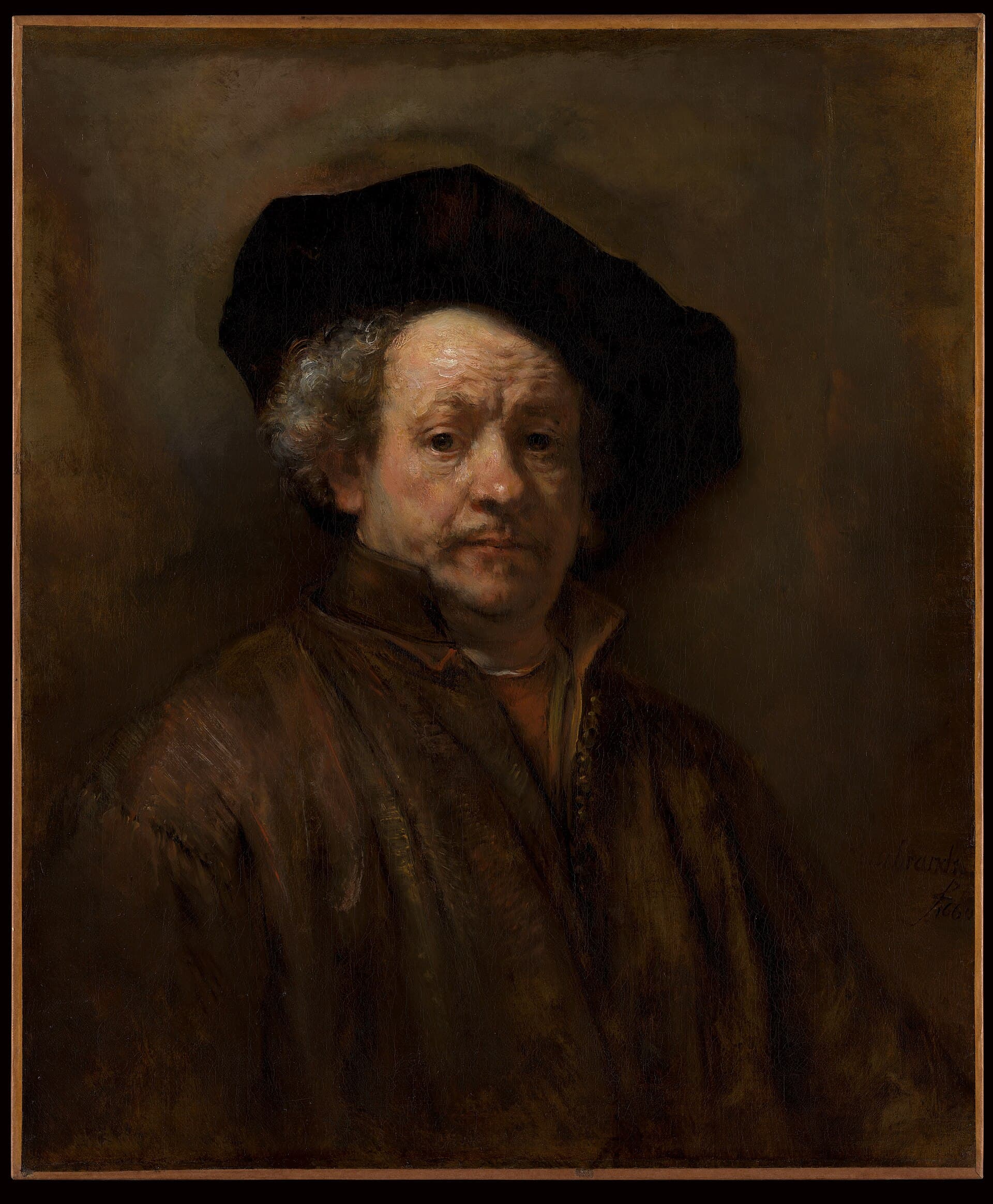
Self-Portrait, 1660, oil on canvas, 80.3 by 67.3 cm (The Metropolitan Museum of Art, New York, Bequest of Benjamin Altman, 1913). Rembrandt at 54, the year of the Louvre's self-portrait at the easel. (Rembrandt van Rijn, Self-Portrait, 1660 (The Metropolitan Museum of Art, Open Access), via Wikimedia Commons · CC0)
He painted himself throughout, and more often as he got older. English Heritage counts roughly eighty self-portraits across forty years: about forty paintings, thirty-one etchings and seven drawings, far more than any painter before him.[26] The Mauritshuis explains the commercial logic. A self-portrait sold twice over, as a picture by a famous artist and as a specimen of his technique.[10]
The late paintings
The city gave him one more public commission and then took it away. For the new town hall on Dam Square Rembrandt painted The Conspiracy of the Batavians under Claudius Civilis, in which the Batavians swear an oath of revolt against Rome in the year 69.[27] The canvas was about five and a half meters square, the largest thing he ever made.[27] It was installed in July 1662, taken down within months, and the commission went to one of his former pupils. Rembrandt cut the canvas down himself, and the surviving central group has hung in the Nationalmuseum in Stockholm since 1874, on loan from the Royal Swedish Academy of Fine Arts.[27]
In the same year, 1662, he painted The Sampling Officials of the Amsterdam Drapers' Guild, known as The Syndics.[28] Six men sit at a table under a Persian rug with an open book of cloth samples, and all six look up as though somebody has just come into the room. Five are guild officials and the sixth, Frans Hendricksz Bel, is their servant.[28] It is 191.5 by 279 centimeters and hangs in the Rijksmuseum.[28]
The last of the great paintings has no agreed subject. Isaac and Rebecca, known since the nineteenth century as The Jewish Bride, was painted between about 1665 and 1669.[19] A man in a gold sleeve rests one hand on a woman's chest and the other on her shoulder, she lays her hand over his, and neither looks at the other. The Rijksmuseum reads them as Isaac and Rebecca at the moment their intimacy gives them away to King Abimelech.[19]
Isaac and Rebecca, known as The Jewish Bride, c. 1665–1669, oil on canvas, 121.5 by 166.5 cm (Rijksmuseum, Amsterdam, on loan from the City of Amsterdam, A. van der Hoop Bequest). The man's sleeve is thick paint scratched into with the butt of the brush. (Rembrandt van Rijn, Isaac and Rebecca, known as The Jewish Bride, c. 1665–1669 (Rijksmuseum, Amsterdam), via Wikimedia Commons · Public domain)
Vincent van Gogh saw it in October 1885, a few months after the Rijksmuseum opened its new building, and wrote to his brother Theo about it from Nuenen.[29] He called The Syndics perfect and the finest Rembrandt, and The Jewish Bride an intimate and infinitely sympathetic painting, painted with a glowing hand.[29] Then he wrote the line that has been quoted after him ever since.
Rembrandt goes so deep into the mysterious that he says things for which there are no words in any language.[29]
Around 1665, at fifty-nine, he began Self-Portrait with Two Circles, now at Kenwood in London.[26] He shows himself in working clothes, in a fur-lined tabard and a white linen cap, with a palette, brushes and a mahlstick in his left hand.[26] Behind him are two large incomplete circles, which nobody has explained. English Heritage lists the readings on offer: symbols of divine perfection, symbols of theory and practice, the two halves of a hemisphere map, or a nod to the story that Giotto proved his skill by drawing a perfect circle freehand.[26]
Death and burial in the Westerkerk
Titus married Magdalena van Loo in 1668 and died seven months later, at twenty-six.[8] His daughter Titia was born six months after his death.[8] Money troubles had already forced Rembrandt to sell Saskia's grave in the Oude Kerk.[8]
Rembrandt died in Amsterdam on 4 October 1669, aged sixty-three.[9] No contemporary document gives a cause, and none has ever been established.[30] The Westerkerk's register of deaths carries a note written by Nicolaes Sebastiaensz Vinck, an apothecary and a distant relative: “den 4 8b[er] is overleeden neeff Rembrant van Rhijn schilder”, meaning that on the fourth of October cousin Rembrandt van Rijn, painter, died.[9]
He was buried four days later, on 8 October 1669, in the Westerkerk.[9] The Chamber of Orphans' register lists him as “Rembrant van Reyn schilder Rose gracht”, a painter of the Rozengracht, with two children surviving him.[9] Sixteen bearers carried the coffin.[9]
The grave was rented and had no stone.[9][10] Neither the burial plot records nor the register of deaths says where in the church it was, so the spot is unknown.[9] A memorial stone was placed in the Westerkerk in 1906, and it marks the church rather than the grave.[9] Hendrickje Stoffels had been buried there in July 1663 and Titus in 1668, and his daughter Cornelia, then fifteen, was the only one of his children still living.[7][8]
What counts as a Rembrandt
How many paintings Rembrandt made is a question with a moving answer. In 1968 the Dutch government research agency ZWO funded five Dutch art historians who called themselves the Rembrandt Research Project.[31] Their brief was to test the 624 paintings that Abraham Bredius had published as authentic in the 1930s.[31] Bob Haak started the project, and Josua Bruyn took the chair and led it in practice.[32]
The team spent twenty-one years producing three volumes of A Corpus of Rembrandt Paintings, which reached only as far as 1642.[31] It cataloged 286 paintings in three classes: A for paintings by Rembrandt, B for those it could neither accept nor reject, and C for those whose authorship it could not accept.[31] It gave 146 to Rembrandt, rejected 122 outright and left twelve undecided.[31] Museums that had labeled a picture Rembrandt for a century found it demoted in print.
The group then broke apart over method. Bruyn held that Rembrandt's way of painting stayed uniform within each period of his career.[32] The youngest member, Ernst van de Wetering, argued that one painter can vary widely inside a period, and that how a picture was made counts for more than how it looks.[32] In 1993 Bruyn and three colleagues announced their withdrawal in a letter to the Burlington Magazine and left van de Wetering to finish alone.[32]
Van de Wetering presented the sixth and final volume, Rembrandt's Paintings Revisited: A Complete Survey, on 8 October 2014.[33] It accepts about 340 paintings: forty-four of the earlier rejections restored, plus around twenty never cataloged before.[33] Van de Wetering said his predecessors had been trying to purify the artist's body of work.[33] Bruyn accepted the argument before he died, but the Metropolitan Museum of Art and the National Gallery in London have not adopted every re-attribution.[32][33]
The Burlington Magazine set the main catalogs side by side, warning that the totals are not strictly comparable, because van de Wetering sometimes gives a picture partly to the studio.[32]
Kurt Bauch, 1966: 560 paintings
Horst Gerson, 1968: 420
Gary Schwartz, 1985: 348
Christian Tümpel, 1986: 265
Ernst van de Wetering, 2014: 349
Where the paintings are, and the Rembrandts in Paris
Rembrandt never came to Paris. The Louvre nevertheless holds one of the largest groups of his paintings outside the Netherlands, assembled across three and a half centuries by four routes: purchase for the king, revolutionary seizure, nineteenth-century acquisition, and a treaty between two governments.
Self-Portrait in a Cap and Gold Chain, 1633, oil on panel, 70 by 53 cm (INV 1745). Seized in 1794 from the confiscated collection of the duchesse de Mortemart.[34]
The Pilgrims at Emmaus, 1648, oil on panel, 68 by 65 cm (INV 1739). Bought for Louis XVI at the Randon de Boisset sale in 1777, and on the wall when the museum opened in 1793.[35]
Bathsheba at Her Bath Holding King David's Letter, 1654, oil on canvas, 142 by 142 cm (MI 957). Bequeathed by the collector Louis La Caze in 1869.[23]
Portrait of Hendrickje Stoffels in a Velvet Beret, about 1654, oil on canvas, 74 by 61 cm (INV 1751). Bought for Louis XVI in 1784.[36]
The Slaughtered Ox, 1655, oil on beech panel, 94 by 69 cm (MI 169). Bought in 1857 from the Paris critic Louis Viardot.[37]
Self-Portrait at the Easel, 1660, oil on canvas, 111 by 85 cm (INV 1747). Acquired by Louis XIV around 1671.[38]
Portrait of Oopjen Coppit, 1634. Bought by the French state in 2016 under an agreement with the Netherlands.[39][40]
The 2016 purchase was the first time two countries bought a single work of art together. Rembrandt painted the full-length portraits of the young Amsterdam couple Maerten Soolmans and Oopjen Coppit in 1634, and they are the only full-length pendant portraits by him that are known.[39] The Rothschild family bought them in 1877.[40] In a private sale through Christie's, France and the Netherlands paid 160 million euros for both and signed the agreement on 1 February 2016.[40] French law does not allow two owners to share one object, so the Netherlands bought Maerten Soolmans and France bought Oopjen Coppit, on terms that require the portraits always to hang together and never to be lent elsewhere.[39][40]
Not every Rembrandt has had an orderly history. Catherine the Great bought Baron Antoine Crozat de Thiers's collection in 1772, in a negotiation conducted for her by the philosopher Denis Diderot, and Rembrandt's Danaë came to St Petersburg with it.[41] On 15 June 1985 a visitor to the Hermitage, Bronius Maigys, threw sulfuric acid over the painting and cut it twice with a knife, destroying about a quarter of it.[42][43] Restoration took twelve years.[43] At the unveiling on 14 October 1997 the Hermitage's director, Mikhail Piotrovsky, said: “The former Danae does not exist any longer and we have to reconcile ourselves to the idea.”[43]
His reputation in France was made in the nineteenth century, and one journal entry marks the turn. On 6 June 1851 Eugène Delacroix wrote about the studio habit Raphael used, of drawing every figure nude before draping it.[44] Had Rembrandt worked that way, Delacroix said, he would have had neither the force of gesture nor the force of effect that makes his scenes look like nature itself.[44] Then he wrote a sentence he knew was heresy.
Perhaps it will be discovered that Rembrandt is a far greater painter than Raphael.
Peut-être découvrira-t-on que Rembrandt est un beaucoup plus grand peintre que Raphaël.[44]
He added at once that he was writing a blasphemy fit to make the hair of every academic stand on end, and that he was not taking sides.[44] Later painters went back to Rembrandt directly. Chaïm Soutine painted a hanging beef carcass over and over, working from The Slaughtered Ox in the Louvre, and Pablo Picasso etched Rembrandt into the Vollard Suite in 1934 and again into the 347 Suite in 1968.[45][46][47]
Life events
15 July 1606
Born in Leiden, the ninth of ten children of the miller Harmen Gerritsz van Rijn and Neeltgen Willemsdr van Zuytbrouck.
— Piet Bakker, Rembrandt van Rijn — The Leiden Collection Catalogue, 4th edition (2017)
1620
Enrolled at the University of Leiden at fourteen, possibly to study theology, and leaves within months.
— Rembrandt van Rijn — artist biography
c. 1621–1624
Apprenticed for about three years to the Leiden painter Jacob Isaacsz van Swanenburg.
— Piet Bakker, Rembrandt van Rijn — The Leiden Collection Catalogue, 4th edition (2017)
1624–1625
Spends about six months in Amsterdam in the studio of the history painter Pieter Lastman.
— Pieter Lastman — The Leiden Collection Catalogue, 4th edition
c. 1625
Sets up as an independent painter in Leiden, sharing a workshop with Jan Lievens.
— Rembrandt (1606–1669) — artist page
1628
Takes his first pupil, the fifteen-year-old Gerrit Dou, at the age of twenty-two.
— Piet Bakker, Rembrandt van Rijn — The Leiden Collection Catalogue, 4th edition (2017)
1630
Etches Self-Portrait in a Cap, Open-Mouthed, a print about the size of a matchbox.
Self-Portrait in a Cap, Open-Mouthed, 1630, etching, sheet trimmed to the plate mark at 5.2 by 4.5 cm (National Gallery of Art, Washington, Rosenwald Collection, 1943.3.7264). Rembrandt was twenty-three or twenty-four and still working in Leiden. (Rembrandt van Rijn, Self-Portrait in a Cap, Open-Mouthed, 1630 (National Gallery of Art, Washington, Open Access), via Wikimedia Commons)
1631
Constantijn Huygens writes in the autobiography of his youth that the beardless Rembrandt has surpassed the Italians and the ancients.
— Eric Jan Sluijter, How Rembrandt surpassed the Ancients, Italians and Rubens as the Master of 'the Passions of the Soul' (2014)
1631
Moves to Amsterdam under contract to the art dealer Hendrick Uylenburgh, and runs his workshop until 1635.
— Piet Bakker, Rembrandt van Rijn — The Leiden Collection Catalogue, 4th edition (2017)
1632
Paints The Anatomy Lesson of Dr Nicolaes Tulp for the Amsterdam surgeons' guild, at twenty-five.
The Anatomy Lesson of Dr Nicolaes Tulp, 1632, oil on canvas, 169.5 by 216.5 cm (Mauritshuis, The Hague, inv. 146). Painted for the Amsterdam surgeons' guild when Rembrandt was twenty-five, and signed at the top centre “Rembrant. fv: 1632”. (Rembrandt van Rijn, The Anatomy Lesson of Dr Nicolaes Tulp, 1632 (Mauritshuis, The Hague), via Wikimedia Commons)
— Rembrandt van Rijn, The Anatomy Lesson of Dr Nicolaes Tulp, 1632 — collection record (inv. 146)
1633
Begins signing his paintings with his first name alone, as Italian masters did.
— Rembrandt van Rijn (1606–1669) — Our masters
5 June 1633
Engaged to Saskia van Uylenburgh, weeks after meeting her.
— Ben Broos, Uylenburgh, Saskia van (1612–1642) — Digitaal Vrouwenlexicon van Nederland (2014)
22 June 1634
Marries Saskia van Uylenburgh at Sint Annaparochie in Friesland.
— Ben Broos, Uylenburgh, Saskia van (1612–1642) — Digitaal Vrouwenlexicon van Nederland (2014)
1634
Paints the full-length wedding portraits of Maerten Soolmans and Oopjen Coppit, his only known pendant pair of that kind.
— Portraits of Maerten Soolmans and Oopjen Coppit by Rembrandt — press release (2016)
5 January 1639
Signs the deed for the house at Jodenbreestraat 4 for 13,000 guilders, payable in installments.
— Bob Wessels, The purchase price in 1639 for Rembrandt's house (2021)
1639
The Stadholder's court pays 1,200 guilders for The Entombment and The Resurrection.
— Piet Bakker, Rembrandt van Rijn — The Leiden Collection Catalogue, 4th edition (2017)
22 September 1641
His son Titus is baptized, the only one of Saskia's four children to survive infancy.
— Ben Broos, Uylenburgh, Saskia van (1612–1642) — Digitaal Vrouwenlexicon van Nederland (2014)
1642
Finishes The Night Watch for the Kloveniersdoelen, 379.5 by 453.5 centimeters.
Officers and other civic guardsmen of District II in Amsterdam, under the command of Captain Frans Banninck Cocq and Lieutenant Willem van Ruytenburch, known as The Night Watch, 1642, oil on canvas, 379.5 by 453.5 cm (Rijksmuseum, Amsterdam, on loan from the City of Amsterdam). Strips were cut from all four sides in 1715. (Rembrandt van Rijn, The Night Watch, 1642 (Rijksmuseum, Amsterdam), via Wikimedia Commons)
— Officers and other civic guardsmen of District II in Amsterdam, known as 'The Night Watch', 1642 — collection record (SK-C-5)
14 June 1642
Saskia van Uylenburgh dies at twenty-nine and is buried in the Oude Kerk on 19 June.
— Ben Broos, Uylenburgh, Saskia van (1612–1642) — Digitaal Vrouwenlexicon van Nederland (2014)
1647
Hendrickje Stoffels comes to Amsterdam from Bredevoort and enters the household as a maid.
— Astrid Waltmans, Stoffels, Hendrickje (1626/1627–1663) — Digitaal Vrouwenlexicon van Nederland
23 October 1649
Amsterdam commissioners order him to pay Geertje Dircks two hundred guilders a year.
— Frouke Wieringa, Dircks, Geertje (ca. 1610–1656?) — Digitaal Vrouwenlexicon van Nederland
August 1650
Geertje Dircks is committed to the house of correction at Gouda, where she is held until May 1655.
— Frouke Wieringa, Dircks, Geertje (ca. 1610–1656?) — Digitaal Vrouwenlexicon van Nederland
1654
Paints Bathsheba at Her Bath, now in the Louvre.
Bathsheba at Her Bath Holding King David's Letter, 1654, oil on canvas, 142 by 142 cm (Musée du Louvre, Paris, inv. MI 957, bequest of Louis La Caze, 1869). The Louvre's record says Hendrickje Stoffels probably posed for the figure. (Rembrandt van Rijn, Bathsheba at Her Bath, 1654 (Musée du Louvre, Paris), via Wikimedia Commons)
— Musée du Louvre, Rembrandt, Bethsabée au bain tenant la lettre de David, 1654 — collection record (MI 957)
23 July 1654
Hendrickje Stoffels appears before the Amsterdam church council for fornication, six months pregnant.
— Astrid Waltmans, Stoffels, Hendrickje (1626/1627–1663) — Digitaal Vrouwenlexicon van Nederland
30 October 1654
Their daughter Cornelia is baptized in the Oude Kerk under Rembrandt's surname.
— Astrid Waltmans, Stoffels, Hendrickje (1626/1627–1663) — Digitaal Vrouwenlexicon van Nederland
1655
Paints The Slaughtered Ox and etches four plates for Menasseh ben Israel's Piedra Gloriosa.
— Steven Nadler and Victor Tiribás, Rembrandt's Etchings for Menasseh ben Israel's Piedra Gloriosa: A Mystery Solved (2021)
July 1656
Applies for cessio bonorum. The inventory of his goods lists more than 130 paintings and 70 albums of prints and drawings.
— Piet Bakker, Rembrandt van Rijn — The Leiden Collection Catalogue, 4th edition (2017)
February 1658
The house is sold at a loss of two thousand guilders and the household moves to the Rozengracht.
— Astrid Waltmans, Stoffels, Hendrickje (1626/1627–1663) — Digitaal Vrouwenlexicon van Nederland
1660
Paints Self-Portrait at the Easel, now in the Louvre, and the Self-Portrait now in New York.
Self-Portrait, 1660, oil on canvas, 80.3 by 67.3 cm (The Metropolitan Museum of Art, New York, Bequest of Benjamin Altman, 1913). Rembrandt at 54, the year of the Louvre's self-portrait at the easel. (Rembrandt van Rijn, Self-Portrait, 1660 (The Metropolitan Museum of Art, Open Access), via Wikimedia Commons)
— Musée du Louvre, Rembrandt, Autoportrait au chevalet et à l'appuie-main de peintre, 1660 — collection record (INV 1747); Rembrandt, Self-Portrait, 1660 — collection record (14.40.618)
December 1660
Hendrickje Stoffels and Titus register an art dealership as equal partners and employ Rembrandt without pay, putting him beyond his creditors.
— Astrid Waltmans, Stoffels, Hendrickje (1626/1627–1663) — Digitaal Vrouwenlexicon van Nederland
July 1662
The Conspiracy of the Batavians under Claudius Civilis is installed in the Amsterdam town hall and removed within months.
— Batavernas trohetsed till Claudius Civilis — the Royal Swedish Academy of Fine Arts on its Rembrandt
1662
Paints The Syndics for the Amsterdam drapers' guild.
— The Sampling Officials of the Amsterdam Drapers' Guild, known as 'The Syndics', 1662 — collection record (SK-C-6)
24 July 1663
Hendrickje Stoffels, probably a victim of the plague, is buried in the Westerkerk.
— Astrid Waltmans, Stoffels, Hendrickje (1626/1627–1663) — Digitaal Vrouwenlexicon van Nederland
c. 1665
Begins Self-Portrait with Two Circles at fifty-nine, now at Kenwood in London.
— Rembrandt's Self-Portrait with Two Circles — Kenwood, the Iveagh Bequest
c. 1665–1669
Paints Isaac and Rebecca, known as The Jewish Bride.
Isaac and Rebecca, known as The Jewish Bride, c. 1665–1669, oil on canvas, 121.5 by 166.5 cm (Rijksmuseum, Amsterdam, on loan from the City of Amsterdam, A. van der Hoop Bequest). The man's sleeve is thick paint scratched into with the butt of the brush. (Rembrandt van Rijn, Isaac and Rebecca, known as The Jewish Bride, c. 1665–1669 (Rijksmuseum, Amsterdam), via Wikimedia Commons)
— Isaac and Rebecca, known as 'The Jewish Bride', c. 1665–1669 — collection record (SK-C-216)
1668
Titus dies at twenty-six, seven months after marrying Magdalena van Loo.
— Rembrandt (1606–1669) — artist page
4 October 1669
Dies in Amsterdam at sixty-three. No document records a cause.
— Bob Wessels, R.I.P. Rembrandt, 4 October 1669 — the death and burial registers (2019)
8 October 1669
Buried in a rented, unmarked grave in the Westerkerk, carried by sixteen bearers.
— Bob Wessels, R.I.P. Rembrandt, 4 October 1669 — the death and burial registers (2019)
Selected works
Cataloged from the holding institutions' records. Reproductions appear only where the rights are verified.
Rembrandt van Rijn finished The Night Watch in 1642 as a group portrait of an Amsterdam militia company. It belongs to the City of Amsterdam and hangs in the Rijksmuseum, and it shows the company in motion rather than posed in rows.
The Greek philosopher Aristotle, in a wide black hat and a gold chain, rests his hand on a marble bust of the poet Homer. Rembrandt van Rijn painted the picture in 1653 for Don Antonio Ruffo, a nobleman in Messina, Sicily. The Metropolitan Museum of Art in New York bought it at auction in 1961 for $2.3 million.
Rembrandt van Rijn looks straight out from under a black beret, in a brown work gown with a red waistcoat at the neck. He painted himself in 1660, the year he turned 54. The Metropolitan Museum of Art in New York has owned the painting since Benjamin Altman left it to the museum in 1913.
A man in a thick gold sleeve lays his hand on a woman's chest, and she rests her hand lightly on his. Rembrandt van Rijn painted the couple in about 1665 to 1669. The Rijksmuseum in Amsterdam calls the painting Isaac and Rebecca, known as The Jewish Bride.
Five officials of the Amsterdam drapers' guild and their servant look up from a table covered with a red Persian rug, as if someone has just walked in. Rembrandt van Rijn painted them in 1662 for the guild's hall. The painting is known as The Syndics and hangs in the Rijksmuseum in Amsterdam.
Rembrandt never went to Italy and no document places him in front of a painting by Caravaggio. The way of lighting a scene reached him second hand, through prints and through Dutch painters who had worked in Rome: his own teacher Pieter Lastman, who was in Rome between about 1603 and early 1607 and saw Caravaggio's work there, and the Utrecht painter Gerrit van Honthorst, who spent 1610 to 1620 in Rome and came home the best known of the Dutch followers of Caravaggio. The National Gallery in London dates the result in Rembrandt's own paintings to the 1630s, when he began modeling a face out of patches of light and shadow instead of lighting one side and shading the other.
— Rembrandt (1606–1669) — artist page; Pieter Lastman — The Leiden Collection Catalogue, 4th edition; Gerrit van Honthorst (1592–1656) — artist page; Caravaggio (Michelangelo Merisi) (1571–1610) and His Followers
The Louvre reads Rembrandt's Self-Portrait in a Cap and Gold Chain of 1633 as a claim to stand beside Peter Paul Rubens and Anthony van Dyck. The art historian Eric Jan Sluijter argues that Rubens, with Titian, was the modern painter a Dutch artist of the 1630s was expected to try to equal, and that Rembrandt spent his career competing with Rubens at painting what the period called the passions of the soul.
— Musée du Louvre, Rembrandt, Autoportrait à la toque et à la chaîne d'or, 1633 — collection record (INV 1745); Eric Jan Sluijter, How Rembrandt surpassed the Ancients, Italians and Rubens as the Master of 'the Passions of the Soul' (2014), pp. 63–89
Who Rembrandt van Rijn Inspired
People who found inspiration in Rembrandt van Rijn’s work.
The Buffalo AKG Art Museum records that Chaïm Soutine's paintings of a hanging beef carcass were inspired by Rembrandt's The Slaughtered Ox of 1655, which the Louvre bought in 1857 and which Soutine could see in Paris. In 1925, after moving to a larger studio, Soutine had a whole steer carcass brought in and painted it over several weeks while it rotted, paying a model to sit beside it and fan the flies away. Carcass of Beef, of about 1925, is one of at least four canvases from those weeks.
— Chaïm Soutine, Carcass of Beef, ca. 1925 — collection record; Musée du Louvre, Rembrandt, Le Bœuf écorché, 1655 — collection record (MI 169)
In his journal entry of 6 June 1851, Eugène Delacroix wrote: “Peut-être découvrira-t-on que Rembrandt est un beaucoup plus grand peintre que Raphaël” — perhaps it will be discovered that Rembrandt is a far greater painter than Raphael. He added that he was writing a blasphemy that would make the hair of every academic stand on end, and that he was not taking sides. The entry is printed in volume 2 of the Plon edition of the journal, published in 1893.
— Eugène Delacroix, Journal de Eugène Delacroix, entry of 6 June 1851 (Plon, 1893, vol. 2, pp. 62–66) (1893), vol. 2, pp. 62–66
Pablo Picasso put Rembrandt's head into the Vollard Suite in 1934. The Metropolitan Museum of Art holds an impression of that etching, titled Rembrandt with a Palette, made in 1934 and printed in 1939. Picasso returned to him thirty-four years later with a sugar-lift aquatint from the 347 Suite that the Met titles Le déjeuner sur l'herbe, in the style of Rembrandt, with Maja and Célestine.
— Pablo Picasso, Rembrandt with a Palette, from the Vollard Suite, 1934 — collection record (1984.1199.1), accession 1984.1199.1; Pablo Picasso, Le déjeuner sur l'herbe, in the style of Rembrandt, with Maja and Célestine, from 347 Suite, 1968 — collection record, accession 1984.1205.26
Vincent van Gogh saw the Rembrandts at the newly opened Rijksmuseum in Amsterdam in October 1885 and wrote to his brother Theo about them from Nuenen on or about 10 October. He called The Syndics “perfect” and “the finest Rembrandt”, and of Isaac and Rebecca, then known as The Jewish Bride, he wrote: “What an intimate, what an infinitely sympathetic painting, painted — with a glowing hand.” In the same letter he wrote that Rembrandt “goes so deep into the mysterious that he says things for which there are no words in any language”.
— Vincent van Gogh, Letter 534 to Theo van Gogh, Nuenen, on or about 10 October 1885 (1885), letter 534; Isaac and Rebecca, known as 'The Jewish Bride', c. 1665–1669 — collection record (SK-C-216)
Movements
The artistic and literary currents this life ran through.
Art movement and historical period · circa 1600–1750
The Night Watch, finished in 1642, turned a militia group portrait into a developing action rather than an orderly row of sitters. It is not a night scene, and it is not the painting Rembrandt finished: strips were cut from all four sides in 1715 to fit it between two doors in Amsterdam's Town Hall, the largest from the left, and never recovered.
— Why Is The Night Watch So Famous? — Operation Night Watch
Questions about Rembrandt van Rijn
Who was Rembrandt van Rijn?
Rembrandt van Rijn (1606–1669) was a Dutch painter and etcher, the son of a Leiden miller, who spent his working life in Leiden and Amsterdam and never left the Dutch Republic. He painted portraits, biblical and mythological scenes and about eighty self-portraits, made roughly 300 etchings, and trained some twenty-five painters. His best-known works are The Anatomy Lesson of Dr Nicolaes Tulp (1632), The Night Watch (1642), The Syndics (1662) and The Jewish Bride (about 1665 to 1669).
How did Rembrandt die?
Nobody knows. Rembrandt died in Amsterdam on 4 October 1669, aged sixty-three, and no contemporary document gives a cause of death. The Westerkerk's register of deaths records only the fact, in a note written by an apothecary and distant relative named Nicolaes Sebastiaensz Vinck. Rembrandt had lost his partner Hendrickje Stoffels to what was probably plague in 1663 and his son Titus in 1668, and was living on the Rozengracht in reduced circumstances. He was buried in the Westerkerk on 8 October 1669 in a rented grave with no stone, and its position was never recorded, so the spot is unknown. A memorial stone was placed in the church in 1906.
Why is The Night Watch called The Night Watch, and why was it cut down?
The name is a mistake, and the painting is not a night scene: the guardsmen are marching in daylight, and the Rijksmuseum calls the nickname a misinterpretation that stuck. The picture was cut in 1715, when it was moved from the militia company's hall to the Small Council of War Chamber in Amsterdam's Town Hall and turned out to be too big for the space. Strips came off all four sides: 64.4 cm from the left, 23.3 cm from the top, 11.3 cm from the bottom and 7 cm from the right. The pieces were never recovered. In 2021 the Rijksmuseum reconstructed the missing edges from a seventeenth-century copy by Gerrit Lundens, using neural networks trained on Rembrandt's handling, and hung the printed panels around the original.
Where can you see Rembrandt's paintings in Paris?
In the Louvre, which holds one of the largest groups of Rembrandts outside the Netherlands. The Richelieu wing shows Bathsheba at Her Bath (1654), the Self-Portrait at the Easel (1660) and the Self-Portrait in a Cap and Gold Chain (1633). It also shows the Portrait of Hendrickje Stoffels (about 1654), The Slaughtered Ox (1655) and The Pilgrims at Emmaus (1648). The Portrait of Oopjen Coppit (1634), bought by France in 2016, alternates between the Louvre and the Rijksmuseum in Amsterdam. The treaty behind that purchase requires it always to hang beside the companion portrait of her husband, Maerten Soolmans.
Did Rembrandt go bankrupt?
He applied for insolvency in July 1656, using an Amsterdam procedure called cessio bonorum, in which a debtor surrendered his goods to his creditors and in return was not imprisoned. He had bought a 13,000-guilder house in 1639 without ever completing the payments, and he collected art and curiosities compulsively. The inventory taken of his possessions ran to more than 130 paintings and 70 albums of prints and drawings. The house and the collection were auctioned in 1657 and 1658, the house at a loss of two thousand guilders. He went on painting, but from December 1660 he worked as an unpaid employee of the art dealership that his partner Hendrickje Stoffels and his son Titus had registered in their own names.
What is Rembrandt lighting?
It is a portrait lighting setup named after him by photographers. One light is placed about forty-five to sixty degrees to the side of the sitter's face and roughly thirty degrees above eye level. The far cheek then stays in shadow except for a small triangle of light under the eye, which photographers call the Rembrandt patch. The name comes from the pattern in Rembrandt's own portraits, which are typically low-key, with one lit side and the rest of the picture in deep brown.
How many paintings did Rembrandt make?
The accepted number keeps moving, because so many pictures were painted in his manner by his own pupils. Abraham Bredius published 624 as authentic in the 1930s. The Rembrandt Research Project, founded in 1968 to check them, accepted only 146 of the 286 early paintings it cataloged and rejected 122. Its last surviving member, Ernst van de Wetering, reversed much of that in the sixth and final Corpus volume, presented on 8 October 2014, which accepts about 340. The Burlington Magazine's comparison of the main catalogs runs from Kurt Bauch's 560 in 1966 to Christian Tümpel's 265 in 1986.
Was Rembrandt married to Hendrickje Stoffels?
No, and the reason was money. Saskia van Uylenburgh's will of 5 June 1642 gave Rembrandt the income from her estate only for as long as he did not remarry. Hendrickje Stoffels entered the household as a maid in 1647 and lived with him from 1649. In 1654 the Amsterdam church council summoned her for fornication and ordered her to stay away from communion. Rembrandt was not summoned, because he was not a professing member of the church and she was. Their daughter Cornelia was baptized on 30 October 1654 and registered under Rembrandt's surname.
Connections and Sources
Rembrandt van Rijn’s connections to people, places, and works, with the sources behind each one.
The Night Watch, finished in 1642, turned a militia group portrait into a developing action rather than an orderly row of sitters. It is not a night scene, and it is not the painting Rembrandt finished: strips were cut from all four sides in 1715 to fit it between two doors in Amsterdam's Town Hall, the largest from the left, and never recovered.
— Why Is The Night Watch So Famous? — Operation Night Watch
The Buffalo AKG Art Museum records that Chaïm Soutine's paintings of a hanging beef carcass were inspired by Rembrandt's The Slaughtered Ox of 1655, which the Louvre bought in 1857 and which Soutine could see in Paris. In 1925, after moving to a larger studio, Soutine had a whole steer carcass brought in and painted it over several weeks while it rotted, paying a model to sit beside it and fan the flies away. Carcass of Beef, of about 1925, is one of at least four canvases from those weeks.
— Chaïm Soutine, Carcass of Beef, ca. 1925 — collection record; Musée du Louvre, Rembrandt, Le Bœuf écorché, 1655 — collection record (MI 169)
In his journal entry of 6 June 1851, Eugène Delacroix wrote: “Peut-être découvrira-t-on que Rembrandt est un beaucoup plus grand peintre que Raphaël” — perhaps it will be discovered that Rembrandt is a far greater painter than Raphael. He added that he was writing a blasphemy that would make the hair of every academic stand on end, and that he was not taking sides. The entry is printed in volume 2 of the Plon edition of the journal, published in 1893.
— Eugène Delacroix, Journal de Eugène Delacroix, entry of 6 June 1851 (Plon, 1893, vol. 2, pp. 62–66) (1893), vol. 2, pp. 62–66
Pablo Picasso put Rembrandt's head into the Vollard Suite in 1934. The Metropolitan Museum of Art holds an impression of that etching, titled Rembrandt with a Palette, made in 1934 and printed in 1939. Picasso returned to him thirty-four years later with a sugar-lift aquatint from the 347 Suite that the Met titles Le déjeuner sur l'herbe, in the style of Rembrandt, with Maja and Célestine.
— Pablo Picasso, Rembrandt with a Palette, from the Vollard Suite, 1934 — collection record (1984.1199.1), accession 1984.1199.1; Pablo Picasso, Le déjeuner sur l'herbe, in the style of Rembrandt, with Maja and Célestine, from 347 Suite, 1968 — collection record, accession 1984.1205.26
Vincent van Gogh saw the Rembrandts at the newly opened Rijksmuseum in Amsterdam in October 1885 and wrote to his brother Theo about them from Nuenen on or about 10 October. He called The Syndics “perfect” and “the finest Rembrandt”, and of Isaac and Rebecca, then known as The Jewish Bride, he wrote: “What an intimate, what an infinitely sympathetic painting, painted — with a glowing hand.” In the same letter he wrote that Rembrandt “goes so deep into the mysterious that he says things for which there are no words in any language”.
— Vincent van Gogh, Letter 534 to Theo van Gogh, Nuenen, on or about 10 October 1885 (1885), letter 534; Isaac and Rebecca, known as 'The Jewish Bride', c. 1665–1669 — collection record (SK-C-216)
Rembrandt never went to Italy and no document places him in front of a painting by Caravaggio. The way of lighting a scene reached him second hand, through prints and through Dutch painters who had worked in Rome: his own teacher Pieter Lastman, who was in Rome between about 1603 and early 1607 and saw Caravaggio's work there, and the Utrecht painter Gerrit van Honthorst, who spent 1610 to 1620 in Rome and came home the best known of the Dutch followers of Caravaggio. The National Gallery in London dates the result in Rembrandt's own paintings to the 1630s, when he began modeling a face out of patches of light and shadow instead of lighting one side and shading the other.
— Rembrandt (1606–1669) — artist page; Pieter Lastman — The Leiden Collection Catalogue, 4th edition; Gerrit van Honthorst (1592–1656) — artist page; Caravaggio (Michelangelo Merisi) (1571–1610) and His Followers
The Louvre reads Rembrandt's Self-Portrait in a Cap and Gold Chain of 1633 as a claim to stand beside Peter Paul Rubens and Anthony van Dyck. The art historian Eric Jan Sluijter argues that Rubens, with Titian, was the modern painter a Dutch artist of the 1630s was expected to try to equal, and that Rembrandt spent his career competing with Rubens at painting what the period called the passions of the soul.
— Musée du Louvre, Rembrandt, Autoportrait à la toque et à la chaîne d'or, 1633 — collection record (INV 1745); Eric Jan Sluijter, How Rembrandt surpassed the Ancients, Italians and Rubens as the Master of 'the Passions of the Soul' (2014), pp. 63–89
References
References
The sources below include biographies, scholarly essays, interviews, and primary materials that informed this page. They reflect both the historical record and ongoing critical conversations about Rembrandt van Rijn and their work.
The Leiden Collection, edited by Arthur K. Wheelock Jr. and Elizabeth Nogrady, 2017
Used for
Piet Bakker's catalog biography, the backbone of the dates here: birth order, the two apprenticeships, the Uylenburgh contract, the court payments, the Night Watch fee, teaching income and the 1656 inventory.
The National Gallery of Art's artist biography, cited for the parents, the seven years at the Latin School, the 1620 university enrollment and Orlers as first biographer.
3abcdefghijklmnopqRembrandt van Rijn, The Anatomy Lesson of Dr Nicolaes Tulp, 1632 — collection record (inv. 146)
Website
Mauritshuis, The Hague
Used for
Collection record for The Anatomy Lesson of Dr Nicolaes Tulp: the commission, Aris Kindt, the X-radiograph, the dimensions and the 1828 state purchase.
The National Gallery's artist page, cited for the Caravaggio influence in the 1630s, his decision not to go to Italy, cessio bonorum, and the death of Titus.
10abcdefghijRembrandt van Rijn (1606–1669) — Our masters
Website
Mauritshuis, The Hague
Used for
The Mauritshuis's own account of Rembrandt, cited for the twenty-five pupils, the first-name signature from 1633, the paint thickness and the unmarked grave.
13abcdefHow Rembrandt surpassed the Ancients, Italians and Rubens as the Master of 'the Passions of the Soul'
Periodical
BMGN – Low Countries Historical Review, vol. 129, no. 2, pp. 63–89, 2014
Used for
Eric Jan Sluijter's article on Rembrandt and the passions of the soul: Huygens's judgment, the Judas, the 1639 letter, and the competition with Rubens.
26abcdRembrandt's Self-Portrait with Two Circles — Kenwood, the Iveagh Bequest
Website
English Heritage
Used for
The count of roughly eighty self-portraits, split between paintings, etchings and drawings. The date, the working clothes and tools, and the theories about the two circles.
These references anchor the page in the documented record and in the scholarly conversations around Rembrandt van Rijn. Every claim on this page traces back to one or more of the works listed here.






 View source