

Crucifix in a Deathhand
The collection before it — the last of the hand-made Loujon books.
Read our take
The first Bukowski book from Black Sparrow Press — 45 poems, 800 paperbound copies, and the start of the partnership of his life.
At Terror Street and Agony Way, published in 1968, is a collection of 45 Charles Bukowski poems and the first of his books from Black Sparrow Press — the small Los Angeles publisher John Martin had founded partly on the conviction that Bukowski was an important American writer. The first printing was modest: 800 paperbound copies alongside 75 hardbound. What it began was not modest at all. Black Sparrow published Bukowski for the rest of his life, from Post Office in 1971 to the posthumous collections, and this thin book of poems is where the partnership starts. It has never been reprinted on its own; its poems are read today through the selected volume Burning in Water, Drowning in Flame.
John Martin had discovered Bukowski's poems in little magazines, begun corresponding with him in 1965, and sold his own rare-book collection to the University of California, Santa Barbara to fund a press. At Terror Street and Agony Way is the book that turned that plan into a publishing relationship. The earliest copies carry a small famous flaw: the cover text was printed with "Sreet" for "Street", caught after binding had begun, and corrected with a sticker — a collector's point ever since. The poems themselves are the Bukowski of the late post-office years: rented rooms, bad jobs, and the city, written flat and close to the bone.
“Beerbottle” turns a small accident into an argument about reading one's luck. The bottle survives its fall, while damaged possessions interrupt the speaker's delight. His explanation expands into a world whose unequal outcomes cannot be accounted for. Yet he returns to the bottle as a hopeful sign, despite having denied that such forces can be understood. The final wish for improved circumstances and further poems leaves that contradiction intact. Optimism becomes a provisional way to continue, not a law the accident has proved.
“I Met a Genius” gives authority to someone the adult speaker might ordinarily be expected to instruct. The child's age follows the extravagant announcement of genius, briefly unsettling expectations about who deserves that description. What earns it is an unexpected judgment about the ocean, not a demonstration of learning. The closing response records the adult's changed perception without an elaborate description of the scenery to settle the matter. The encounter interrupts habitual seeing; it does not establish that one person's taste must govern everyone else's.
The first book of the press that published Bukowski for life — the origin point of the whole familiar shelf.
45 poems from the years just before Post Office, when the voice of the novels was forming line by line.
The forty-five poems provide a manageable view of Bukowski before the novels brought a larger readership.
1965
John Martin discovers Bukowski's poems in little magazines and begins corresponding with him.
1968
Black Sparrow Press publishes the collection — its first Bukowski book — in 800 paperbound and 75 hardbound copies.
1974
A selection of the poems returns to print in Burning in Water, Drowning in Flame.
The collection before it — the last of the hand-made Loujon books.
Read our take
The next Black Sparrow collection, a year later and still in print.
Read our take
The in-print selected volume that reprints poems from this collection.
Read our take
The novel that followed three years later, once John Martin's monthly stipend freed Bukowski from the post office.
Read our takeA 1968 collection of 45 Charles Bukowski poems, and the first of his books published by John Martin's Black Sparrow Press.
It began the Black Sparrow partnership. Martin went on to publish Post Office in 1971 and nearly everything after it; the relationship lasted until Bukowski's death in 1994.
800 paperbound copies and 75 hardbound — a small printing for a fledgling press that was still being run alongside its founder's day job.
The earliest covers were printed with "Sreet" instead of "Street". The error was caught after binding had begun and corrected with a sticker, so uncorrected copies are scarce and collected.
Yes. Burning in Water, Drowning in Flame, the selected volume covering 1955 to 1973, includes a section drawn from this collection and remains in print.
Explore authors with a similar voice, perspective, and influence.
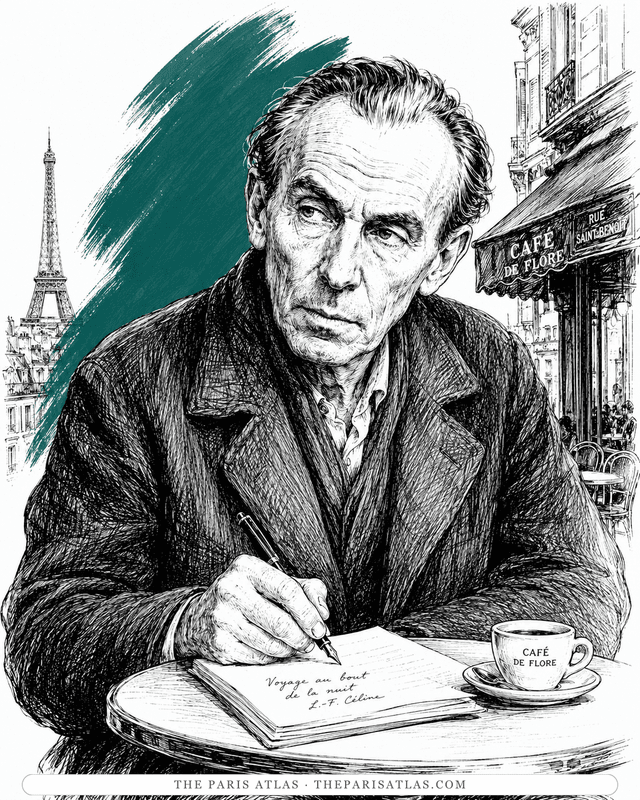
The doctor of the Paris slums who wrote the century's blackest, funniest novel — and changed the sound of French prose.
View author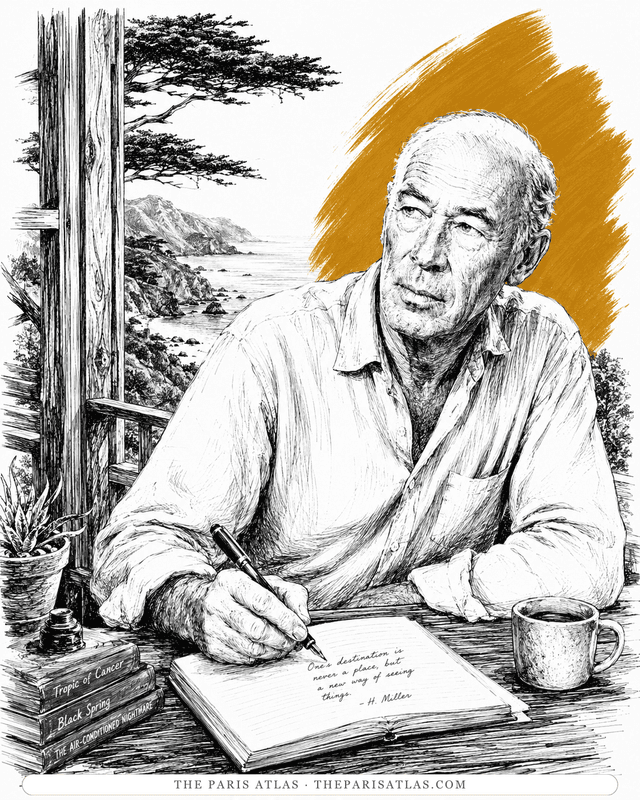
The Brooklyn dropout who arrived in Paris broke at thirty-eight and wrote the exuberant, banned books that ended American censorship.
View author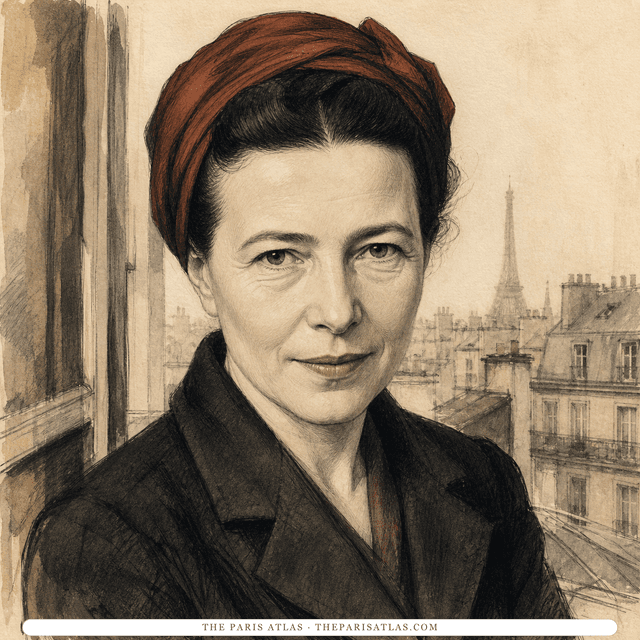
French writer and philosopher whose novels, memoirs, and social analysis examined freedom, gender, responsibility, aging, and the material conditions that shape a life.
View authorThe sources below include the primary text, editions, scholarship, archival materials, and other records that informed this page. They document At Terror Street and Agony Way, its publication, and its place in literary history.

The primary text represented by this page, used for descriptions of the work’s contents and for any quoted passages shown here.

Publication year, print run, the misprint, and the book's place in the chronology.
Bibliographic details of the first edition checked against the checklist.
The Martin correspondence and the founding of Black Sparrow Press.
Career arc from the little magazines into the Black Sparrow years.
Complete later transcriptions of the two illustrated poems; not a 1968 facsimile or independently verified autobiography.
Specialist contents confirm Beerbottle and I Met a Genius on pages 5 and 49. Approximate composition dates are not adopted.
The primary text is the baseline reference for every book page. Additional references document publication history, interpretation, and historical context where that evidence is available.
 Explore more resources