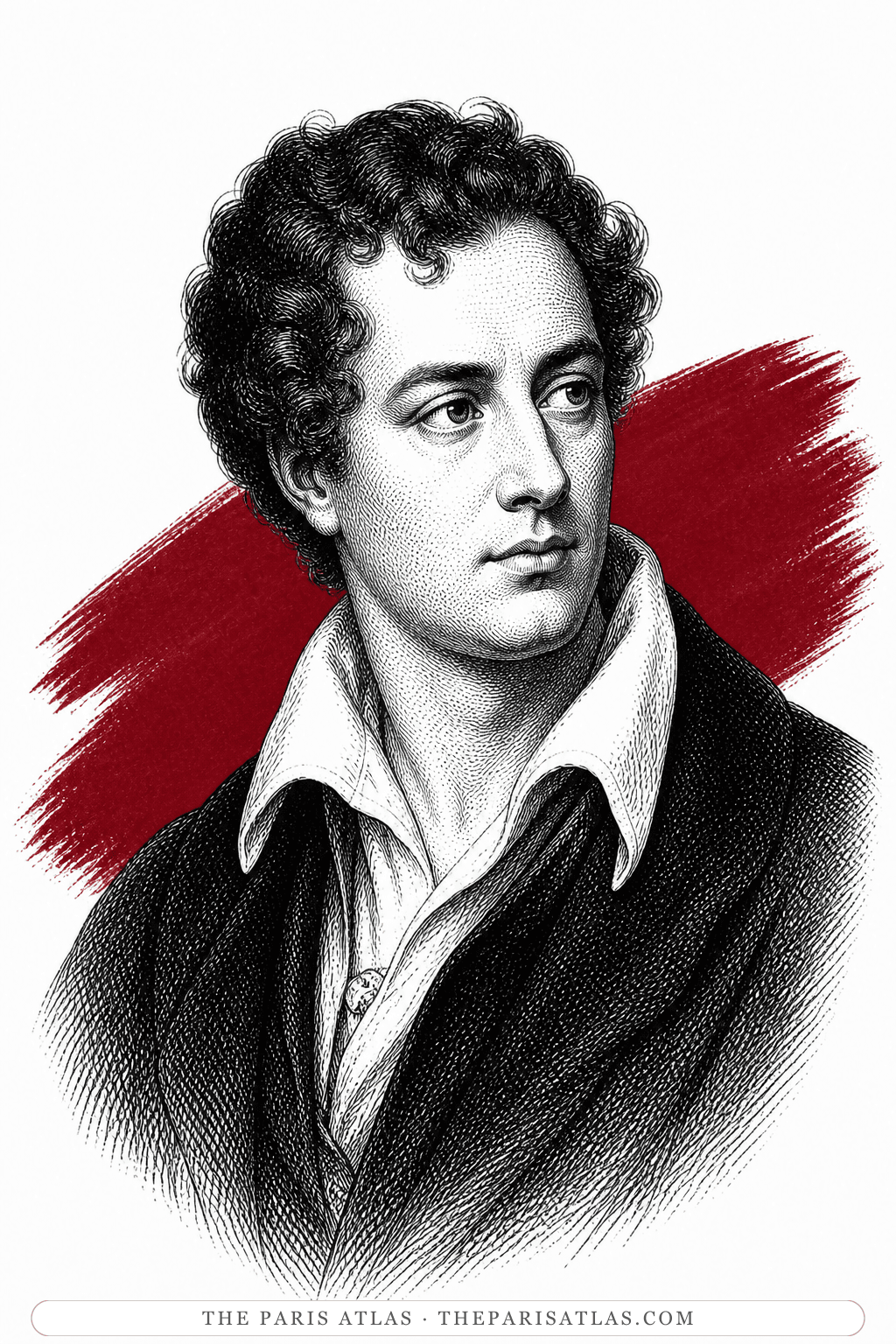


Childe Harold's Pilgrimage
by Lord Byron
The travel poem that made Byron famous overnight: a bored young lord wanders from Lisbon to Rome, and the poet slowly takes his place.
- 1812
- Melancholy
- Atmospheric
- lyrical
- autobiographical
- episodic
- political
About Lord Byron
The story, briefly
Spoiler-freeChilde Harold's Pilgrimage is a long poem in four cantos that Lord Byron published between 1812 and 1818. The first two cantos follow Harold, a young English nobleman sick of pleasure, through Portugal, Spain, Albania and Greece. The third takes him past the field of Waterloo, up the Rhine and into Switzerland. The fourth moves through Italy to Rome. The poem mixes landscape, history and politics with the moods of its gloomy hero. Readers took Harold for Byron himself, and by the last canto Byron stopped pretending otherwise. The first two cantos sold out in three days in March 1812 and made him the most talked-about writer in England.[1][2]
The story, in more detail
Byron wrote the first two cantos on the long journey east he began in 1809. He started the first canto at Janina, in Albania, on 31 October 1809, and finished the second at Smyrna on 28 March 1810. His preface says nearly the whole poem was written in the eastern Mediterranean. In the manuscript the hero was called Childe Burun, and the few facts given about his past came from Byron's own life.[1]
Back in London in July 1811, Byron showed his friend Robert Charles Dallas a verse imitation of Horace that he wanted to publish. Dallas asked whether he had written anything else. Byron took the Harold stanzas out of a small trunk and said they were not worth the trouble. Dallas disagreed, and John Murray, then a publisher in Fleet Street, took the poem.[1]
Murray published the first two cantos as a quarto on Tuesday 10 March 1812, and the edition of five hundred copies sold in three days. Thomas Moore, Byron's friend and first biographer, quotes Byron's own summary of what happened next: "I awoke one morning and found myself famous." Four more editions followed before the end of 1812.[1][2]
What's inside
Canto I introduces Harold, a young English lord who has spent his youth on revelling and is sick of it. He sails from England singing a farewell song, Childe Harold's Good Night. The canto then crosses Portugal, with the hills of Sintra, which Byron spells Cintra, and Spain, then at war with Napoleon's France. Byron describes the battles of Talavera and Albuera, a bullfight and the city of Cadiz.[1]
Canto II goes east to Greece and Albania. At Athens the poet mourns the ruins and attacks the Scottish lord who stripped sculptures from the temple of Athena on the Acropolis. The stanza does not name him, but the target was Lord Elgin. In Albania Harold is received by Ali Pasha, the local ruler. Later stanzas ask whether the Greeks, then under Turkish rule, will ever strike a blow to free themselves.[1]
Canto III was written after Byron left England for good in 1816. The canto opens with an address to Byron's daughter Ada as he leaves England. It then turns to Waterloo, recalls the Duchess of Richmond's ball in Brussels before the fighting, and follows the Rhine into Switzerland. The long stanzas on Lake Geneva, which Byron calls Lake Leman, are about nature, solitude, Jean-Jacques Rousseau and a night-time thunderstorm over the mountains.[1]
Canto IV begins on the Bridge of Sighs in Venice and travels through Arquà, Ferrara and Florence to Rome. Most of it is about art and ruins: the Colosseum, the Pantheon, St Peter's and the statues in the Vatican. The poem ends with the poet looking out at the Mediterranean from the Alban hills and addressing the ocean.[1]
Themes and analysis
Is Harold Byron?
Byron said no, at first. He wrote to Dallas on 31 October 1811 that he meant to deny all connection with Harold, and added: "I would not be such a fellow as I have made my hero for all the world." The preface to the first edition calls Harold the child of imagination.
Readers did not believe him, and the manuscript name Childe Burun did not help. By the fourth canto Byron gave up. In his dedication to John Cam Hobhouse he wrote that he had become weary of drawing a line which every one seemed determined not to perceive. Harold barely appears in the last canto, and the poet speaks in his own voice.
In the opening of the third canto, the speaker does not simply confess that he is Harold. After addressing Ada, he describes giving an imagined figure life and receiving a more intense life in return. Only then does Harold reappear. The order matters: the poem shows a character being remade before resuming his travels. The speaker can feel through that invented companion even while describing his own feelings as exhausted. Imagination supplies both closeness and distance, making the poem more than either a disguise or a direct autobiographical record.
A poem that grew for nine years
The poem was never planned as four cantos. Byron added ten stanzas to the second canto in the seventh edition of 1814. He finished the third canto at Ouchy, on Lake Geneva, on 27 June 1816, and Percy Bysshe Shelley carried a copy to Murray in London that September. Murray sold seven thousand copies of the third canto to booksellers at a single dinner in December 1816.
In June 1817 Byron told Murray he had no plans to continue. He began the fourth canto nine days later and had 126 stanzas by 20 July. Over the autumn he kept adding more, including six on the death of Princess Charlotte in November 1817. The finished canto has 186 stanzas and was published on 28 April 1818.
The final two stanzas turn the poem's long growth into a question about what can last. The speaker declares his task finished, pictures imagination as a fading light, and says he is no longer what he was. Yet his repeated farewell keeps the departure from becoming abrupt. He finally makes the journey's value conditional on a thought or memory surviving in a reader. Completion is therefore more than arrival at a destination: a changed speaker entrusts the poem's future to people whose response he cannot guarantee.
Harold in Paris
Byron never went to Paris, but Childe Harold was read there in English within a few years. Galignani, a bookseller and publisher at 18 rue Vivienne, issued Byron's works in Paris in 1818, and a second edition in 1819 opened with the first two cantos. A French verse translation, Le Pèlerinage de Childe Harold, was published in Paris in 1828.
Hector Berlioz, the French composer, turned Harold into music. In 1834 he wrote a symphony with a solo viola, and in his memoirs he explains the title. He wanted the viola to be a kind of melancholy dreamer in the manner of Byron's Childe Harold, so he called the piece Harold in Italy. The symphony had its first performance at a concert Berlioz gave at the Paris Conservatoire on 23 November 1834.
Quotes from Childe Harold's Pilgrimage
Roll on, thou deep and dark blue Ocean—roll! Ten thousand fleets sweep over thee in vain
There is a pleasure in the pathless woods, There is a rapture on the lonely shore, There is society, where none intrudes, By the deep Sea, and Music in its roar: I love not Man the less, but Nature more
There was a sound of revelry by night, And Belgium's Capital had gathered then Her Beauty and her Chivalry
Why we recommend it
The book that made Byron famous
Five hundred copies sold in three days in March 1812. Byron later summed it up: he awoke one morning and found himself famous.
The first Byronic hero
Harold is young, rich, bored, guilty and alone. Readers across Europe took him for Byron, and the type has been copied ever since.
A guidebook in verse
Sintra, Cadiz, Athens, Waterloo, the Rhine, Lake Geneva, Venice and Rome each get their own run of stanzas.
The lines everyone half-remembers
The sound of revelry by night, the pleasure in the pathless woods and the deep and dark blue ocean all come from this poem.
What this book explores
Bring it to book club
- Byron insisted Harold was not a self-portrait, then gave up the pretence in the fourth canto. Does the poem read differently once the poet speaks as himself?
- Canto II attacks Lord Elgin for taking the Parthenon sculptures. How does that argument sound today?
- The third canto turns from Byron's departure from England to the Duchess of Richmond's ball before Waterloo. What does that shift from private loss to public catastrophe do?
- Which landscape in the poem did you find most vivid, and which felt like a list of sights?
- Hector Berlioz turned Harold into a viola that wanders through Italy. What would you choose to represent Harold in music or film?
Timeline
1809
Byron begins the first canto at Janina, in Albania, on 31 October, during his journey east.
1810
He finishes the second canto at Smyrna on 28 March.
1812
John Murray publishes Cantos I and II on 10 March. The first edition of five hundred copies sells out in three days.
1816
Byron finishes Canto III at Ouchy on Lake Geneva on 27 June. Murray publishes it on 18 November.
1818
Canto IV is published on 28 April. Galignani in Paris had issued Byron's works in English that year, and its 1819 edition opens with Harold.
1828
A French verse translation, Le Pèlerinage de Childe Harold, is published in Paris.
1834
Hector Berlioz's symphony Harold in Italy, named after Byron's hero, is first performed at the Paris Conservatoire on 23 November.
Book editions

- Paperback
- Oxford University Press
- 2008
- 9780199537334
Ebook
- Ebook
- Project Gutenberg
- 1899
Hardcover
- Hardcover
- John Murray
- 1812
Reader reviews
Readers may also like

The Prisoner of Chillon and Other Poems
Written on Lake Geneva in June 1816, in the same weeks Byron finished the third canto of Harold.
Read our take
The Giaour
The first of the Eastern tales Byron wrote after Harold's success, set in the Greece of Canto II.
Read our take
Frankenstein
Begun at the Villa Diodati on Lake Geneva in June 1816, the summer Byron was writing the Swiss stanzas of Canto III.
Read our takeChilde Harold's Pilgrimage: frequently asked questions
What is Childe Harold's Pilgrimage about?
A young English lord, tired of pleasure, travels through Portugal, Spain, Albania and Greece, then later through Belgium, the Rhine, Switzerland and Italy. The story is thin. Most of the poem describes places, history and politics, and the poet's feelings about them.
What does Childe mean?
An old title for a young man of noble birth waiting to become a knight, as the note in Ernest Hartley Coleridge's edition explains. Byron's preface says he chose the archaic word to suit the old-fashioned verse form.
Is Childe Harold based on Byron himself?
Largely, though Byron denied it at first. In the manuscript the hero was called Childe Burun, and his past was drawn from Byron's own. In the dedication to the fourth canto Byron admits he had given up trying to separate himself from the pilgrim.
Did Byron really wake up famous?
Byron said so himself. Thomas Moore quotes him: I awoke one morning and found myself famous. The first edition of the first two cantos, published on 10 March 1812, sold out in three days.
How many cantos are there, and when were they published?
Four. Cantos I and II appeared together on 10 March 1812, Canto III on 18 November 1816 and Canto IV on 28 April 1818.
What stanza is it written in?
The Spenserian stanza: nine lines, the last one longer than the others. Byron's preface quotes the poet James Beattie, who said the stanza lets a writer be droll or pathetic, tender or satirical, as the mood takes him.
What is the connection between Childe Harold and Paris?
Byron never went to Paris. But Galignani printed the poem in English there from 1818, a French verse translation came out in Paris in 1828, and Hector Berlioz named his 1834 symphony Harold in Italy after Byron's hero. The symphony was first played at the Paris Conservatoire.
If you like Lord Byron
Explore authors with a similar voice, perspective, and influence.
Louis-Ferdinand Céline
The doctor of the Paris slums who wrote the century's blackest, funniest novel — and changed the sound of French prose.
View author
Henry Miller
The Brooklyn dropout who arrived in Paris broke at thirty-eight and wrote the exuberant, banned books that ended American censorship.
View author
Charles Bukowski
American poet and novelist of Los Angeles rooming houses, racetracks and the post office, who quit his job to write when a publisher offered him a hundred dollars a month. He came to Paris once, in September 1978, drank his way through a live television book programme and walked off the set — and French television has been replaying it ever since.
View author
References
References
The sources below include the primary text, editions, scholarship, archival materials, and other records that informed this page. They document Childe Harold's Pilgrimage, its publication, and its place in literary history.


1abcdefghThe Works of Lord Byron, Poetry, Vol. II: Childe Harold's Pilgrimage, edited by Ernest Hartley Coleridge (John Murray, 1899; Project Gutenberg #25340)
PoetryProject Gutenberg, 1899Used forThe complete poem with Byron's notes and Ernest Hartley Coleridge's introductions, used for the dates of writing and publication, the sales, the letters to Dallas and the dedication to Hobhouse. The quotations were checked against it.
3The Works of Lord Byron, Poetry, Vol. VII, with Ernest Hartley Coleridge's bibliography of the editions and translations (John Murray, 1904; Project Gutenberg #27577)
PoetryProject Gutenberg, 1904Used forColeridge's bibliography, used for the Galignani editions printed in Paris in 1818 and 1819 and the 1828 French translation.

4Harold in Italy: Berlioz's Memoirs, chapter 45 (English translation by Michel Austin)
MemoirThe Hector Berlioz WebsiteUsed forBerlioz's own account of Harold in Italy in his memoirs, in Michel Austin's English translation, with the date of the first performance at the Conservatoire.
5Lord Byron, The Major Works, edited by Jerome J. McGann — Open Library edition records (work OL1092507W)
WebsiteOpen Library, Internet ArchiveUsed forCatalogue records for the Oxford Major Works, used with the Library of Congress record to confirm its ISBN.
6Childe Harold's Pilgrimage
PoetryLord Byron, 1812Used forThe primary text represented by this page, used for descriptions of the work’s contents and for any quoted passages shown here.
i
Why these sources are here
The primary text is the baseline reference for every book page. Additional references document publication history, interpretation, and historical context where that evidence is available.
 Explore more resources