
Catherine de Médicis
The queen mother: Florentine, a reader of horoscopes and hens' brains, and the hand behind every poison in the book.
That the crown never leave her sons for Henri de Navarre, whatever the stars and the hens say.
The book

At a glance
- Queen mother; effectively regent, the epilogue says, once Henri III is king
- René the Florentine, perfumer and astrologer, with a shop on the Pont Saint-Michel
- Gloves, a lip salve, a book, and the heads of the executed for her experiments
- Charlotte de Sauve, placed in Henri de Navarre's way
- Catherine de Médicis · 1519–1589 · Florence
Who they are in the book
Spoiler-freeCatherine de Médicis is the widow of Henri II and the mother of Charles IX, the duc d'Anjou, the duc d'Alençon and Marguerite. The court believes she had Jeanne de Navarre killed with a pair of perfumed gloves, and the book gives the reader no reason to doubt it. Her instrument is René, a Florentine perfumer with a shop on the Pont Saint-Michel and a back room with an altar for sacrifices. Her ladies, Madame de Sauve among them, are placed where she needs them.
She wants the throne to stay with her sons and never pass to Henri de Navarre, and she has seen in the entrails of two black hens that it will. Dumas makes her the engine of the plot: every attempt on Henri's life is hers, and every one of them lands on someone else. She is also, in her scenes with Charles IX, a mother, which is what makes the end of the book so hard to watch.
How Catherine de Médicis Is Portrayed
- The glovesIn Chapter I the narrator reports the rumour that she poisoned Jeanne de Navarre with perfumed gloves made by René. The doctors, he adds, were told to open the body but not the skull, the one place the poison would show.
- Supposing he were not?Chapter X ends with Charles IX whispering that Henri is, after all, his brother-in-law. She whispers back: yes, but supposing he were not?
- The black hensIn Chapter XX she cuts the throats of two black hens on René's altar, reads a triple death in their cries, and finds the letter H four times in the second one's brain. She says the name aloud, Henri IV, and that she is accursed in her posterity. On her way out she steals a box of lip salve meant for Madame de Sauve.
- The clasp from FlorenceIn Chapter XXXII she gives the duc d'Alençon a jewelled clasp for his sword belt and tells him under her breath that if he hears a noise in Henri's room that night he is not to stir.
- The treatise on hawkingIn Chapter XLIX she comes out of the private closet where she does her chemistry, her hands marked with reddish stains, and hands her son a book on falconry whose pages are stuck together. She tells him it can only be read by wetting the finger.
- The book in the fireIn Chapter LXII the dying king makes her take the book out of his travelling box herself and drop it in the hearth. She watches the bluish flame rise from the poisoned leaves while the room fills with the smell of arsenic.
Her book kills her own son. Charles IX finds it in Henri's room, reads fifty pages with a wet thumb, and understands only when his greyhound dies with paper in its teeth. In Chapter LXV, as he names Henri regent, she answers that no Bourbon will reign in France while a Valois remains, and when Henri escapes she cries from the window that she has won and the Béarnais will not reign.
The epilogue gives her the last plot of the book. From the Hôtel de Soissons she dictates to Maurevel the anonymous letter meant to bring Madame de Sauve's husband, and Maurevel's men, to Henri's door. Maurevel dies in the attempt. She is still ignorant, Dumas notes, of René's small act of treason.
If you like Queen Margot


If you like Alexandre Dumas
Explore authors with a similar voice, perspective, and influence.

Mark Twain
The Missouri newspaperman who became America's most famous writer, and whose first book made its reputation partly out of Paris: in 1867 he arrived with a shipload of American tourists, renamed his guide Ferguson, watched the high-kicking can-can through his fingers and wrote it all down. He kept coming back — and was living in Paris in the mid-1890s, broke, while finishing the novel he considered his best, Personal Recollections of Joan of Arc.
View author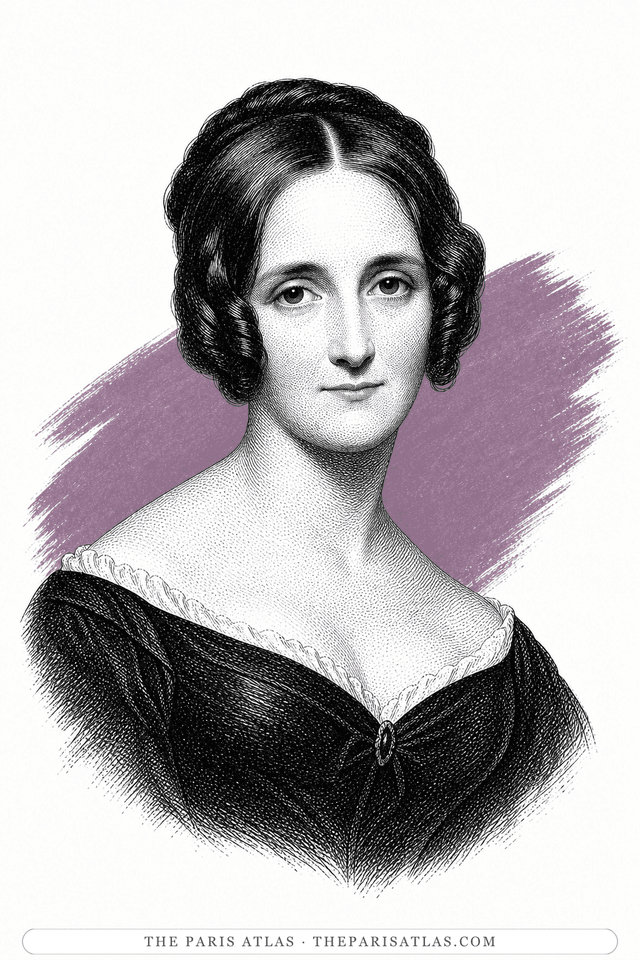
Mary Shelley
The author of Frankenstein, who first saw Paris at sixteen as a runaway. In the summer of 1814 she crossed from England to Calais with the poet Percy Bysshe Shelley and her stepsister Claire Clairmont, spent a week trapped in an expensive Paris hotel with no money, then bought a donkey and walked south-east across a France still wrecked by the Napoleonic wars. That journey became her first published book. Two years later, on a lake in Switzerland, she began her second.
View author
Louis-Ferdinand Céline
The doctor of the Paris slums who wrote the century's blackest, funniest novel — and changed the sound of French prose.
View author