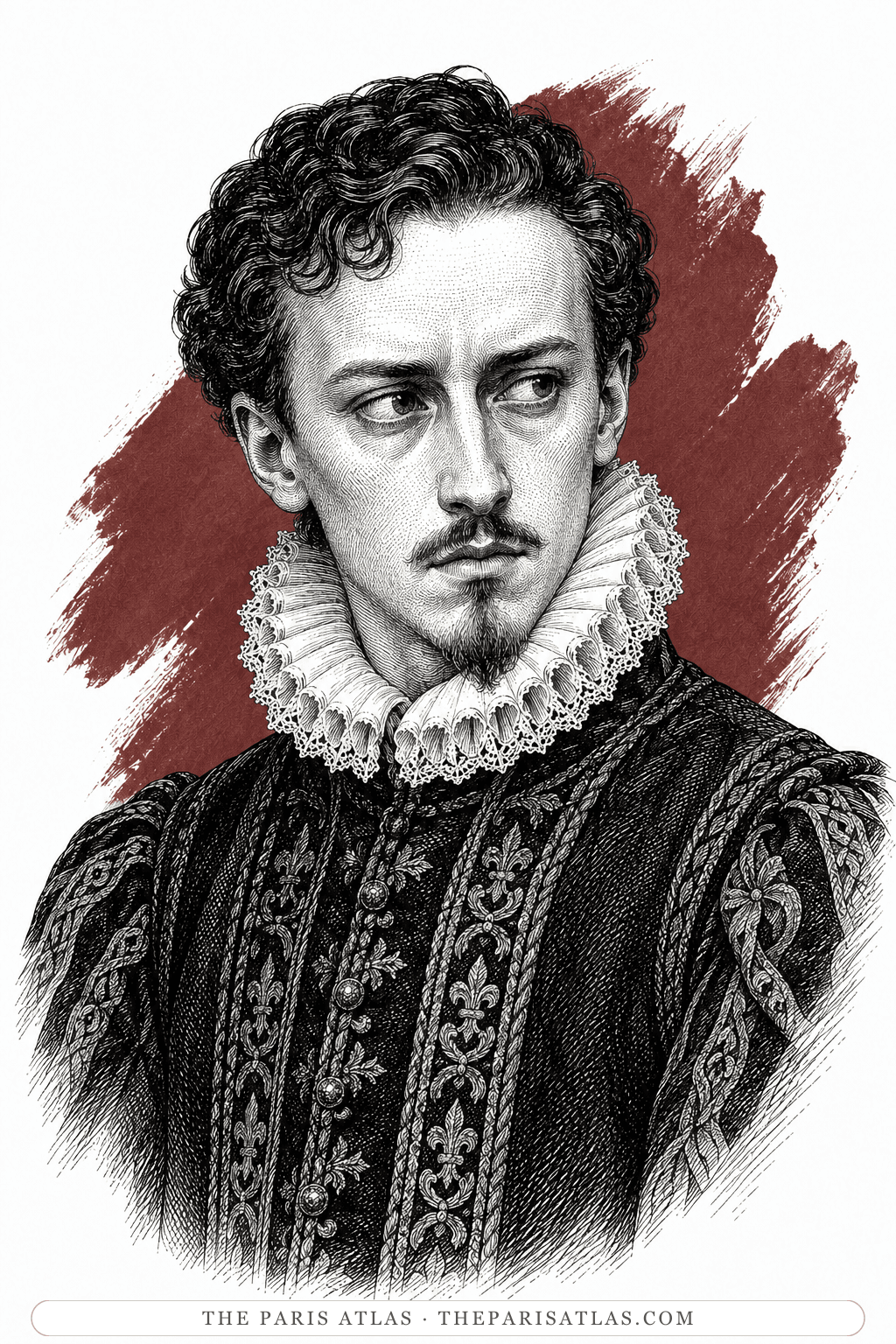
Charles IX
The king: a hunter and a poet who lends his arquebuses to assassins, and the only member of his family who comes to love Henri de Navarre.
To hunt, to write verse and to be king on his own account for once, out of his mother's hands.
The book

At a glance
- King of France since 1560; his mother has governed for him
- Twenty-five by his own count in the spring of 1574
- An armoury hung with axes, shields and arquebuses, with his nurse's chamber behind a tapestry
- Actéon, a greyhound that follows him everywhere
- Pierre de Ronsard, in poetry; Pompée, in fencing
- Charles IX, King of France · 1550–1574
Who they are in the book
Spoiler-freeCharles IX is the young King of France, twenty-two at the wedding, who has spent his reign under his mother's hand and is trying, in the first chapters, to slip out from it by making Admiral Coligny his adviser. He tells Coligny he was born to be a poet, not a king, reads him his verses to Ronsard, and keeps an armoury where he takes fencing lessons and poetry lessons in the same room. He hunts as if it were the only thing that made him happy, and it may be.
The same man commissions Maurevel to shoot the admiral, gives the order that starts the massacre, and improvises an epitaph over Coligny's hanging corpse. Dumas does not resolve the contradiction; he shows the king whistling a hunting air while he arranges a murder. What changes him is Henri de Navarre's knife at the boar hunt, after which the king's affection, once given, is the most dangerous thing in the Louvre for the man who receives it.
How Charles IX Is Portrayed
- Born to be a poetIn Chapter III he tells Coligny he is not a man of action but a dreamer, born to be a poet, and recites the verses he has sent that morning to Ronsard. His new arquebuse carries four lines of his own, inlaid in silver on the barrel.
- The whistled hunting airIn the same chapter he receives the assassin Maurevel in the armoury with his hand on a wheel-lock pistol and whistles his favourite hunting tune. He recites the man's crimes to him, then tells him where his cousin de Guise's deadliest enemy walks every morning at ten, carrying a red morocco portfolio.
- His nurseMadelon, a Protestant peasant from the Caux country, has a room next to his bedchamber and calls him Charlot. In Chapter III he goes to her prie-dieu to ask whether the man he sent for has come.
- A dead enemy smells sweetIn Chapter XVI, at Montfaucon, Henri complains of the stench from Coligny's body. The king answers that a dead enemy's corpse always smells sweet, and improvises four lines of verse on the admiral hung by the feet for want of a head.
- The boar at BondyIn Chapter XXXI he rides hatless with the horn at his bloody lips, refuses a musket because one cannot feel a bullet, misses with the spear, and goes down under his own horse with the boar at his boot.
- ActéonIn Chapter LIII he finds his greyhound stiff on the armoury floor with scraps of a woodcut in its teeth. He kneels to examine it and holds the candle while René opens the stomach. Then he orders the dog buried in a corner of the Louvre garden, with a tomb if he has time.
Charles IX quotes
In giving my sister Margot to Henry of Navarre, I give my sister to all the Protestants of the kingdom.
Death, mass, or the Bastille!
Well, then, I am not of your opinion; a dead enemy's corpse always smells sweet.
He dies of his mother's book. Finding it in Henri's empty room, he takes it away and reads fifty pages, wetting his thumb at every one. The dog dies first. He makes René sign a note that the book came from the queen mother and keeps the secret for weeks. Because the true cause cannot be named, he lets La Mole and Coconnas go to the scaffold for having poisoned him by sorcery. In Chapter LXII, sweating blood at Vincennes on 30 May 1574, he makes his mother burn the book and tells her she is no more his mother than the duc d'Alençon is his brother.
In Chapter LXV he names Henri de Navarre regent, tries to order his mother's arrest, and chokes on blood before the captain of the guards can hear the order. He dies in his nurse's arms saying that he comes to God without sceptre or crown. The real Charles IX died at Vincennes on 30 May 1574; the poisoned book is the novel's.
If you like Queen Margot


If you like Alexandre Dumas
Explore authors with a similar voice, perspective, and influence.

Mark Twain
The Missouri newspaperman who became America's most famous writer, and whose first book made its reputation partly out of Paris: in 1867 he arrived with a shipload of American tourists, renamed his guide Ferguson, watched the high-kicking can-can through his fingers and wrote it all down. He kept coming back — and was living in Paris in the mid-1890s, broke, while finishing the novel he considered his best, Personal Recollections of Joan of Arc.
View author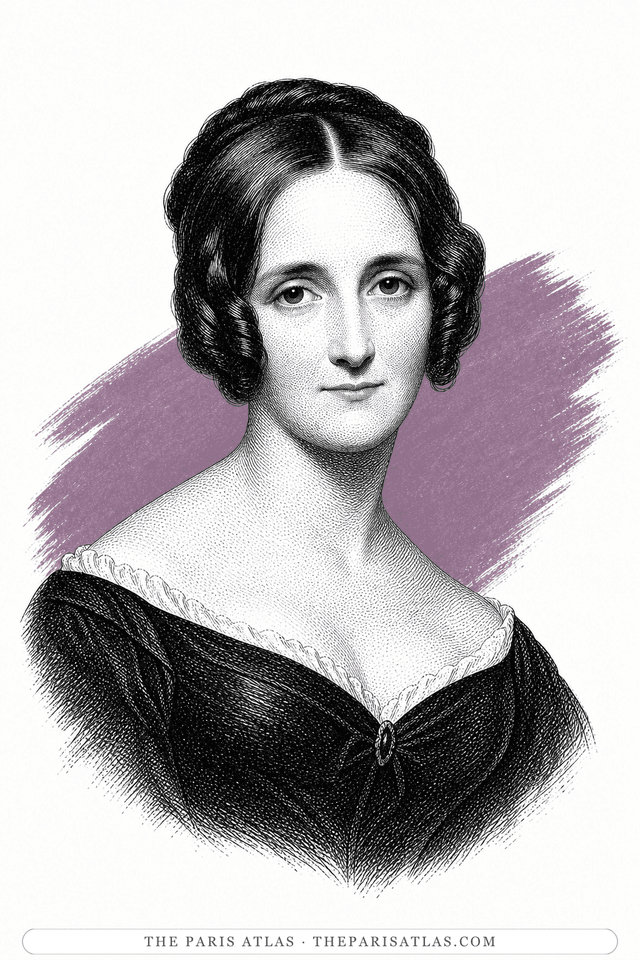
Mary Shelley
The author of Frankenstein, who first saw Paris at sixteen as a runaway. In the summer of 1814 she crossed from England to Calais with the poet Percy Bysshe Shelley and her stepsister Claire Clairmont, spent a week trapped in an expensive Paris hotel with no money, then bought a donkey and walked south-east across a France still wrecked by the Napoleonic wars. That journey became her first published book. Two years later, on a lake in Switzerland, she began her second.
View author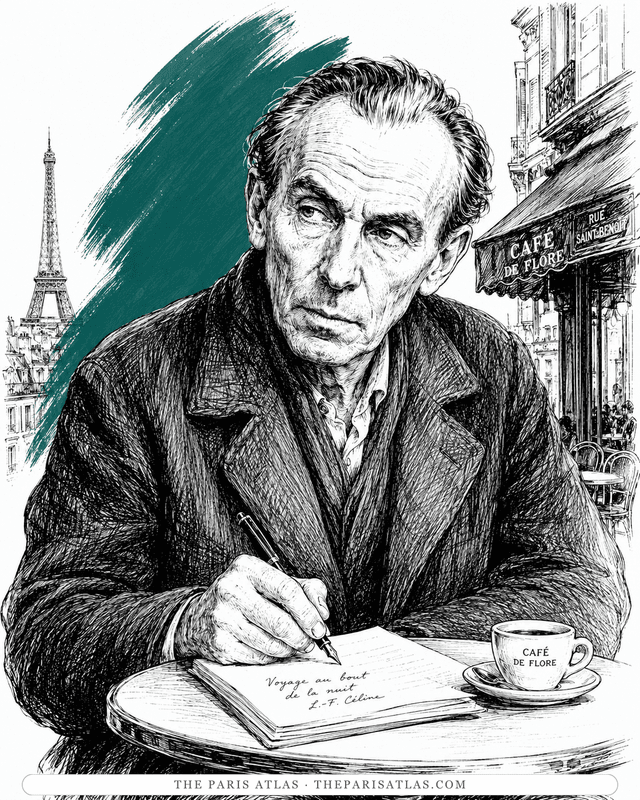
Louis-Ferdinand Céline
The doctor of the Paris slums who wrote the century's blackest, funniest novel — and changed the sound of French prose.
View author