
Marguerite de Valois
Margot: sister of Charles IX, married on the first page to Henri de Navarre, and the woman who hides a wounded Protestant in her closet on the night of the massacre.
To choose her own allies and her own lover in a family that treats her as a marriage contract, and to keep La Mole alive once she has saved him.
The book

At a glance
- Queen of Navarre from the first page; called Margot by her brother the king
- Scarcely twenty at the wedding of August 1572
- The first floor of the Louvre above the moat, with a hidden closet and a secret stair
- Henriette, duchesse de Nevers; their password is Eros, Cupido, Amor
- The Duc de Guise when the book opens, then La Mole
- Marguerite de France, called Marguerite de Valois · 1553–1615 · Saint-Germain-en-Laye
Who they are in the book
Spoiler-freeMarguerite de Valois is twenty when the book opens, the daughter of the late Henri II, the sister of the reigning Charles IX, and the bride of the young Protestant King of Navarre. The court poets compare her to the dawn; an Italian scholar who talks with her for an hour in four languages says that to see the court without seeing her is to see neither France nor the court. Her brother calls her Margot. Her lover, when the book starts, is the Duc de Guise, the Catholic party's champion, and her husband spends his wedding night with another woman.
She is the character the book returns to when it wants intelligence rather than force. She burns a letter that could hang her, agrees with her husband to be his political ally and nothing more, and dresses La Mole's wounds with a silver needle while diagnosing them in Latin. Her friendship with the duchesse de Nevers, sealed with a three-word password, gives the novel its lightest pages. Her love for La Mole gives it its last ones.
How Marguerite de Valois Is Portrayed
- The portrait at the ballIn Chapter I she comes back into the ballroom without her veil: black hair, a brilliant complexion, coral lips, a tiny foot in a satin slipper. Dumas adds that she is also the most learned woman of her time, and quotes the Italian scholar who spoke with her in Italian, Spanish, Latin and Greek.
- Two words of LatinIn the same chapter the Duc de Guise bows and murmurs Ipse attuli, I have brought it myself. She answers Noctu pro more, tonight as usual, into the bell of her enormous collar so that only he can hear.
- The letter she burnsIn Chapter II she searches the duke's silver casket for the one letter in which she warned him that the king meant to have him killed. She finds it, holds it to the candle and treads the ashes into the floor.
- A faithful allyIn Chapter II her husband guesses someone is hidden in her closet and tells her she is an unfaithful wife but a faithful ally. She offers her hand on those terms: a political alliance, frank and loyal.
- The surgeonIn Chapter X she cuts the laces of La Mole's doublet, probes his wounds with a round-pointed silver needle and pronounces in Latin that the shoulder wound is severe but not mortal. Daughters of France, she tells him, are trained to know herbs and make balsams.
- A smile on her lipsIn Chapter LXI, on the evening of the execution, she puts on new jewels and goes to her brother's ball. Charles IX warns her quietly that there is a spot of blood on her arm. She asks what difference that makes, since she has a smile on her lips.
Marguerite de Valois quotes
To see the court without seeing Marguerite de Valois is to see neither France nor the court.
In giving my sister Margot to Henry of Navarre, I give my sister to all the Protestants of the kingdom.
Queen, I have no throne; wife, I have no husband!
La Mole is beheaded on the Place Saint-Jean-en-Grève in Chapter LX with his eyes on the tower window where she stands. That night she goes with Henriette to the executioner's house, lifts the head with jewelled hands, puts it in a bag embroidered with pearls, and has it embalmed. It stays in the closet beside her bedroom, which becomes an oratory. She then goes to the ball because her brother asks her to.
The epilogue leaves her in Navarre with her husband, sad and gloomy, finding in the mountains not distraction but a softening of the two griefs Dumas names as absence and death. The real Marguerite's marriage was annulled in 1599; she kept a small literary court in Paris and left poems and memoirs. The book stops long before that.
If you like Queen Margot


If you like Alexandre Dumas
Explore authors with a similar voice, perspective, and influence.

Mark Twain
The Missouri newspaperman who became America's most famous writer, and whose first book made its reputation partly out of Paris: in 1867 he arrived with a shipload of American tourists, renamed his guide Ferguson, watched the high-kicking can-can through his fingers and wrote it all down. He kept coming back — and was living in Paris in the mid-1890s, broke, while finishing the novel he considered his best, Personal Recollections of Joan of Arc.
View author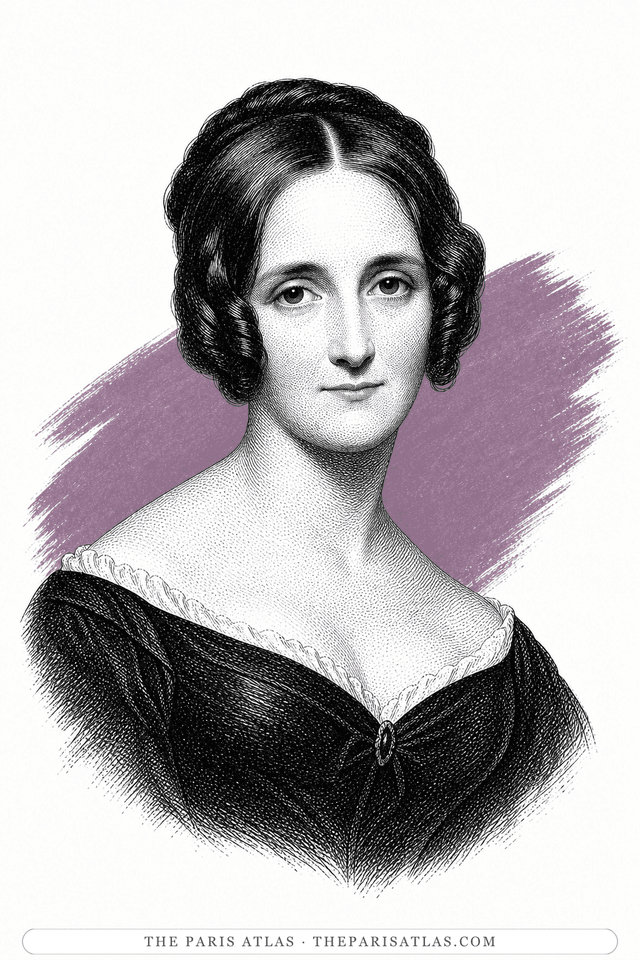
Mary Shelley
The author of Frankenstein, who first saw Paris at sixteen as a runaway. In the summer of 1814 she crossed from England to Calais with the poet Percy Bysshe Shelley and her stepsister Claire Clairmont, spent a week trapped in an expensive Paris hotel with no money, then bought a donkey and walked south-east across a France still wrecked by the Napoleonic wars. That journey became her first published book. Two years later, on a lake in Switzerland, she began her second.
View author
Louis-Ferdinand Céline
The doctor of the Paris slums who wrote the century's blackest, funniest novel — and changed the sound of French prose.
View author