

Run with the Hunted
497 pages arranged by the period of life each piece describes, not by publication date — a life told through its own writing.
- 1993
- Savage
- Wry
- Melancholy
- autobiographical
- voice-driven
- funny
- spare
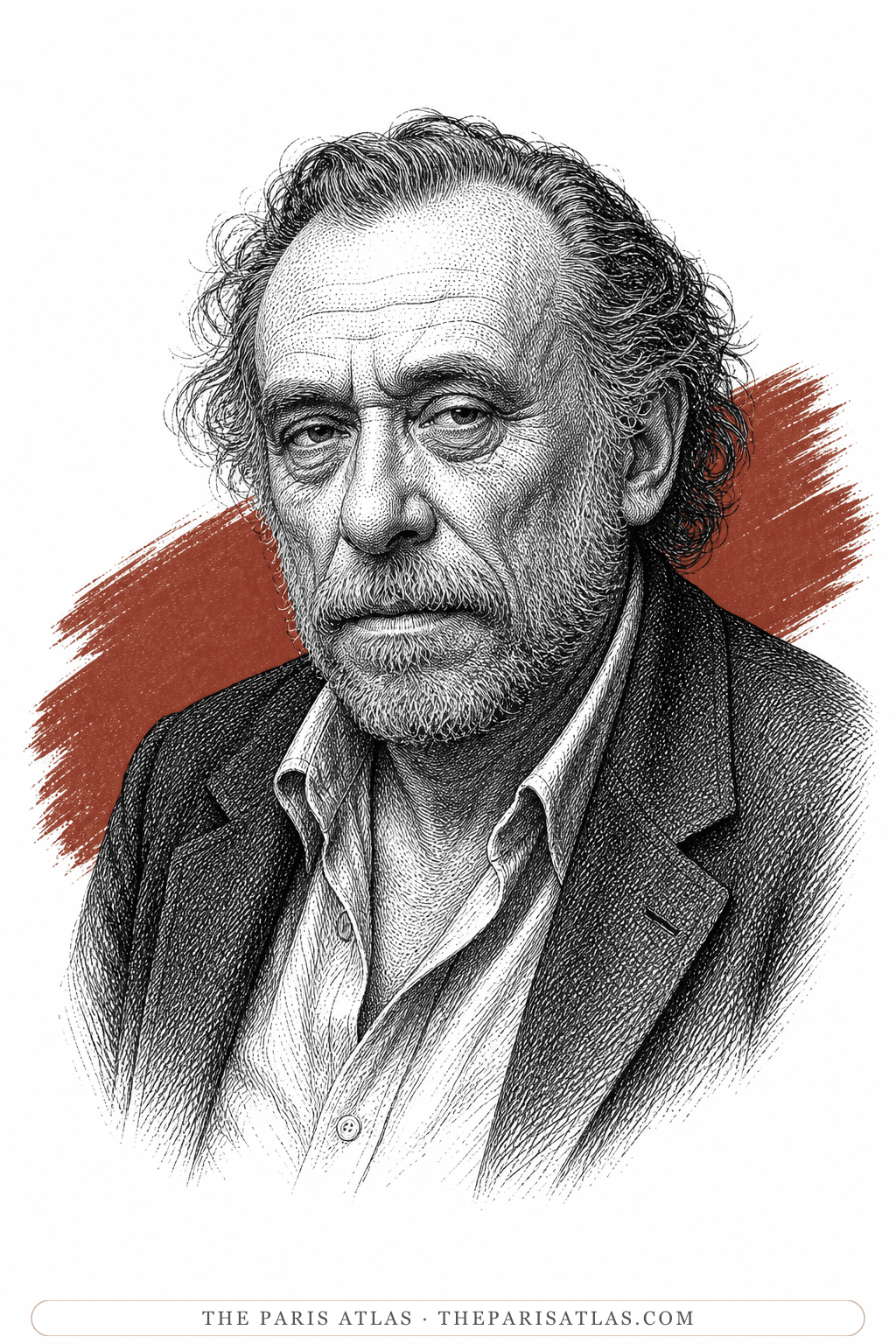
About Charles Bukowski
The story, briefly
Spoiler-freeRun with the Hunted: A Charles Bukowski Reader, published by HarperCollins in 1993 and selected by John Martin, gathers poems, stories and novel excerpts across 497 pages. Its organising idea is unusual and worth stating plainly: the contents are arranged not by when Bukowski published them but by the period of his life each piece describes. A poem written in 1985 about his childhood therefore sits near the front, ahead of a story written twenty years earlier about a later part of the life. The effect is a life told in the writer's own words and in the order it was lived, assembled from work produced across five decades. Martin had published Bukowski since 1968 and knew the whole body of work, including what was still unpublished.
The story, in more detail
The reader was published the year before Bukowski died, and functions as a summary of the career made while he was still alive to see it. Because it draws on the novels as well as the poems and stories, it is also the one book that shows how much the same events recur across forms — the post office in a novel and in a poem, the father in Ham on Rye and in verse written decades apart.
Themes and analysis
Sunlight beneath the table
The opening memory gives the child a world organized by scale and sensation rather than adult importance. Beneath the table, cloth and sunlight matter more than the people whose legs surround him; being unnoticed feels comfortable. But the adult voice has to estimate where and when this happened, and a blank separates that recollection from the next Christmas scene. The reader therefore begins with a double perspective: vivid sensory confidence and uncertainty about the past's coordinates. This is an assembled memory of childhood, not a continuous record simply waiting to be recovered.
A waitress brings coffee
In “Young in New Orleans,” the waitress's brief attention gives the speaker a form of contact that does not demand a different life from him. Her smile and momentary lingering are sufficient; the poem does not develop them into a romance. That small exchange complicates his larger preference for solitude. The city permits anonymity, but freedom from other people's expectations need not mean the complete absence of kindness. His final celebration remains deliberately difficult to name: it concerns being left alone within a place, rather than acquiring the possessions and obligations he lists as absent.
Why we recommend it
The best single-volume introduction
Poems, stories and novel excerpts in one place, chosen by the man who published him for twenty-five years.
A life in its own words
The arrangement by lived period rather than publication date makes it read as autobiography assembled from fiction and verse.
Different forms for the same life
Poems, stories, and novel excerpts let readers compare how Bukowski revisits experience across genres.
What this book explores
Timeline
1968
John Martin begins publishing Bukowski at Black Sparrow Press.
1993
HarperCollins publishes the reader, selected by Martin.
1994
Bukowski dies in March, the year after it appears.
Book editions

- Hardcover
- HarperCollins
- 1993
- 9780060169114

- Paperback
- Ecco
- 2003
- 9780060924584
Reader reviews
Readers may also like


Run with the Hunted: frequently asked questions
What is Run with the Hunted?
A 497-page Charles Bukowski reader published by HarperCollins in 1993, selected by John Martin, gathering poems, stories and excerpts from the novels.
How is it arranged?
By the period of Bukowski's life each piece describes, not by publication date — so the book reads as a life told chronologically in his own writing.
Is this a good first Bukowski book?
It is the best single volume for someone who wants everything at once: poems, stories and novel excerpts, chosen by his publisher of twenty-five years.
Who was John Martin?
The founder of Black Sparrow Press, who began publishing Bukowski in 1968 and paid him a hundred dollars a month to leave the post office.
Is it the same as the 1962 chapbook of that title?
No. A separate Run with the Hunted appeared in 1962 as a small chapbook. This 1993 reader takes its title from it but is an entirely different book.
If you like Charles Bukowski
Explore authors with a similar voice, perspective, and influence.
Louis-Ferdinand Céline
The doctor of the Paris slums who wrote the century's blackest, funniest novel — and changed the sound of French prose.
View author
Henry Miller
The Brooklyn dropout who arrived in Paris broke at thirty-eight and wrote the exuberant, banned books that ended American censorship.
View author
Simone de Beauvoir
French writer and philosopher whose novels, memoirs, and social analysis examined freedom, gender, responsibility, aging, and the material conditions that shape a life.
View author
References
References
The sources below include the primary text, editions, scholarship, archival materials, and other records that informed this page. They document Run with the Hunted, its publication, and its place in literary history.


1Run with the Hunted
NonfictionCharles Bukowski, 1993Used forThe primary text represented by this page, used for descriptions of the work’s contents and for any quoted passages shown here.

2Run with the Hunted — Ecco opening excerpt
WebsiteEcco / AbeBooksUsed forPublicly indexed Ecco excerpt, opening table memory through the Christmas recollection; not a complete chapter or first-edition collation.
3Young in New Orleans — poem transcription
WebsitePoetryVerseUsed forFull poem transcription; the reading concerns its narrated solitude and the waitress's brief attention, not independently verified biography.
4Run with the Hunted (1993) — contents and publication record
WebsiteBukowski DatabaseUsed forSpecialist contents identify Young in New Orleans in the 1993 reader, distinct from the 1962 chapbook.
5Charles Bukowski timeline (bukowski.net)
WebsiteUsed forPublication year, editor, arrangement and edition details.
6Charles Bukowski: books and chapbooks (Verdant Press checklist)
WebsiteUsed forBibliographic details including the Black Sparrow issue.
8Charles Bukowski
BiographyReaktion Books, 2012Used forThe Martin relationship across twenty-five years.
i
Why these sources are here
The primary text is the baseline reference for every book page. Additional references document publication history, interpretation, and historical context where that evidence is available.
 Explore more resources