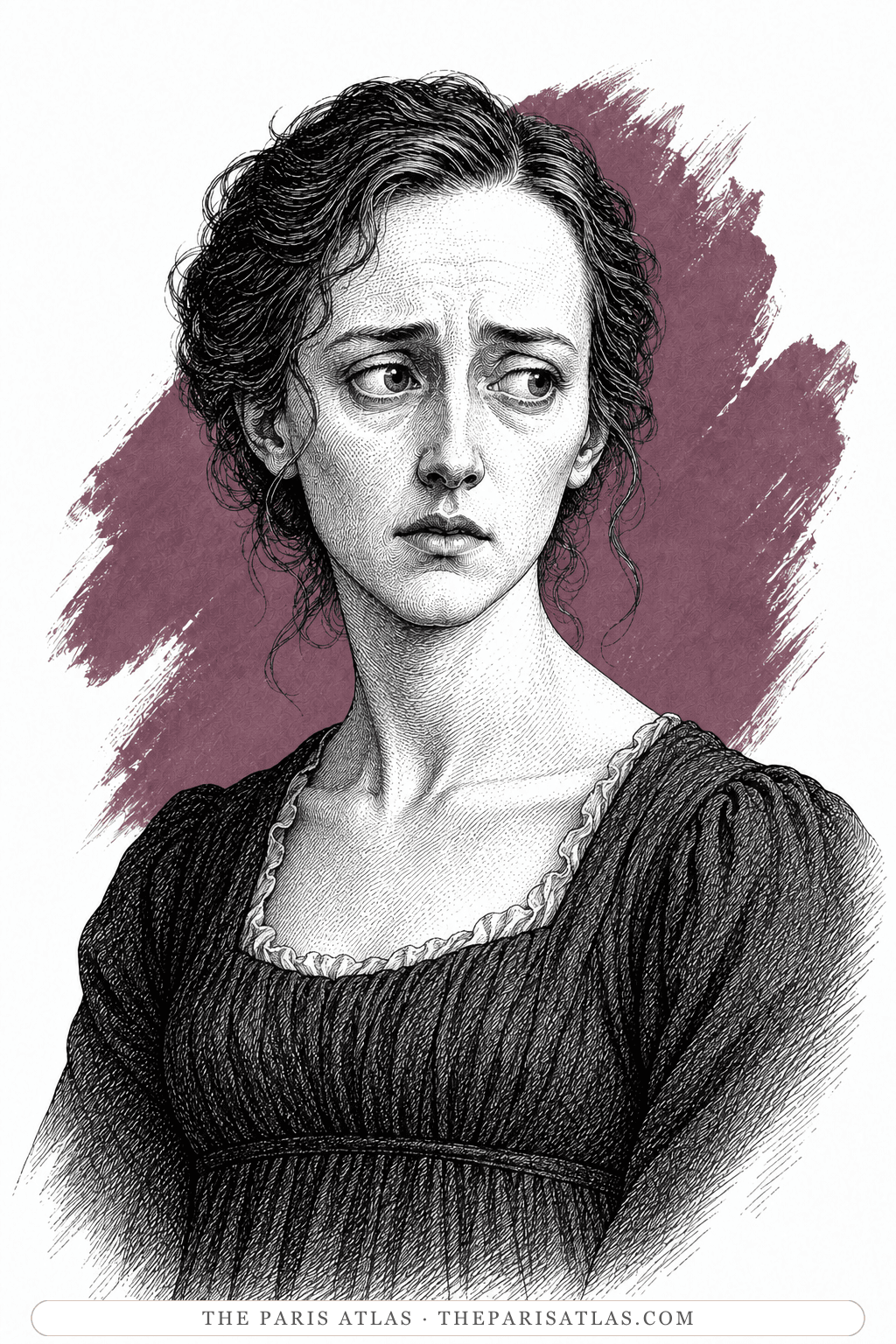
Madeline Usher
Roderick’s ill sister, glimpsed through the visitor’s uncertain account.
The book

Who they are in the book
Spoiler-freeMadeline Usher is Roderick Usher's gravely ill sister in Edgar Allan Poe's The Fall of the House of Usher. She lives in the ancestral mansion into which Roderick invites the narrator. Although she speaks no reported dialogue, her condition governs the household and eventually becomes central to what the narrator can no longer explain away.
A woman the narrator scarcely knows
Madeline first passes through the room while Roderick speaks about her illness. The visitor watches her with dread but has no conversation with her. This brief appearance establishes a limit that remains important: the narrator can describe his response to her, but cannot report her private understanding of events.
Roderick's grief makes her seem emotionally central even while she remains personally inaccessible. The imbalance is part of the story's construction. Readers receive extensive accounts of her brother's sensations and beliefs, yet very little of Madeline's own voice or choices.
Illness creates uncertainty about appearances
The narrator describes wasting illness and episodes resembling catalepsy, a condition involving profound immobility. The physicians have not adequately understood her case. These details establish that appearances may be dangerously difficult to interpret.
The medical uncertainty should remain uncertainty. Poe does not provide enough reliable information for a retrospective diagnosis, nor does the story authorize Roderick's fears as medical expertise. Madeline's body is repeatedly observed and interpreted by others. The consequences of those interpretations matter more than supplying a modern label that the narrative cannot verify.
Why she cannot be reduced to her brother's symbol
Madeline belongs to the same enclosed family and house as Roderick, and her failing health appears to repeat their decline. That parallel makes symbolic readings possible. But it can also tempt readers to treat her solely as a representation of something happening inside her brother.
Her suffering has a literal place in the story. Keeping that fact in view changes the moral emphasis: the question is not only what Madeline means to Roderick, but how his fear and the narrator's compliance affect her. Her limited access to speech makes attention to their actions especially necessary.
Sources and passages
- Edgar Allan Poe, The Fall of the House of Usher
Primary text: Madeline's first appearance and illness; the observations at the vault; Roderick's confession and Madeline's return near the conclusion.
How Madeline Usher Is Portrayed
- A quiet appearanceMadeline crosses a distant part of the room slowly, without acknowledging the visitor. Her first appearance gives the narrator little opportunity to know her.
- A striking resemblanceThe visitor sees a close resemblance between Madeline and Roderick. The story later identifies them as twins.
- An illness others cannot explainThe narrator reports wasting, withdrawal, and episodes resembling catalepsy. The physicians’ uncertainty remains part of the account.
- An effort to remain activeBefore taking to bed, Madeline continues moving through the house despite her condition. Her brother describes her illness as longstanding.
If you like Tales of the Grotesque and Arabesque


If you like Edgar Allan Poe
Explore authors with a similar voice, perspective, and influence.

Louis-Ferdinand Céline
The doctor of the Paris slums who wrote the century's blackest, funniest novel — and changed the sound of French prose.
View author
Henry Miller
The Brooklyn dropout who arrived in Paris broke at thirty-eight and wrote the exuberant, banned books that ended American censorship.
View author
Charles Bukowski
American poet and novelist of Los Angeles rooming houses, racetracks and the post office, who quit his job to write when a publisher offered him a hundred dollars a month. He came to Paris once, in September 1978, drank his way through a live television book programme and walked off the set — and French television has been replaying it ever since.
View author