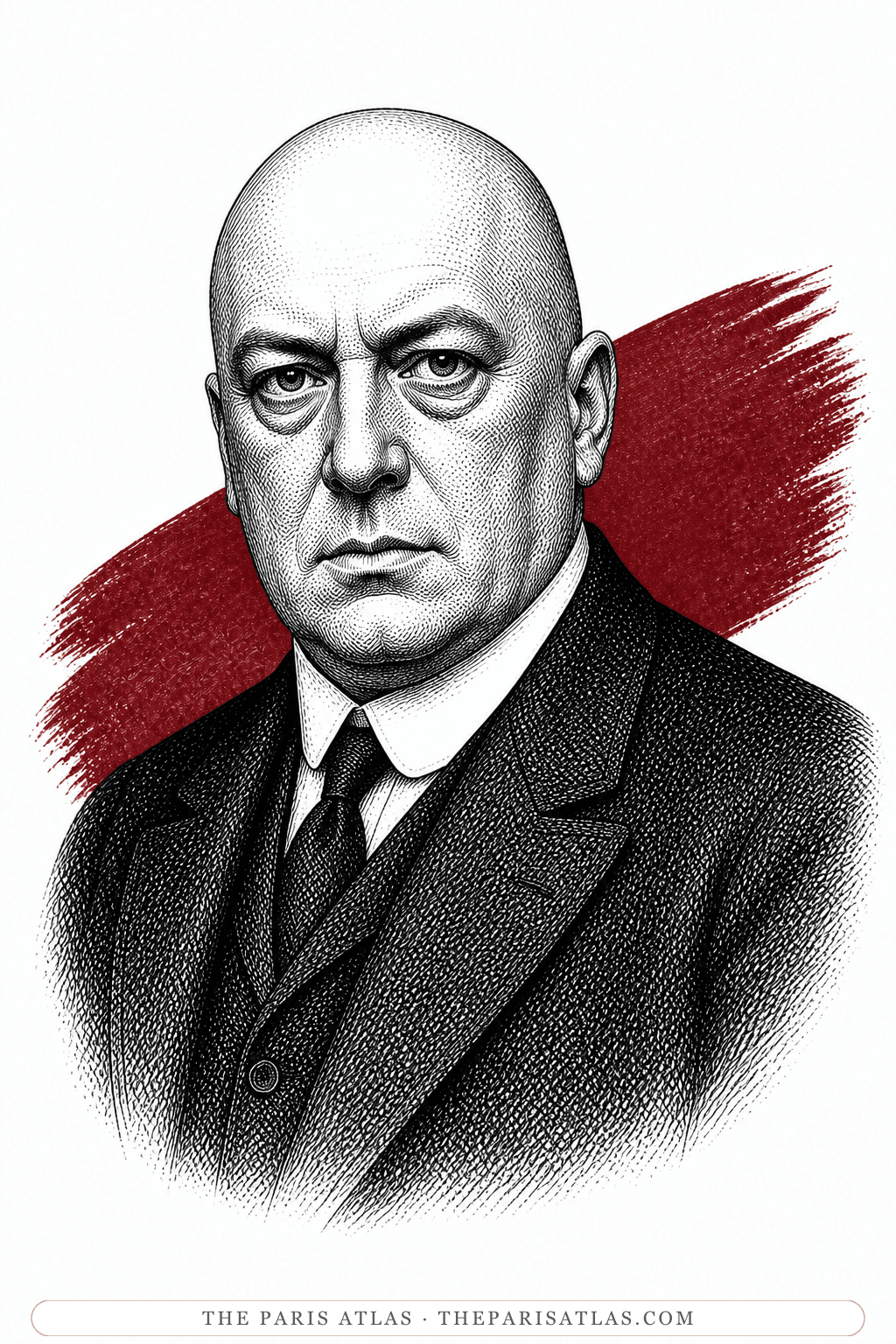

The Diary of a Drug Fiend
The fiction that makes Crowley’s drugs, spiritual ideas, and taste for self-dramatization part of a love story.
Read our take
Crowley’s enormous autobiography of travel, sex, drugs, mountaineering, feuds, magic, scandal, and self-mythology.
Crowley narrates his own legend through travel, magical experiments, mountaineering, relationships, drugs, feuds, and a relentless effort to control the meaning of his life.
A long autobiography in which Crowley presents his travels, occult work, scandals, relationships, and public reputation on his own terms.
Crowley calls the writers he carries his family. The travelling library therefore offers more than amusement on a journey: it supplies a chosen ancestry that he can take abroad. His account of vellum bindings and ties makes that affiliation practical. Protecting the books from a soaked rucksack becomes a small demonstration of fidelity to the literary past within a life presented as adventurous and unconventional.
That fidelity does not mean agreement. At Tuticorin, he describes reading Browning as the beginning of a counterargument, borrowing the poet’s title and manner to challenge his Christianity. The episode casts authorship as an active reply to reading. Crowley’s account makes rebellion depend on an intimate relationship with the tradition against which he rebels.
In the Rodin chapter, Crowley links artistic mastery with recognizing an underlying unity across different arts. His account of interpreting sculpture in verse puts him inside that privileged circle of understanding. The collaboration consequently does double work in the memoir: it records a literary project while presenting the narrator as someone capable of recognizing, and being recognized by, a celebrated master.
Tobias Churton’s biographical account adds a useful social scale to this self-portrait. It identifies Haweis’s work photographing Rodin and notices the condescension in Crowley’s later description of a man less than three years younger than himself. That discrepancy suggests a way to read the memoir’s encounters: the people who help make an artistic life possible may receive less credit than the narrator reserves for his own powers. Admiration for a famous colleague can coexist with competition closer to home.
The autobiography gives Crowley’s own sprawling, self-serving, and often entertaining account of the life behind the fiction.
Crowley’s efforts to explain himself make the book useful for examining how a controversial figure builds a public identity.
Travel and mountaineering broaden the account beyond the magical experiments with which Crowley is usually associated.
1929
Mandrake Press publishes the first two parts under the title The Spirit of Solitude; the planned six-volume edition remains incomplete.
1969
Jonathan Cape publishes a single-volume edition edited by John Symonds and Kenneth Grant, drawing on all six manuscript parts.
1989
Arkana publishes a paperback edition of the autobiography.

The fiction that makes Crowley’s drugs, spiritual ideas, and taste for self-dramatization part of a love story.
Read our take
His other major novel turns the occult world of the memoir into magical fiction.
Read our take
It is an autobiography, although Crowley’s self-presentation requires critical reading. His account should not be mistaken for an independent biography.
Crowley writes about travel, mountaineering, magical experiments, relationships, drugs, and quarrels. The range is wider than an account of occult practice alone.
No. Its main form is a life narrative. Magical work appears as part of Crowley’s account of himself, alongside many other interests and experiences.
No. The narrative is intensely concerned with Crowley’s reputation and interpretation of his own life. Compare disputed claims with independent historical evidence.
The book shows an autobiographer constructing a public identity through adventure, argument, and self-justification. Readers interested in unreliable self-portraiture can approach it on those terms.
Explore authors with a similar voice, perspective, and influence.
The Brooklyn dropout who arrived in Paris broke at thirty-eight and wrote the exuberant, banned books that ended American censorship.
View author
French writer and philosopher whose novels, memoirs, and social analysis examined freedom, gender, responsibility, aging, and the material conditions that shape a life.
View author
American novelist and composer whose expatriate fiction explores dislocation, unstable intimacy, fatalism, and North Africa.
View authorThe sources below include the primary text, editions, scholarship, archival materials, and other records that informed this page. They document The Confessions of Aleister Crowley, its publication, and its place in literary history.

The primary text represented by this page, used for descriptions of the work’s contents and for any quoted passages shown here.

Official record used to verify names, dates, institutional details, or other factual information on this page.
Official record used to verify names, dates, institutional details, or other factual information on this page.
Archival evidence used to document the historical record connected to The Confessions of Aleister Crowley.
Biographical evidence used to verify chronology, relationships, and historical context connected to The Confessions of Aleister Crowley.
Web source consulted for documented facts and historical context presented on the The Confessions of Aleister Crowley page.
Web source consulted for documented facts and historical context presented on the The Confessions of Aleister Crowley page.
Crowley’s own account, read as autobiographical self-presentation.
The primary text is the baseline reference for every book page. Additional references document publication history, interpretation, and historical context where that evidence is available.
 Explore more resources