The Paris AtlasCharting the artists, works, and places worth returning to.
  • Author
  • Playwright
  • Translator
· French · 1869–1951

André Gide

French novelist and essayist, Nobel laureate 1947, co-founder of the Nouvelle Revue Française and one of the most influential French writers of the first half of the twentieth century. Camus regarded him as the French moralist whose responsibility-of-the-writer position his own 1957 Nobel lecture deliberately echoed.

1 book on our shelves

In images

Details

Lived
1869–1951
Born
22 November 1869
Birthplace
Paris, France
Died
19 February 1951 · aged 81
Place of death
Paris, France
Nationality
French
Roles
AuthorPlaywrightTranslator
Also known as
André Paul Guillaume Gide

About André Gide

André Gide was a French novelist, essayist and critic who won the Nobel Prize in Literature in 1947.[1] He was born in Paris on 22 November 1869 and died there on 19 February 1951. In 1909 he helped found the Nouvelle Revue Française, the review at the center of French literature for half a century. In 1911 he became one of the three founders of the publishing house that grew into Éditions Gallimard.

Gide was raised in a strict Protestant household. In his twenties, travelling in North Africa, he realised he was attracted to men. He then married his cousin Madeleine Rondeaux and stayed married to her for forty-three years without ever sleeping with her.[2] Most of his books come out of that situation, and they ask the same question: what happens to a person who tells the truth about himself, and what happens if he does not? He asked it as fiction in [The Immoralist](book:the-immoralist) and Strait Is the Gate, and as argument in Corydon. He asked it again as autobiography in Si le grain ne meurt, where he wrote openly about his homosexuality at a time when almost no established writer did.

In his fifties Gide started writing about politics. A journey through French Equatorial Africa in 1925 and 1926 made him a public critic of the colonial companies operating there. In the early 1930s he became the most famous literary supporter of communism in France. Then he toured the Soviet Union, and in 1936 published Retour de l'U.R.S.S., a short book saying plainly that he had found fear and conformity where he had hoped to find freedom. Former allies attacked him for it, and it remains one of the earliest disillusioned accounts of Stalin's Russia by a sympathizer.

Gide changed French literature by running things as well as by writing. The Nouvelle Revue Française decided which new writers were taken seriously in France. It published most of the important ones, and it turned down Marcel Proust, which became the most famous mistake in French publishing.[3] In 1939 Gide became the first living writer published in the Bibliothèque de la Pléiade, the collected-classics series that functions in France as a national canon. A year after his death, the Catholic Church placed his entire body of work on its Index of Forbidden Books.

A Protestant childhood between Paris and Normandy

André Paul Guillaume Gide was born on 22 November 1869 at 19 rue de Médicis in Paris, in an apartment facing the Luxembourg Gardens.[4] He was the only child of Paul Gide, a professor of Roman law at the University of Paris, and Juliette Rondeaux, who came from a wealthy Protestant family of Rouen industrialists. The economist Charles Gide was his uncle. In 1875 the family moved to 2 rue de Tournon, a short walk away.

Both sides of the family were Protestant, a small minority in Catholic France, and the household was strict. His father died in October 1880, when André was ten, and the boy was raised by his mother, whose Calvinist discipline governed everything from his reading to his clothes. Summers were spent on the Norman properties of his mother's family, including the house at Cuverville where he and his wife would later live.

Gide wrote about this upbringing for the rest of his life. He had been taught that his desires were sinful, he went on having them, and he never claimed to have settled the argument with himself. Most of his early books are about people in that position.

School, illness and the Journal

Gide entered the École Alsacienne, a Protestant school in Paris, at eight.[5] His schooling was constantly interrupted — by real illness, by nervous conditions, and by long stays away from Paris for treatment — and he was not a distinguished pupil. He finished his education at the Lycée Henri-IV.

The steadiest part of his intellectual life began outside school. In 1887, at seventeen, he started keeping a journal. He kept it for more than sixty years, into his final illness, and it grew into one of the largest and most read diaries in French literature. The Journal records his friendships, his reading, his religious struggles and his sexual life with a frankness that made it a work in its own right rather than a writer's notebook.

Mallarmé's Tuesdays and the first book

As a young man Gide was drawn into the Symbolist circle around the poet Stéphane Mallarmé, who received writers at his apartment at 89 rue de Rome on Tuesday evenings. The Symbolists prized suggestion over statement and treated literature as something close to a religion. Gide's earliest writing belongs to that world.

His first book, Les Cahiers d'André Walter, appeared in 1891, when he was twenty-one.[2] He published it anonymously, though people in Paris knew who had written it. The book is the diary of an invented young man who wants to be pure and also wants sex, which is what Gide was going through at the time. Mallarmé admired it. The book sold almost nothing, but it introduced Gide to literary Paris, and literary Paris took note of him from then on.

North Africa, 1893

On 18 October 1893 Gide sailed from Marseille for Tunis with his friend the painter Paul-Albert Laurens. He was twenty-three and had never been out from under his family's supervision. In Tunisia he fell dangerously ill with what was diagnosed as tuberculosis. In January 1894 the two settled at Biskra, an oasis town in Algeria, for his convalescence, and his mother travelled out to join them.[6] The illness and the recovery together became the turning point of his life.

Away from Paris and his mother, Gide had his first sexual experiences with adolescent boys, and stopped treating his desire for males as a sickness to be cured. The discovery did not free him from his Protestant conscience — nothing ever did — but from then on he regarded the war between the two as his real subject. He went back to North Africa many times over the next years, and the oases, the heat and the freedom he felt there appear in the books he wrote over the following decade.

Oscar Wilde and the slate at Blida

Gide had met Oscar Wilde in Paris in 1891, when Wilde was at the height of his fame and Gide was a promising beginner. Wilde's conversation dazzled him, and Wilde's French astonished him. The older writer took a mischievous interest in the pious young man, and Gide left their meetings shaken.

They met again early in 1895, in Algeria, weeks before Wilde's trials began in London. Checking out of his hotel in Blida, Gide saw the names of Wilde and Lord Alfred Douglas chalked on the slate of arriving guests. He erased his own name and left for the station. On the way he decided the erasure had been cowardice, turned back, and wrote his name up again. Gide told the story himself, in his memoir of Wilde, as evidence of how much the older man frightened him.

In the days after Blida, the two met again in Algiers. In his memoir Si le grain ne meurt, Gide describes a night there that Wilde arranged for him with a young musician, and presents it as the moment he stopped lying to himself about what he wanted. Months later Wilde was in prison. Gide's short book about him, published after Wilde's death, is one of the earliest sympathetic accounts of his ruin.

His mother's death and marriage to Madeleine

Juliette Gide died in 1895. Within months, Gide married his first cousin Madeleine Rondeaux, whom he had loved since childhood. The wedding took place in October 1895 at Cuverville in Normandy, where Madeleine's family had its house.

The marriage was never consummated. Gide loved Madeleine and wanted men, and he did not think the two cancelled each other out. She never said publicly what she thought of the arrangement. They lived much of each year at her family house at Cuverville. The marriage was affectionate, unhappy, and impossible to fix, and it lies behind several of his books. Strait Is the Gate, about a woman who gives up the man she loves in order to be holy and destroys herself doing it, was drawn from Madeleine.

Mayor of La Roque-Baignard

In May 1896 Gide became mayor of La Roque-Baignard, a small [7]commune in Normandy where his mother's family owned property. He was twenty-six, and he took the duties seriously enough to preside over council meetings and local ceremonies while writing Les Nourritures terrestres, the most anarchic book of his career.

The mayoralty was a small episode, but it captures something constant in him. Gide spent his life inside respectable institutions — the mairie, the marriage, the review, the publishing house — while writing books that questioned the foundations of each one.

Les Nourritures terrestres

Les Nourritures terrestres, published in 1897, is not a novel but a rhapsody. It addresses an imagined young reader named Nathanaël and urges him to throw off books, teachers, habits and families, and to give himself to sensation and the present moment. It came directly out of the North African convalescence, when Gide had learned what it felt like to want to be alive.

The book sold almost nothing for twenty years. After the First World War, a generation that had watched the old certainties destroy themselves adopted it as a manual, and it became one of the most influential French books of the century. Gide watched the delayed triumph with some unease, and later warned readers that the book was a stage to pass through, not a place to live.

The Immoralist

The Immoralist, published in 1902, is the book where Gide's method arrives whole. Michel, a young scholar, nearly dies of tuberculosis on his honeymoon in North Africa. Recovering, he decides that health, sensation and his own desires outrank every duty he has been taught, and he tests that creed while his wife Marceline sickens. He follows it to the end, and the end is her death.

Gide called the book a récit: a short story told by one person about himself. Nobody in the book tells the reader that Michel is wrong. Michel explains himself well, his wife dies anyway, and the reader is left to put the two together. Readers have argued ever since about how much of Michel is Gide. The book found few readers when it appeared; its reputation grew with his.

Strait Is the Gate

La Porte étroite — Strait Is the Gate in English — appeared in 1909 and is The Immoralist's mirror image. Alissa Bucolin loves her cousin Jérôme and is loved in return. Step by step she renounces him, and finally life itself, in pursuit of a holiness that admits no earthly attachment. The novel records her self-erasure through Jérôme's baffled memory and her own diary.

Michel destroys other people to please himself; Alissa destroys herself to please God. Gide wrote the two books as a pair, said so, and treated both endings as disasters. The two récits made his name, and Strait Is the Gate reached a far wider readership than anything he had published before.

Founding the Nouvelle Revue Française

In November 1908 Gide and a group of friends — Jean Schlumberger, Jacques Copeau, Henri Ghéon, André Ruyters and Marcel Drouin among them — brought out the first issue of a literary review, the Nouvelle Revue Française. They disliked the result, disowned it, and relaunched the review with a new first issue on 1 February 1909.[8] That second start is the one that counted.

The NRF had one rule: judge writing as writing, not by the politics or the sales of the author, which is how the older reviews worked. Gide never edited it day to day, but he was its conscience and its most famous name, and his judgment shaped what it printed. Within ten years it was the most important literary review in France, and being printed in it made a writer's reputation. Its offices at 31 rue Jacob, and later on the rue de Beaune, became an address writers aimed at.

The publishing house that became Gallimard

On 31 May 1911 the review added a publishing arm. Les Éditions de la Nouvelle Revue Française was founded by Gaston Gallimard, a young man of means brought in to run the business, together with Gide and Jean Schlumberger. The imprint later took its manager's name and became Éditions Gallimard, the most important literary publisher in France.

Gide's part in the firm was editorial rather than commercial. He read manuscripts, argued for and against them, and gave the house its early identity as the publisher of the NRF's kind of literature. Most of Gide's own books appeared under the imprint for the rest of his life.

Turning away Marcel Proust

At the end of 1912, Marcel Proust submitted Du côté de chez Swann, the first volume of In Search of Lost Time, to the NRF. The review turned it down, and Gide bore the largest share of the decision. Proust seemed to him a society amateur, a snob with too many duchesses in his pages, and the manuscript was barely read. Proust published the book at his own expense with Bernard Grasset in 1913.

Gide understood the mistake within months. In January 1914 he wrote to Proust calling the refusal the gravest error the NRF had made — and, he added, one of the sharpest regrets of his life, since he was largely responsible for it. Proust answered graciously, and the NRF went on to publish the rest of In Search of Lost Time. The episode has become the most famous rejection in publishing history, and Gide's apology is part of why: the error was total, admitted in writing, and repaired.

Récits, soties and one novel

Gide sorted his own fiction into categories. The short, single-voiced books — The Immoralist, Strait Is the Gate, La Symphonie pastorale — he called récits. The satirical entertainments he called soties, a medieval word for fools' plays. Of everything he wrote, he reserved the word novel for only one book, The Counterfeiters.

Les Caves du Vatican, a sotie published in 1914, follows a swindle built on the rumor that the Pope has been kidnapped and replaced. Its most discussed figure, the young Lafcadio, pushes a stranger from a moving train for no reason at all — the "gratuitous act" that moralists and philosophers argued about for decades afterward. La Symphonie pastorale, published in 1919 in the NRF and then as a book, is a récit again. A Swiss pastor takes in a blind girl, educates her, and hides his desire for her from himself inside the language of Christian charity. It became one of his most widely read books.

Marc Allégret and the burned letters

In 1916 Gide began a love affair with Marc Allégret, the teenage son of a pastor whose family Gide had known for years. The relationship consumed him, and in 1918 he left for England with Marc for the summer, making little effort to hide what was happening.

Madeleine's answer came while he was away. She gathered every letter he had written her since his youth and burned them all. Gide called the letters the best of himself and grieved over their destruction for the rest of his life. They remained married until her death. Allégret grew up to become a film director, and remained close to Gide for decades.

Corydon

Corydon is Gide's defense of homosexuality. It is written as four dialogues in which a doctor answers the objections of a hostile visitor. Gide printed it privately and anonymously twice, twelve copies in 1911 and twenty-one in 1920. In 1924 he published a signed trade edition, against the advice of nearly everyone he trusted.

The book argues from Greek history, from natural science as Gide understood it, and from the plain existence of men like himself, that same-sex desire is natural and has been part of every civilization. Friends begged him not to put his name on it. He thought it was his most important book for exactly that reason: someone respectable had signed it. It damaged him. The scandal shadowed the rest of his public life and is generally counted among the reasons the Académie française never elected him.

Si le grain ne meurt

Si le grain ne meurt — the title quotes the Gospel of John, "unless a grain of wheat dies" — is Gide's memoir of his childhood and youth, ending with his engagement to Madeleine. Partial private printings circulated from 1920, and the trade edition went on sale in 1926.[9]

The book tells, in the first person and under his own name, what the novels had told in disguise: the Protestant household, the awakening in North Africa, the nights in Algiers with Wilde, the decision to marry. No French writer of his standing had published such a thing before. Alongside Corydon it made Gide the most visible homosexual man in European letters, four decades before that visibility stopped being dangerous.

The Counterfeiters

Les Faux-Monnayeurs — The Counterfeiters — appeared in 1925, and Gide called it his only novel. It runs dozens of characters through interlocking plots about counterfeit coins, counterfeit feelings and counterfeit literature, centered on a novelist, Édouard, who is writing a book called The Counterfeiters and failing at it.

The novel questions its own telling as it goes — the narrator breaks in, judges his characters, and admits uncertainty about them — and Gide published his working notebook, the Journal des Faux-Monnayeurs, alongside it. The techniques were adopted by writers across Europe, and the book stands with the major modernist novels of its decade. It was also, quietly, the first of his books to place homosexual characters at the center of an ordinary social world rather than in confession or defense.

A daughter, Catherine

In April 1923 a daughter, Catherine, was born to Gide and Elisabeth van Rysselberghe, the daughter of the painter Théo van Rysselberghe and of Maria van Rysselberghe, one of Gide's closest friends. Gide was fifty-three. The birth was kept from almost everyone, including Madeleine.

Catherine was the only child Gide ever had, and their relationship grew close in his later years. After his death she managed his literary estate, and the Fondation Catherine Gide, which she created, now holds his archives.

The Congo journey

In July 1925 Gide sailed from Bordeaux for French Equatorial Africa with Marc Allégret. They travelled for ten months through the colonies of the Congo and Chad basins, returning on 31 May 1926. Allégret shot a documentary film; Gide kept the journal that became Voyage au Congo, published in 1927, and Le Retour du Tchad, published in 1928.

What Gide found was forced labor. The great concession companies, granted enormous territories by the French state, were working African populations to death collecting rubber, and local administration either could not or would not stop them. Gide named companies, quoted figures, and described what he had seen village by village. The books caused a public controversy in France and strengthened the campaign against the concession system. He had left France as a novelist and came back as a witness, and he wrote about politics for the rest of his life.

Communism and the return from Moscow

In the early 1930s Gide declared his hope in the Soviet Union. He never joined the Communist Party, but he was the most famous French writer to align himself publicly with the communist cause, and his name was worth a great deal to it. In June 1936 he finally accepted an invitation to see the country, arriving in Moscow days after the death of the writer Maxim Gorky. He spoke at Gorky's funeral on Red Square, then toured the country as an honored guest.

The tour disillusioned him. Everywhere he found the same rehearsed answers, the same fear of opinion, the same worship of Stalin, and a conformity of thought stricter than anything he knew in the capitalist West. Retour de l'U.R.S.S., the short book he published that November, said so plainly. The communist press, which had celebrated him for years, turned on him overnight; in Moscow his books were pulled from circulation. He answered his critics with a sequel, Retouches à mon Retour de l'U.R.S.S., in 1937, sharper than the original. He never recanted either book.

The war years in Tunis and Algiers

Gide was seventy when France fell in 1940. He spent the first years of the war in the south of France, and in May 1942 crossed to Tunis. He was still there when German forces occupied the city that November, and he lived under the occupation until the Allies took Tunis in May 1943, keeping the journal later published as his wartime diary.

From Tunis he moved on to Algiers. There in 1943 he saw his old friend Antoine de Saint-Exupéry, with whom he played chess; Gide had written the preface to Saint-Exupéry's Vol de nuit a decade earlier. He returned to Paris after the Liberation and published Thésée in 1946[10] — an old Theseus looking back over his labyrinth, generally read as Gide's own farewell to his life's work.

The Nobel Prize

On 13 November 1947 the Swedish Academy awarded Gide the Nobel Prize in Literature, "for his comprehensive and artistically significant writings, in which human problems and conditions have been presented with a fearless love of truth and keen psychological insight." Earlier that year Oxford had given him an honorary doctorate, the first university honor of his life.

He was seventy-seven. The citation's phrase "fearless love of truth" was the point. The Academy was rewarding not only the novels but the career-long insistence — in Corydon, in the memoir, in the Congo books, in the Moscow book — on saying what he had actually seen and actually was.

Death at rue Vaneau

Gide had lived since August 1928 in an apartment at 1 bis rue Vaneau, in the seventh arrondissement, surrounded by the Van Rysselberghe household and a changing company of friends. Madeleine had died at Cuverville in 1938; he attended her decline with a guilt he wrote about privately for the rest of his life.

He died at the rue Vaneau apartment on the evening of 19 February 1951, at eighty-one, of pulmonary congestion. He was buried beside Madeleine in the small churchyard at Cuverville. The following year the Catholic Church placed his complete works on the Index of Forbidden Books.

The Journal

Gide's Journal may outlast the fiction. Begun in 1887 and kept for over sixty years, it runs to thousands of pages. It records the religious crises, the marriage, the men, the books read and written, the quarrels of literary Paris, two wars, and his long political education.

In 1939 the Journal was published in the Bibliothèque de la Pléiade, making Gide the first writer to enter the series in his lifetime. For French readers the diary became the great example of a life examined in writing. It also shows him avoiding things and excusing himself, which he left on the page instead of tidying up.

Gide and Paris

Gide's Paris ran along the Left Bank and out to Auteuil. He was born at 19 rue de Médicis, opposite the Luxembourg Gardens, at what is now 2 place Edmond-Rostand. The family moved to 2 rue de Tournon in 1875. As a young man he attended Mallarmé's Tuesday evenings at 89 rue de Rome, and the NRF's offices at 31 rue Jacob and later the rue de Beaune anchored his professional life.

From 1906 he lived at 18 bis avenue des Sycomores in the Villa Montmorency, the gated enclave in Auteuil, in a house he had built by the architect Louis Bonnier. In August 1928 he moved to 1 bis rue Vaneau, his last address. Between those apartments came decades of movement — Cuverville, North Africa, the Riviera — but Paris held the institutions he built, and it is where both his career and his life ended.

Why André Gide matters

Gide matters for two separate reasons. As a writer he perfected the récit and produced in The Counterfeiters one of the inventive landmarks of the modern novel. As a public figure he demonstrated, decades before it was safe, that a writer could tell the truth about his own sexuality and survive. He also twice reported against his own side — on the colonial companies in 1927, and on the Soviet Union in 1936 — when staying quiet would have been easier.

The generation that followed measured itself against him. Albert Camus discovered Gide as an adolescent in Algiers, echoed Gide's position on the writer's responsibility in his own Nobel address ten years after Gide's, and met him once in Paris shortly before Gide's death. The institutions are the other monument: the Nouvelle Revue Française and Gallimard shaped what French literature was for a century, and both were, at the beginning, largely his.

Life events

  1. 1869

    Born André Paul Guillaume Gide on 22 November at 19 rue de Médicis in Paris, the only child of Paul Gide, professor of Roman law, and Juliette Rondeaux.

  2. 1875

    The family moves to 2 rue de Tournon, near the Luxembourg Gardens.

  3. 1880

    His father dies on 28 October. André, ten, is raised from now on by his mother.

  4. 1887

    Enters the rhetoric class at the École Alsacienne and meets the writer Pierre Louÿs. Begins the journal he will keep for more than sixty years.

  5. 1887

    Begins the journal he will keep for more than sixty years.

  6. 1888

    Moves to the Lycée Henri-IV for his philosophy year, where he meets Léon Blum, the future prime minister.

  7. 1890

    Meets the poet Paul Valéry at Montpellier in December. The two correspond for the rest of Valéry's life.

  8. 1891

    Meets Stéphane Mallarmé in February and Oscar Wilde in Paris in November. Publishes Les Cahiers d'André Walter.

  9. 1891

    Publishes his first book, Les Cahiers d'André Walter, and meets Oscar Wilde in Paris.

  10. 1893

    Sails from Marseille for North Africa on 18 October with the painter Paul-Albert Laurens, and falls dangerously ill with tuberculosis.

  11. 1894

    Convalesces at Biskra in Algeria from January. His mother arrives on 7 February.

  12. 1895

    Meets Wilde and Lord Alfred Douglas again in Algeria in February. His mother dies on 31 May. He becomes engaged to his cousin Madeleine Rondeaux on 17 June and marries her at Cuverville on 7 October.

  13. 1896

    Appointed mayor of La Roque-Baignard, a small commune in Normandy, in May.

  14. 1897

    Publishes Les Nourritures terrestres. It sells almost nothing.

  15. 1902

    Publishes The Immoralist.

  16. 1906

    Moves into the house he had built at 18 bis avenue des Sycomores, in the Villa Montmorency in Auteuil.

  17. 1908

    The first issue of the Nouvelle Revue Française appears in November. The founders disown it.

  18. 1909

    The relaunched NRF appears on 1 February. Strait Is the Gate is published the same year.

  19. 1911

    Les Éditions de la Nouvelle Revue Française — later Gallimard — founded on 31 May by Gaston Gallimard, Gide and Jean Schlumberger. Corydon is privately printed in twelve copies.

  20. 1912

    The NRF rejects Marcel Proust's Du côté de chez Swann, with Gide bearing the largest share of the decision.

  21. 1913

    Meets the novelist Roger Martin du Gard, who becomes his closest literary friend.

  22. 1914

    Writes his apology to Proust in January, calling the rejection the gravest error of the NRF. Publishes Les Caves du Vatican.

  23. 1916

    Begins his relationship with Marc Allégret.

  24. 1918

    Spends the summer in England with Allégret. Madeleine burns all his letters to her.

  25. 1919

    Publishes La Symphonie pastorale.

  26. 1920

    A second private printing of Corydon; partial private printings of Si le grain ne meurt begin.

  27. 1923

    His daughter Catherine is born at Annecy on 18 April to Elisabeth van Rysselberghe.

  28. 1924

    Publishes the signed trade edition of Corydon.

  29. 1925

    Publishes The Counterfeiters, the only book he called a novel. Sails for French Equatorial Africa with Allégret in July.

  30. 1926

    Returns to France on 31 May. The trade edition of Si le grain ne meurt goes on sale.

  31. 1927

    Publishes Voyage au Congo, attacking the colonial concession companies.

  32. 1928

    Publishes Le Retour du Tchad. Moves in August to 1 bis rue Vaneau, his last address.

  33. 1932

    Has by now publicly aligned himself with the communist movement, without joining the party.

  34. 1934

    Joins an antifascist committee in February and travels to Berlin with André Malraux to petition for the release of imprisoned communists.

  35. 1935

    Presides over the International Congress of Writers for the Defence of Culture in Paris in June.

  36. 1936

    Arrives in Moscow in June, days after Maxim Gorky's death, and speaks at the funeral on Red Square. Publishes Retour de l'U.R.S.S. in November.

  37. 1937

    Answers his critics with Retouches à mon Retour de l'U.R.S.S.

  38. 1938

    Madeleine dies on 17 April.

  39. 1939

    His Journal enters the Bibliothèque de la Pléiade — the first living writer in the series.

  40. 1942

    Sails for Tunis on 4 May. German forces occupy the city in November.

  41. 1943

    Leaves Tunis for Algiers on 27 May, and dines with Charles de Gaulle there in June. Sees Antoine de Saint-Exupéry in Algiers.

  42. 1946

    Publishes Thésée. The film of La Symphonie pastorale wins the Grand Prix at Cannes.

  43. 1946

    Publishes Thésée, his last major work of fiction.

  44. 1947

    Receives an honorary doctorate from Oxford in June and the Nobel Prize in Literature on 13 November.

  45. 1949

    Records thirty-four radio interviews with Jean Amrouche, the fullest spoken account of his life.

  46. 1951

    Dies of pulmonary congestion at 1 bis rue Vaneau on the evening of 19 February, at eighty-one. Buried at Cuverville on 22 February.

  47. 1952

    The Catholic Church places his complete works on the Index of Forbidden Books on 24 May.

People André Gide Knew

Relationships with other people, with sources for each connection.

Illustrated portrait of Antoine de Saint-Exupéry

Antoine de Saint-Exupéry

  • Author

Met · 1929–1944

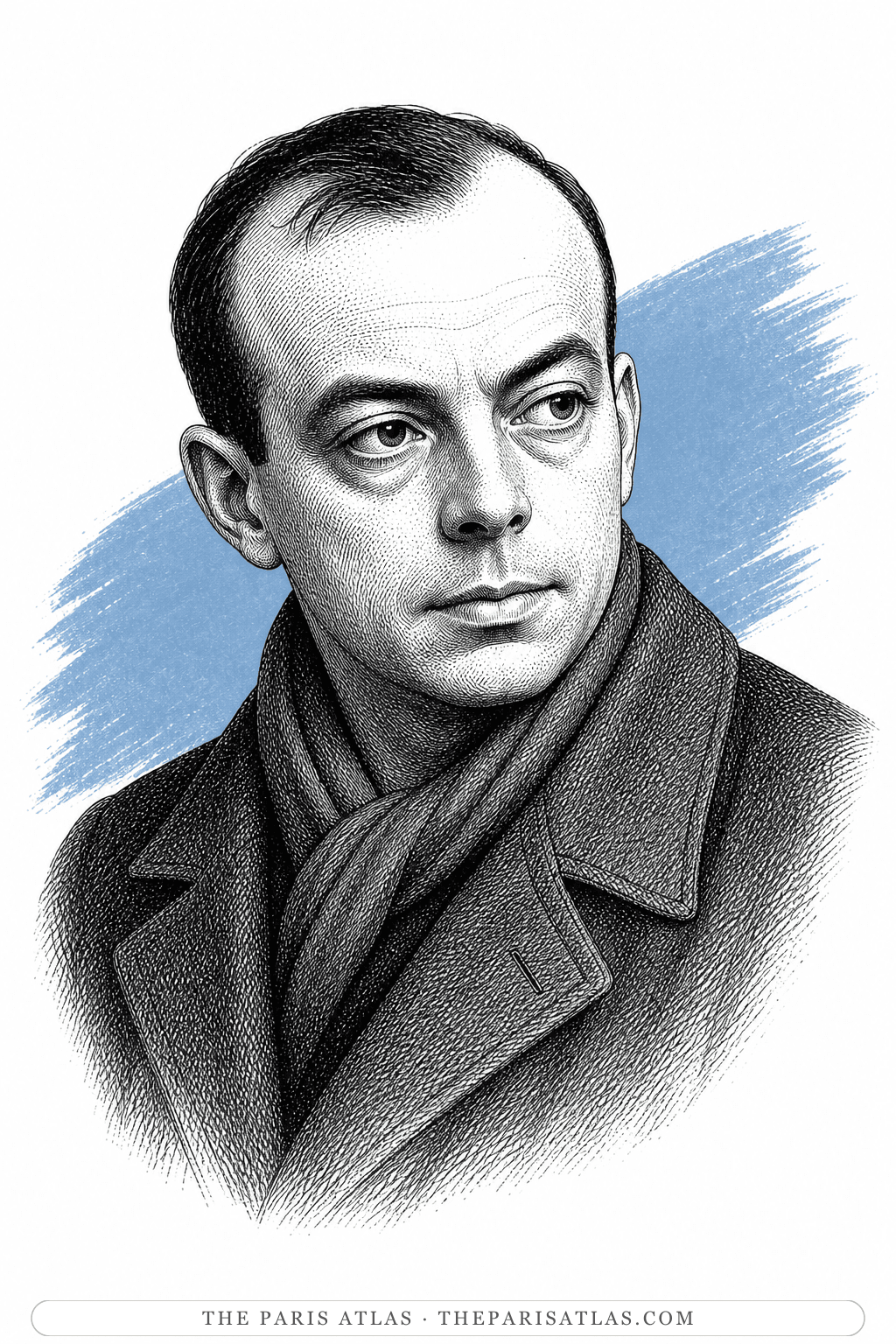
The introduction came through the Paris salons: Gide was a fixture of Yvonne de Lestrange's, and she warmly recommended her cousin Antoine, then trying to write, to him. Saint-Exupéry sent Gide the manuscript of Courrier Sud, and on his return from Argentina gave him Vol de nuit, for which Gide offered to write the preface — the preface Larousse quotes on the novel that took the Prix Femina in 1931. The friendship was close enough to alarm Saint-Exupéry's mother, who thought Gide unfit company, and Antoine defended him to her by letter more than once. Gide told him to reorder the chapters of Terre des hommes and handed him Conrad's The Mirror of the Sea to show that a good book could be made of disparate pieces. They were together at Chitré in August 1938 and again in Algiers in 1943, where they played chess; days before Saint-Exupéry disappeared in July 1944 he offered Gide a flight, and Gide pleaded a cough.

— André Gide (1869 – 1951) — Les amis; Antoine de Saint-Exupéry

Illustrated portrait of Roger Vadim

Roger Vadim

  • Filmmaker
  • Author
  • Actor

Met

Vadim knew André Gide, who introduced him to filmmaker Marc Allégret after the war.

— Roger Vadim — biographical note and Les Liaisons dangereuses; Roger Vadim

Illustrated portrait of Aleister Crowley

Aleister Crowley

  • Author
  • Poet
  • Religious leader

Met · 1924–1929

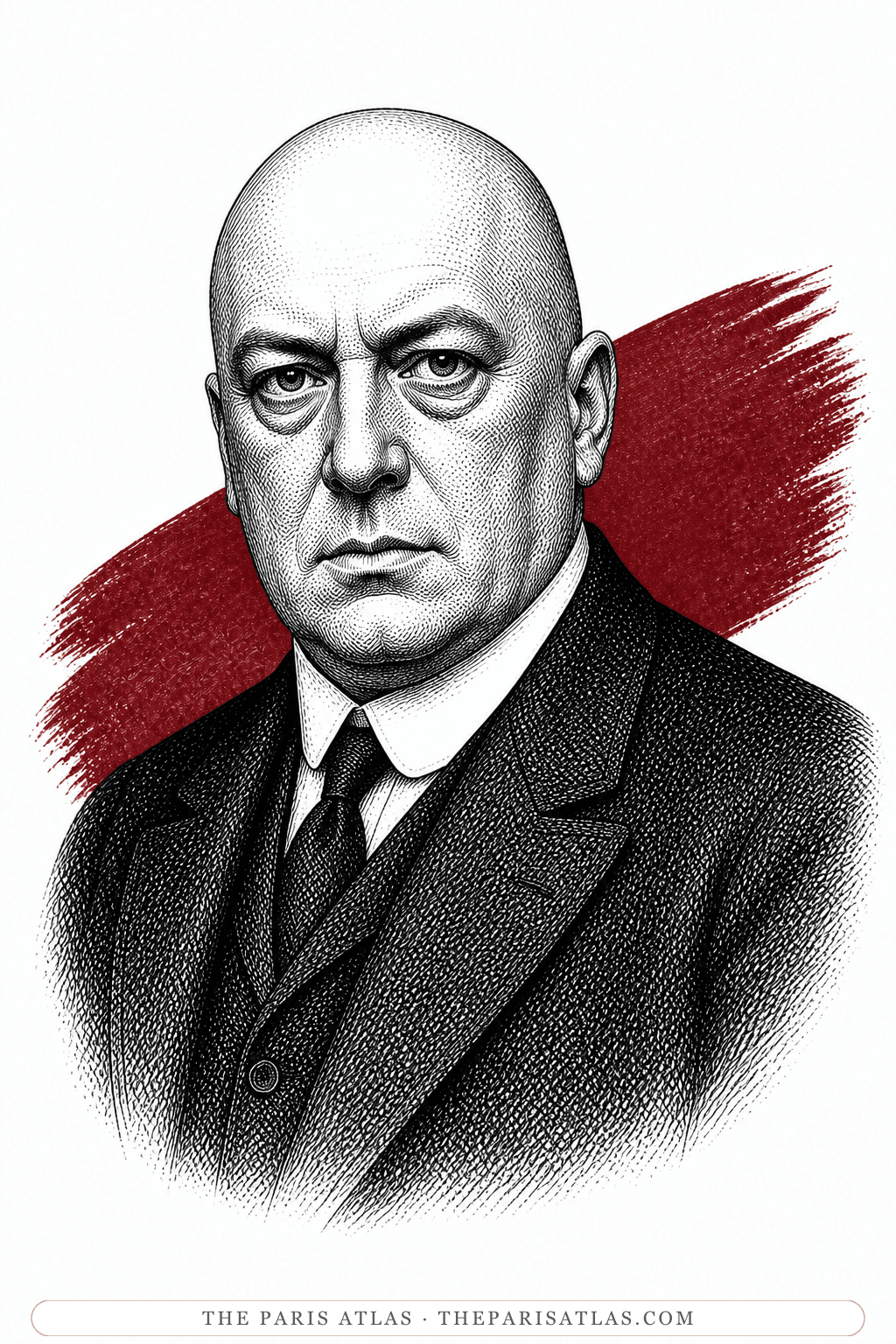
Gide was part of the literary Paris through which Crowley moved in the 1920s; Churton includes him among Crowley's documented interwar connections.

— Aleister Crowley in Paris: Sex, Art, and Magick in the City of Light

Who André Gide Inspired

People who found inspiration in André Gide’s work.

Illustrated portrait of Albert Camus

Albert Camus

Camus discovered Gide as an adolescent in Algiers and named him repeatedly as the French moralist whose responsibility-of-the-writer position mattered most to his own. Camus's 1957 Nobel lecture in Stockholm — delivered when he was forty-three, the second-youngest winner of the literature prize — deliberately echoed the position Gide had taken in his own 1947 Nobel address ten years earlier. Camus met Gide once in Paris shortly before Gide's death in 1951.

— Albert Camus – Biographical (1957); Ronald Aronson, Albert Camus

Books by André Gide

Cover of The Immoralist by André Gide

Modernist fiction

A young scholar survives tuberculosis, begins chasing health and desire at any cost, and learns that escaping every duty does not give his life a purpose.

4.3

Questions about André Gide

What is André Gide best known for?

André Gide is best known for winning the Nobel Prize in Literature in 1947 and for the short novels The Immoralist and Strait Is the Gate. He also wrote The Counterfeiters, one of the landmark modern French novels, and co-founded the Nouvelle Revue Française, the review at the center of French literature for half a century.

Why was André Gide controversial?

Gide published a defense of homosexuality, Corydon, under his own name in 1924, and an autobiography, Si le grain ne meurt, that described his own sexual awakening. His 1927 Congo reporting attacked French colonial companies, and his 1936 book on the Soviet Union broke publicly with communism. In 1952, a year after his death, the Catholic Church placed his entire works on its Index of Forbidden Books.

Was André Gide married?

Yes. In October 1895 Gide married his first cousin Madeleine Rondeaux, and they remained married until her death in 1938. The marriage was never consummated. His only child, Catherine, was born in 1923 to Elisabeth van Rysselberghe.

What should I read first by André Gide?

Start with The Immoralist. It is short, it is the clearest example of his method — a narrator who convicts himself in his own telling — and most of what Gide wrote afterward argues with it. Strait Is the Gate is its companion piece, and The Counterfeiters is the larger novel to read once you know his voice.

Where did André Gide live in Paris?

He was born at 19 rue de Médicis, opposite the Luxembourg Gardens, and grew up at 2 rue de Tournon. From 1906 he lived at 18 bis avenue des Sycomores in the Villa Montmorency in Auteuil, and from August 1928 at 1 bis rue Vaneau in the seventh arrondissement, where he died.

How did André Gide die?

Gide died of pulmonary congestion on 19 February 1951, at his apartment at 1 bis rue Vaneau in Paris. He was eighty-one. He is buried beside his wife Madeleine in the churchyard at Cuverville in Normandy.

Connections and Sources

André Gide’s connections to people, places, and works, with the sources behind each one.

Influenced

Albert Camus

Camus discovered Gide as an adolescent in Algiers and named him repeatedly as the French moralist whose responsibility-of-the-writer position mattered most to his own. Camus's 1957 Nobel lecture in Stockholm — delivered when he was forty-three, the second-youngest winner of the literature prize — deliberately echoed the position Gide had taken in his own 1947 Nobel address ten years earlier. Camus met Gide once in Paris shortly before Gide's death in 1951.

— Albert Camus – Biographical (1957); Ronald Aronson, Albert Camus

Met · 1929–1944

Antoine de Saint-Exupéry

The introduction came through the Paris salons: Gide was a fixture of Yvonne de Lestrange's, and she warmly recommended her cousin Antoine, then trying to write, to him. Saint-Exupéry sent Gide the manuscript of Courrier Sud, and on his return from Argentina gave him Vol de nuit, for which Gide offered to write the preface — the preface Larousse quotes on the novel that took the Prix Femina in 1931. The friendship was close enough to alarm Saint-Exupéry's mother, who thought Gide unfit company, and Antoine defended him to her by letter more than once. Gide told him to reorder the chapters of Terre des hommes and handed him Conrad's The Mirror of the Sea to show that a good book could be made of disparate pieces. They were together at Chitré in August 1938 and again in Algiers in 1943, where they played chess; days before Saint-Exupéry disappeared in July 1944 he offered Gide a flight, and Gide pleaded a cough.

— André Gide (1869 – 1951) — Les amis; Antoine de Saint-Exupéry

Met

Roger Vadim

Vadim knew André Gide, who introduced him to filmmaker Marc Allégret after the war.

— Roger Vadim — biographical note and Les Liaisons dangereuses; Roger Vadim

Met · 1924–1929

Aleister Crowley

Gide was part of the literary Paris through which Crowley moved in the 1920s; Churton includes him among Crowley's documented interwar connections.

— Aleister Crowley in Paris: Sex, Art, and Magick in the City of Light

References

References

The sources below include biographies, scholarly essays, interviews, and primary materials that informed this page. They reflect both the historical record and ongoing critical conversations about André Gide and their work.

  1. 1↑André Gide, Facts

    Website
    The Nobel Prize in Literature 1947
    Used for

    The Academy's page for the 1947 prize, with the citation quoted on the page.

    View source
  2. 2abAndré Gide

    Website
    New World Encyclopedia
    Used for

    General reference used for the 1891 debut, the 1895 marriage, the USSR journey, and the Nobel year.

    View source
  3. 3↑La lettre d'excuses de Gide à Proust

    Website
    Livres Hebdo
    Used for

    On the January 1914 apology letter to Proust, with the wording calling the rejection the gravest error of the NRF.

    View source
  4. 4↑Le Paris d'André Gide

    Website
    Fondation Catherine Gide
    Used for

    The foundation's walk through his Paris addresses, from the rue de Médicis birthplace to the Villa Montmorency house and the final apartment at 1 bis rue Vaneau.

    View source
  5. 5↑André Gide (1869–1951)

    Website
    Musée protestant
    Used for

    The Protestant museum's notice: the family background, the École Alsacienne years, the 1908 founding of the review, and the sequence of the major books.

    View source
  6. 6↑Biskra, Algérie

    Website
    Fondation Catherine Gide
    Used for

    The foundation's dossier on Gide at Biskra, with the dated letters from his stays of 1893-94 and February-March 1895.

    View source
  7. 7↑Gide, André (22 November 1869 – 19 February 1951)

    Website
    Encyclopedia.com
    Used for

    Reference entry used for the La Roque-Baignard mayoralty, the Allégret years, the wartime move to Tunis, and the 1952 Index listing.

    View source
  8. 8↑Histoire de la Nouvelle Revue Française

    Website
    Histoire de la Nouvelle Revue Française
    Used for

    The review's own history: the November 1908 false start, the 1 February 1909 relaunch, the founding group, and Schlumberger's financing.

    View source
  9. 9↑Si le grain ne meurt

    Website
    andre-gide.fr
    Used for

    Edition history of the memoir: partial private printings from 1920–21, the complete text in 1924, the trade edition on sale in 1926.

    View source
  10. 10↑Thésée

    Website
    andre-gide.fr
    Used for

    Reference page on Thésée (1946), Gide's last major work of fiction.

    View source
  1. 11Vie d'André Gide — chronologie

    Website
    Fondation Catherine Gide
    Used for

    The foundation's year-by-year chronology of Gide's life, the most detailed of the sources used here and the authority for the dates in the timeline.

    View source
  2. 12La Nouvelle Revue Française (1909-1943) — collection

    Website
    Éditions Gallimard
    Used for

    The publisher's catalogue of the NRF series, used for the review's publishing arm and its imprint history.

    View source
  3. 13The Nobel Prize in Literature 1947

    Website
    The Nobel Foundation
    Used for

    The prize summary page, used for the award year and the ceremony date.

    View source
  4. 14Project Gutenberg

    Website
    André Gide, Oscar Wilde: A Study
    Used for

    Gide's own memoir of Wilde, the primary source for the 1891 Paris meetings and the January 1895 slate episode at Blida, told in his words.

    View source
  5. 15Médiathèque du patrimoine et de la photographie

    Website
    Marc Allégret au Congo (1925–1926)
    Used for

    The French heritage library's record of the expedition: sailed from Bordeaux 18 July 1925, returned 31 May 1926, with Allégret's film.

    View source
  6. 16Gide Publishes the Signed Edition of Corydon

    Website
    EBSCO Research Starters
    Used for

    The publication history of Corydon: the private printings of twelve and twenty-one copies before the signed 1924 trade edition.

    View source
  7. 17Albert Camus – Biographical

    Biography
    Nobel Prize Outreach, 1957
    Used for

    Biographical evidence used to verify chronology, relationships, and historical context connected to André Gide.

    View source
  8. 18Albert Camus

    Essays
    Stanford Encyclopedia of Philosophy
    Used for

    Published analysis and historical context used in preparing the André Gide page.

    View source
  9. 19André Gide (1869 – 1951) — Les amis

    Website
    La Succession Saint Exupéry – d’Agay
    Used for

    Web source consulted for documented facts and historical context presented on the André Gide page.

    View source
  10. 20Antoine de Saint-Exupéry

    Website
    Encyclopédie Larousse
    Used for

    Web source consulted for documented facts and historical context presented on the André Gide page.

    View source
i
Why these sources are here

These references anchor the page in the documented record and in the scholarly conversations around André Gide. Every claim on this page traces back to one or more of the works listed here.

Explore more resources
Browse all authors