

Giovanni's Room
Both novels follow narrators who want desire and respectability at the same time, then hurt the person closest to them rather than choose honestly.
Read our take
by André Gide
A young scholar survives tuberculosis, begins chasing health and desire at any cost, and learns that escaping every duty does not give his life a purpose.
Michel is a wealthy young French scholar who has spent most of his life studying ancient cultures. He marries Marceline because he believes it is the right thing to do, not because he is deeply in love with her. During their honeymoon in North Africa, he nearly dies of tuberculosis. As he recovers, physical health, beauty, appetite, and desire begin to matter more to him than scholarship, marriage, or the rules he once followed. André Gide tells the story through Michel’s confession to three old friends. Michel wants them—and the reader—to understand why he changed. The harder question is whether his new freedom can excuse what he does to the wife who saved his life.
The novel begins after the main events have already happened. Michel calls three longtime friends to his home in North Africa and tells them the story of his marriage, illness, recovery, and growing rejection of ordinary duties. His friends listen after they have seen the damage his choices caused. The suspense comes not only from learning what Michel did, but from deciding whether his careful explanation makes those actions understandable or merely helps him excuse them.[1]
The change begins in Biskra, a city in Algeria, where Michel nearly dies of tuberculosis. While recovering, he becomes fascinated by food, sunlight, strength, and the healthy boys he sees around him. These things represent the physical life he believes books and social rules have denied him. When he returns to France, his work, his inherited estate, and his marriage feel like burdens. He must decide whether freedom means living more honestly or simply refusing to care for anyone who needs him.[1]
Michel tells the story calmly and notices details that another narrator might hide. That makes him convincing, but not necessarily truthful about his own motives. He can describe theft, attraction, and selfishness without admitting how much harm he causes. Readers must decide whether he truly understands himself or has simply become skilled at defending what he wants.[1]
Michel, a young French scholar mourning his father, marries Marceline, a gentle woman he respects but does not passionately love. On their honeymoon in North Africa he develops tuberculosis and nearly dies in Biskra. Marceline nurses him with patience and devotion. During his slow recovery, Michel becomes intensely aware of physical life and watches the healthy local boys with a mixture of envy, fascination, and desire.[1]
One boy, Bachir, visits while Michel is ill. Another, Moktir, steals Marceline’s scissors as Michel watches and says nothing. Instead of condemning the theft, Michel is thrilled by Moktir’s disregard for rules. Once he and Marceline return to France, he tries to resume his scholarly life but no longer trusts the values that once organized it.[1]
At La Morinière, his estate in Normandy, Michel takes an interest in the farm workers and in Charles, the teenage son of the estate manager Bocage. He learns how the property works, yet he is drawn less to responsibility than to people who seem unconstrained by it. When the young poacher Alcide steals from the estate, Michel eventually joins him, appalling Charles, who has taken the property’s duties seriously.[1]
In Paris, Michel reconnects with Ménalque, a worldly acquaintance who distrusts possessions, permanence, and conventional morality. Ménalque has investigated Michel’s time in Biskra and obtained the scissors Moktir stole. His philosophy of living entirely in the present gives Michel an example of the freedom he has been trying to name.[1]
Marceline becomes pregnant, miscarries, and grows seriously ill. Michel becomes increasingly restless as she weakens. Hoping travel will restore her health, they pass through Switzerland and Italy before returning to North Africa. Their honeymoon is now reversed: Michel is strong and eager to keep moving, while Marceline is exhausted and dying. In Touggourt, Moktir takes Michel to a café and introduces him to his mistress. Michel has sex with the woman while Marceline lies gravely ill and alone at their hotel.[1]
Marceline dies in North Africa after months of worsening illness. Michel is now free of the marriage he had come to regard as a burden, but her death does not give him the satisfying new life he expected. He has escaped his responsibilities without finding a reason to live.
The novel returns to the three friends listening to Michel’s story. Michel asks them to take him away and help him find useful work and a direction for his life. He has rejected his former beliefs, but has built nothing to replace them.
Michel also describes the life he has led during the three months since Marceline’s death. A local boy named Ali brings him food twice a day in exchange for a little money and affection. Ali’s sister, whom Michel says sells sex during the winter in Constantine, sometimes spent the night with Michel. When Ali found them together, he became angry and stayed away for five days. Michel wonders whether the boy was jealous, but does not know. He says he stopped seeing the sister partly out of distaste and partly because he was afraid of losing Ali. She jokes that Michel prefers her brother to her, and Michel admits she may be right. The final disclosure suggests that his attraction to boys continues and that Ali may be one reason he remains in North Africa.
The book ends with Michel free, lonely, and uncertain about what to do next. Even after everything that has happened, he is still following the desires that helped dismantle his former life.
Michel’s recovery really does awaken him to a life he had ignored. Before becoming ill, he followed duty without asking whether it made him happy. The problem is that he begins to treat every responsibility as a threat to his freedom. Marceline’s devotion saves his life, but when she becomes ill, he gives himself fewer and fewer reasons to care for her in return. The novel asks a simple question: what is personal freedom worth when someone else must pay for it?
Tuberculosis divides Michel’s life into a clear before and after. Before becoming ill, he thinks of himself mainly as a scholar: disciplined, well educated, and obedient to the values taught by his father. During his recovery, breathing, eating, sunlight, strength, and healthy bodies begin to matter more to him than books or inherited rules.
Michel and Marceline gradually exchange roles. At first she is healthy and keeps him alive through patient care. Later, Michel is strong while Marceline is seriously ill. Instead of caring for her as she cared for him, he becomes impatient and keeps moving her from place to place. He begins to see health as proof of worth, which makes it easier for him to abandon someone who is weak.
Michel recovers in Biskra, in what was then French-ruled Algeria. He treats Biskra and Touggourt as places where he can escape the rules of life in France. He is fascinated by the health, beauty, and apparent freedom of the boys he meets. Because Michel tells the story, however, readers learn much more about what he wants from these boys than about their own thoughts or lives.
The novel was published in 1902, when Gide could not describe Michel’s attraction to males openly. The attraction is therefore presented through suggestion and indirect language. Even so, the story clearly involves an adult European man desiring adolescent North African boys. The differences in age, wealth, and social power are part of the story and affect how Michel’s behavior should be understood.
Michel tells his story after he has gained the freedom he wanted and discovered that he does not know what to do with it. He may be asking his friends to judge him, rescue him, or agree that his choices were unavoidable. His calm, detailed account can sound honest, but it may also be an attempt to make selfish actions seem reasonable. Gide leaves readers to decide how much of Michel’s explanation they believe.
Gide writes The Immoralist in a clean, controlled style that makes Michel’s behavior more unsettling rather than less. Michel tells his story calmly, even when he is describing desire, theft, betrayal, or his wife’s suffering. He rarely sounds hysterical or openly cruel. Instead, he explains himself so carefully that the reader has to decide where self-understanding ends and self-justification begins.
The confession is also what makes Michel such an interesting narrator. He is intelligent enough to notice almost everything about his own behavior, but that does not mean he understands himself honestly. Gide leaves a gap between what Michel says about his choices and what the reader can see those choices doing to other people.
Ruth and Augustus Goetz adapted the novel for Broadway in 1954. The production opened at the Royale Theatre on February 8, with Louis Jourdan as Michel, Geraldine Page as Marceline, and James Dean as Bachir. Dean announced on opening night that he would leave the production on February 20 to work on East of Eden; Phillip Pine succeeded him on February 22. The play ran for 96 performances, through May 1. It changes major parts of the novel and makes some of its sexual material more explicit for the stage, so it is best treated as a 1950s version of the story rather than a direct copy of the book.
Michel rejects the rules that shaped his early life, but the novel shows that rejecting rules is easier than creating a responsible and meaningful life.
Michel describes his choices calmly and in great detail. Readers must decide whether that precision proves his honesty or merely makes his excuses more convincing.
In a compact story, the novel examines illness, desire, marriage, selfishness, and the difference between feeling free and living well.

The scholar and narrator whose recovery from tuberculosis awakens an appetite for physical life and a suspicion of every obligation.

Michel’s devoted wife, who nurses him back to health and later grows weaker as his pursuit of freedom intensifies.

A worldly acquaintance who distrusts possessions, habit, and moral rules and gives Michel’s restlessness a philosophy.

The boy whose theft of Marceline’s scissors fascinates Michel as an image of life outside moral restraint.

A boy who visits Michel during his illness in Biskra; his health and easy movement help Michel rediscover physical life.

The teenage son of Michel’s estate manager, serious about La Morinière and disgusted when Michel begins undermining its order.

The long-serving manager who keeps Michel’s estate running while Michel loses interest in its responsibilities.

A talkative farmhand who introduces Michel to the estate’s secrets, helps him enter the poaching scheme, and exposes it after being dismissed.

A secretive timber merchant and his five children, connected to the neglected woods, an illegal trade in game, and a series of unverified accusations.

A young poacher whose disregard for property and rules attracts Michel enough to make him an accomplice on his own land.

A local boy who brings Michel his meals at Sidi B. M. and becomes the focus of the troubling final passage in Michel’s confession.

Denis, Daniel, and an unnamed narrator—the school friends who come to hear Michel explain how his search for freedom ended in loss and confusion.
1902
Mercure de France publishes L’Immoraliste in France.
1930
Dorothy Bussy’s English translation appears and becomes the best-known early English version.
1954
Ruth and Augustus Goetz’s stage adaptation opens on Broadway with Louis Jourdan and Geraldine Page.
1970
Richard Howard publishes a new English translation.
2001
Penguin Classics publishes David Watson’s English translation with an introduction by Alan Sheridan.


Both novels follow narrators who want desire and respectability at the same time, then hurt the person closest to them rather than choose honestly.
Read our take
Both books examine men who reject ordinary morality. Genet’s narrator goes much further by building his identity around crime, betrayal, and life outside respectable society.
Read our take
Both novels contrast physical desire with social duty. Lawrence presents tenderness and mutual pleasure as a possible answer, while Gide leaves the problem of responsibility unresolved.
Read our take
Both books use calm, emotionally distant narrators whose actions force readers to decide what responsibility and guilt mean.
Read our takeThe Immoralist follows a young scholar whose recovery from tuberculosis awakens desires that place his marriage, work, and inherited morality under pressure.
Not directly. Gide drew on conflicts from his own life involving sexuality, religion, marriage, and travel in North Africa. Michel, however, is an invented character, and the novel is not a retelling of Gide’s life.
The book never gives Michel a modern identity label. It clearly suggests that he is attracted to boys and young men, but presents that attraction indirectly.
Michel marries largely from duty and affection rather than strong sexual desire, an imbalance that becomes central after his illness changes what he wants from life.
The title refers to Michel’s decision to stop accepting society’s moral rules as automatically right. He rejects his old beliefs but never creates a clear set of principles to replace them.
No. Michel reaches a form of freedom but ends isolated and asking his friends for help because freedom alone has not given his life direction.
Explore authors with a similar voice, perspective, and influence.

The Brooklyn dropout who arrived in Paris broke at thirty-eight and wrote the exuberant, banned books that ended American censorship.
View author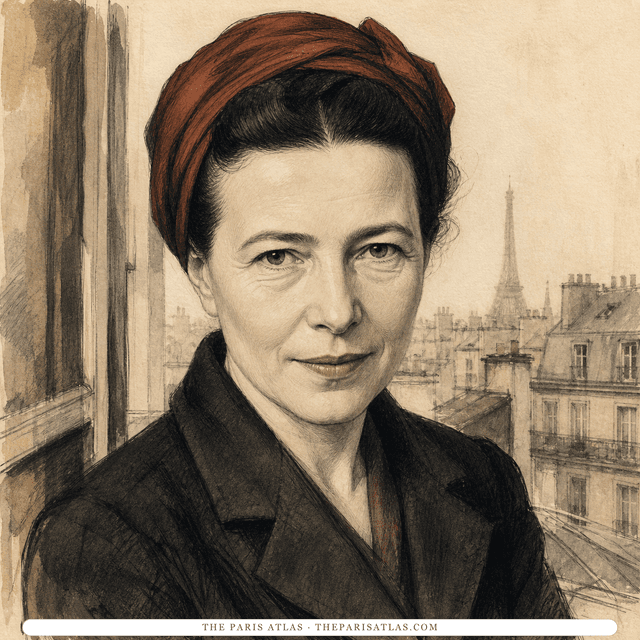
French writer and philosopher whose novels, memoirs, and social analysis examined freedom, gender, responsibility, aging, and the material conditions that shape a life.
View author
French Algerian novelist, essayist, journalist and playwright who used the absurd and revolt to ask how people should live without false consolation.
View authorThe sources below include the primary text, editions, scholarship, archival materials, and other records that informed this page. They document The Immoralist, its publication, and its place in literary history.


Publisher record used for the David Watson translation, Alan Sheridan introduction, 2001 publication date, ISBN, format, and page count.
Internet Broadway Database record used to verify the 1954 production dates, credits, cast, and performance history.
Open Library ISBN catalogue used to verify the title, ISBN, and publication metadata.
Google Books catalogue record used to cross-check the title and edition metadata.
Internet Archive ISBN catalogue used to cross-check the edition and its availability in library holdings.
Library of Congress books catalogue used to cross-check the bibliographic record by ISBN.
The primary text is the baseline reference for every book page. Additional references document publication history, interpretation, and historical context where that evidence is available.
 Explore more resources