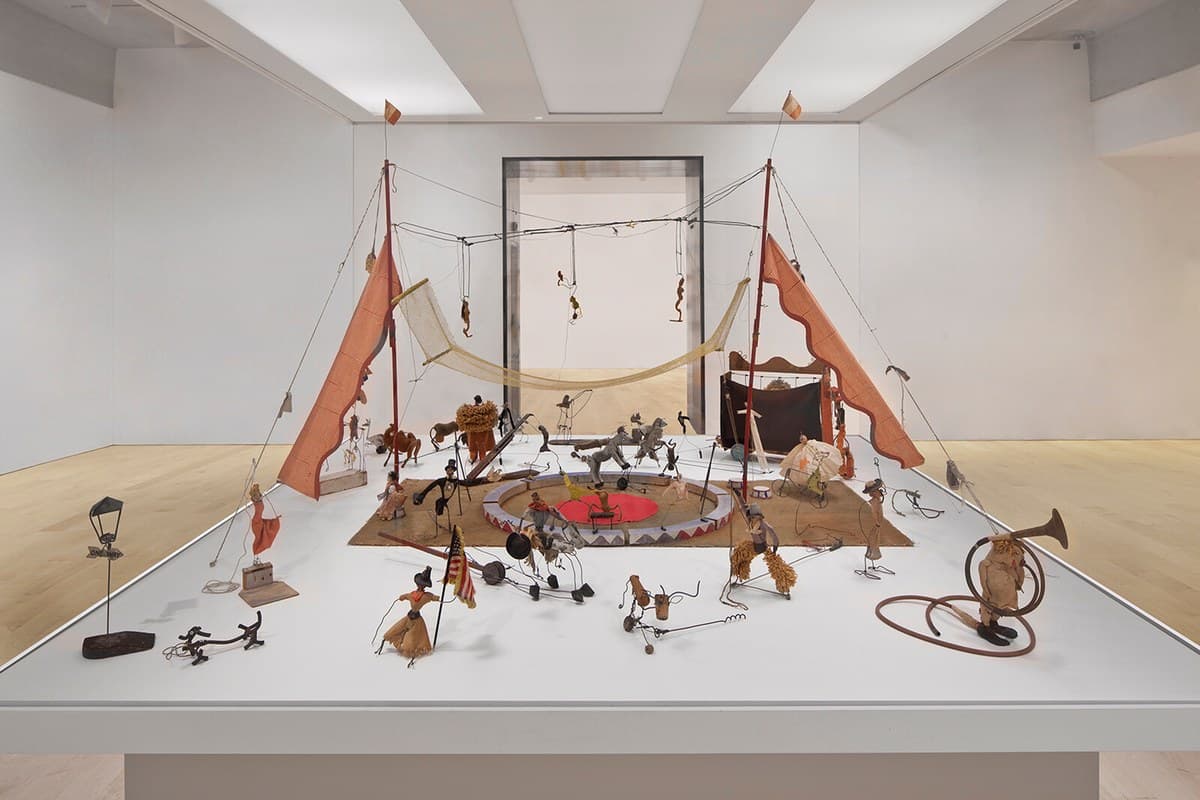
Cirque Calder
The miniature circus Calder built in Paris from 1926 and performed by hand — acrobats, lions and a sword swallower of wire and cork. Acquired by the Whitney Museum through a public campaign in 1983.
- 1926–1931
- Wire, cloth, cork, wood, and found materials
About Alexander Calder
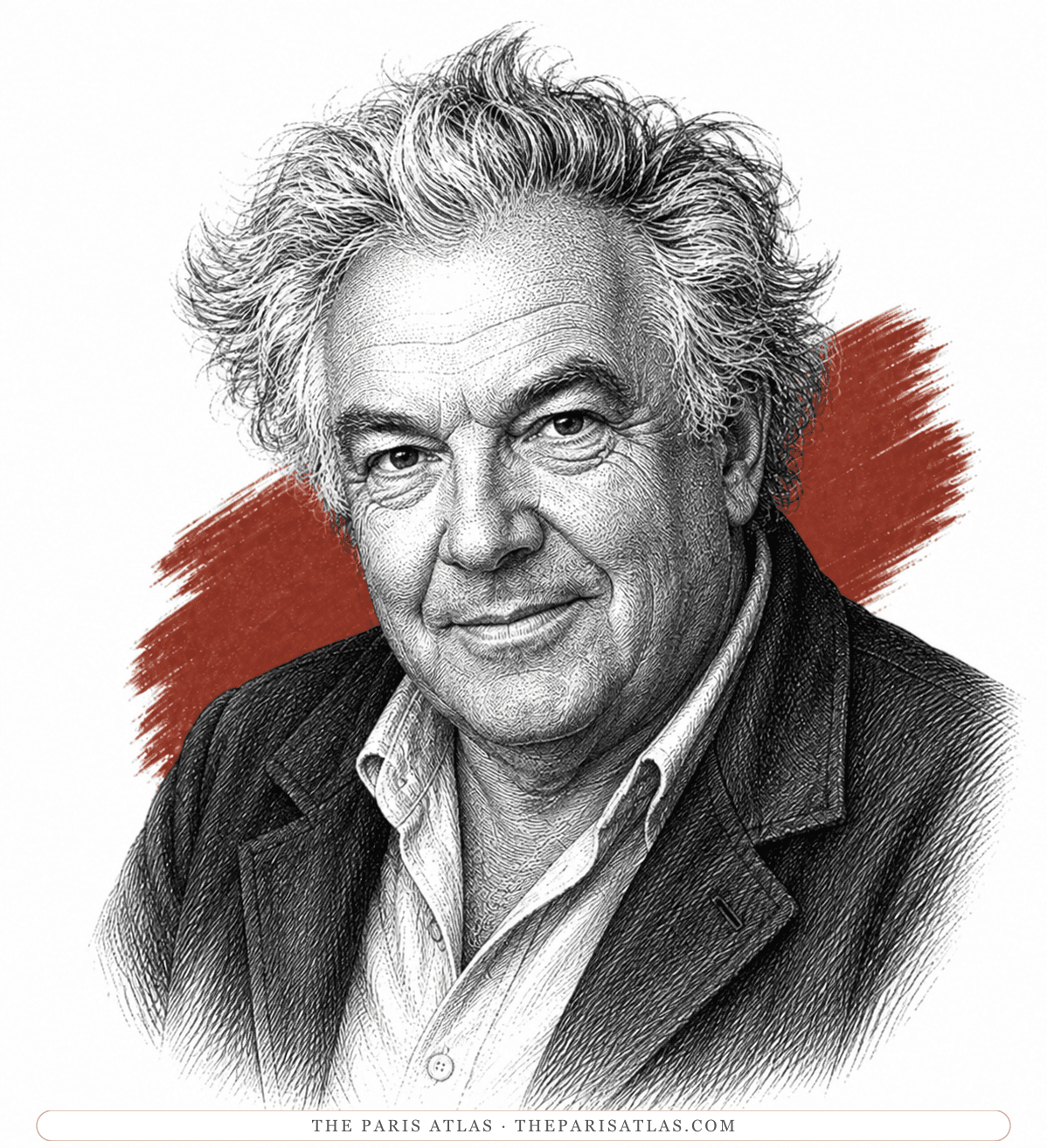
A circus in suitcases
Calder began the circus in Paris in 1926: acrobats, a lion and lion cage, a sword swallower, trapeze artists and a bearded lady, built from wire, cloth, cork, wood and whatever the flea market offered. The whole troupe packed into suitcases.
Performances were the point. Calder knelt on the floor and ran each act by hand — tumbling the acrobats, springing the trapeze — with sound effects and suspense. Joan Miró, Fernand Léger, Marcel Duchamp and Le Corbusier came to watch, and the circus made the unknown American a fixture of the Paris avant-garde.
How it reached the Whitney
The circus grew to dozens of figures over five years, and Calder performed it for decades. In 1983 the Whitney Museum of American Art acquired the ensemble after a major public fundraising campaign. It has been among the museum's most loved holdings since — the seed from which the wire portraits, and then the mobiles, grew.
Close reading
Reading the work, detail by detail
This installation photograph shows Calder's circus at rest. Follow the tiny performers, visible mechanisms, and improvised materials that make the ensemble suggest a performance.
1.The circus ring
The ring organizes a collection that otherwise spreads in many directions. Its colored center gives the eye a place to return between the separate acts.
2.Acrobats overhead
The large gaps around the figures make their tiny bodies seem exposed. Threads, supports, and net remain plainly visible, allowing the mechanics to share the spectacle.
3.The side curtains
The curtain establishes a theatrical boundary with very little material. Its soft irregular edge contrasts with the taut supporting wires around it.
4.Animals around the ring
Wire legs and roughly formed bodies make the animals readable through a few selected features. Their different sizes keep the ensemble lively even in this stationary arrangement.
5.The foreground performers
The foreground exposes the circus as a collection of separate constructions. Each figure occupies its own little patch of space, inviting close inspection of how it was made.
6.A coiled instrument
The instrument's looping tube turns an everyday shape into a conspicuous line in space. Its oversized bell gives this small act a visual prominence at the edge of the installation.
Where to see it
A viewing location has not yet been listed for this work.
Frequently asked questions
What is the Cirque Calder?
A miniature circus — acrobats, animals, ringmaster and props of wire, cloth, cork and found materials — that Alexander Calder built in Paris from 1926 to 1931 and performed by hand, act by act, for audiences.
Who came to see Calder's circus in Paris?
The avant-garde: Joan Miró, Fernand Léger, Marcel Duchamp and Le Corbusier were among the audiences. The performances made Calder's name in Paris before the mobiles existed.
How was the circus performed?
By Calder himself, kneeling on the floor: he moved each wire figure through its act, cued sounds, and ran the show like a ringmaster. Film of his late performances survives.
Where is the Cirque Calder now?
At the Whitney Museum of American Art in New York, which acquired it in 1983 through a public fundraising campaign.
Why does the circus matter in Calder's career?
It is the root of everything: the wire figures led to the wire portraits, the performances built his Paris reputation, and the instinct for motion it trained became the mobile.
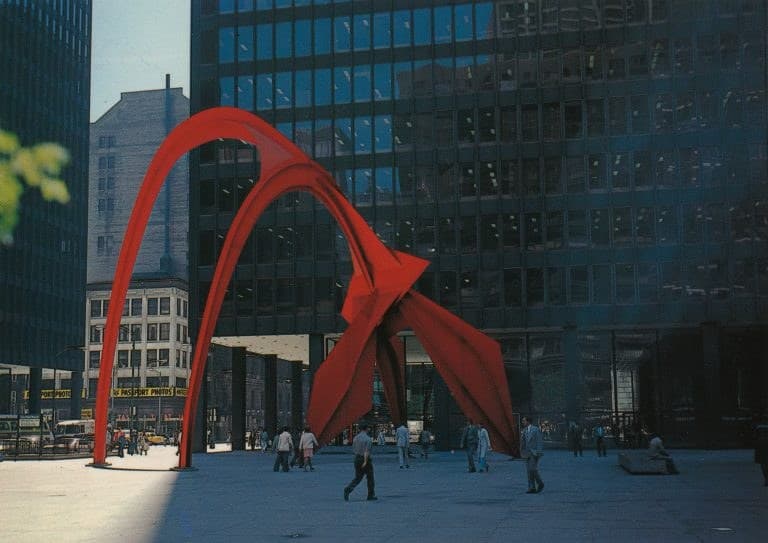
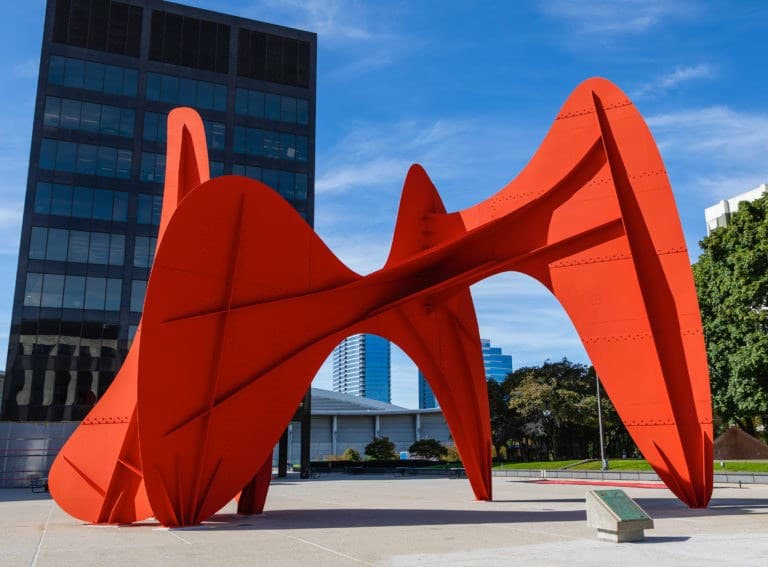
More by Alexander Calder
If you like Alexander Calder
Explore sculptors from the same movements and circles.
Arman
French-American artist, lifelong friend of Yves Klein, and a founder of New Realism.
View artist
Jean Arp
Strasbourg-born sculptor and poet — Hans in German, Jean in French, both all his life — who co-founded Dada at the Cabaret Voltaire in 1916, composed collages by dropping torn paper 'according to the laws of chance', and settled at Meudon outside Paris in a house his wife Sophie Taeuber-Arp designed.
View artist
Frédéric Auguste Bartholdi
Frédéric Auguste Bartholdi was a French sculptor best known for designing the Statue of Liberty, dedicated in New York Harbor in 1886. Born in Colmar and based in Paris, he created public monuments that gave visible form to ideas of freedom, resistance and national memory. His other major works include the Lion of Belfort and the fountain in Lyon's Place des Terreaux.
View artist
References
The sources below include collection records, catalogues, scholarly research, and primary materials that informed this page. They document Cirque Calder, its making, and its place in cultural history.


1Calder's Circus — collection series
WebsiteWhitney Museum of American ArtUsed forWeb source consulted for documented facts and historical context presented on the Cirque Calder page.
2High Wire: Calder's Circus at 100 — press release
WebsiteWhitney Museum of American ArtUsed forWeb source consulted for documented facts and historical context presented on the Cirque Calder page.
3Cirque Calder
WebsiteWikipediaUsed forWeb source consulted for documented facts and historical context presented on the Cirque Calder page.
4Timeline 1926–1930
WebsiteCalder FoundationUsed forWeb source consulted for documented facts and historical context presented on the Cirque Calder page.
These references provide the documented foundation for this work's history and interpretation. Claim-level citations remain attached to the specific claims they support.
 Explore more resources