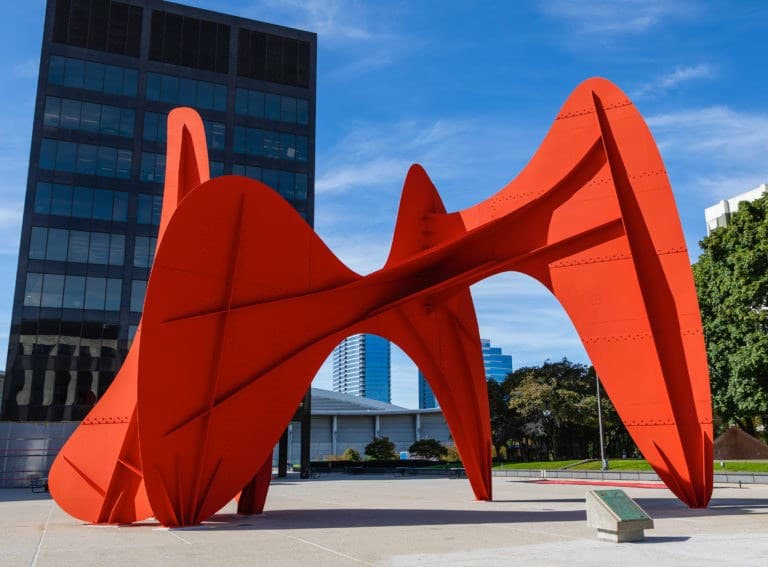
La Grande Vitesse
The 1969 vermilion stabile on Calder Plaza in Grand Rapids — the first NEA-funded public artwork in America, and so beloved the city put its silhouette in the official logo.
- 1969
- Painted steel
About Alexander Calder
The first public art of its kind in America
La Grande Vitesse was the first work funded by the National Endowment for the Arts' new Art in Public Places program, installed on the civic plaza of Grand Rapids, Michigan in 1969. The name is a French pun: the great swiftness — the grand rapids.
Skeptics called it a boondoggle; the city fell in love. The plaza is now Calder Plaza, the stabile's silhouette sits in the city's official logo and on its vehicles, and the commission became the founding precedent for federally supported public art across the United States.
Close reading
Reading the work, detail by detail
Calder builds a sense of movement from fixed steel plates. Look for sweeping edges, openings between supports, and the visible seams that hold the monumental form together.
1.The rising sweep
The edge joins low and high parts in one continuous movement. Following it gives a fixed structure the visual tempo suggested by the work's title.
2.The broad left plane
This large surface supplies weight against the thinner central span. Its convex outline lets the eye travel around the mass rather than stopping at a rectangular boundary.
3.The tall right support
The plate rises like a fin, then returns to a tight point at the pavement. The visible side face makes its depth clear while preserving a sharp silhouette.
4.The open arch
The sculpture incorporates a view of the city within its own outline. This empty interval gives the surrounding red steel a legible scale and direction.
5.Rows of fastenings
The seams reveal how the large surface is assembled. Their small, repeated units temper the sweeping outline with evidence of fabrication.
6.Steel meeting the ground
The separate planes converge into a compact cluster at ground level. Their overlapping shadows make the sculpture feel anchored even as its upper edges seem to accelerate.
Where to see it
A viewing location has not yet been listed for this work.
Frequently asked questions
What is La Grande Vitesse?
A monumental vermilion stabile Alexander Calder made in 1969 for the civic plaza of Grand Rapids, Michigan — the first artwork funded by the National Endowment for the Arts' Art in Public Places program.
What does the name La Grande Vitesse mean?
It is Calder's French pun on the city's name: 'the great swiftness' — the grand rapids of the river the city is named for.
Why is La Grande Vitesse historically important?
It was the first federally funded public artwork under the NEA program, and its success opened the era of major public sculpture commissions in American cities.
How did Grand Rapids respond to the sculpture?
By adopting it outright: the plaza was renamed Calder Plaza, and the stabile's silhouette appears in the city's official logo.
Is La Grande Vitesse a mobile or a stabile?
A stabile — a standing steel sculpture. Its curved plates suggest motion, but only the viewers move.
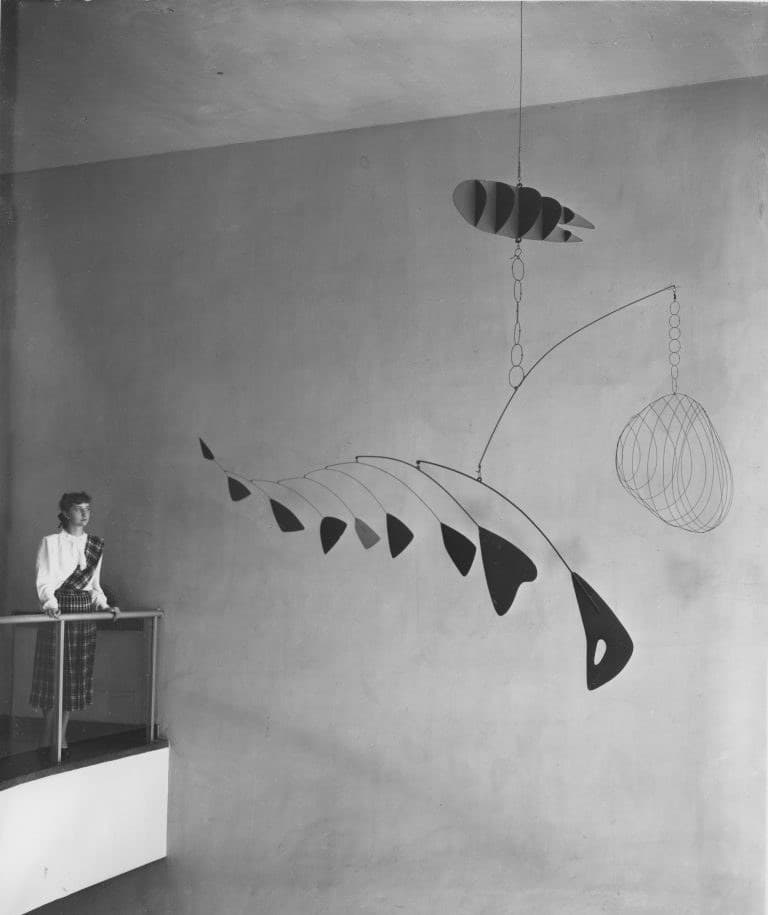
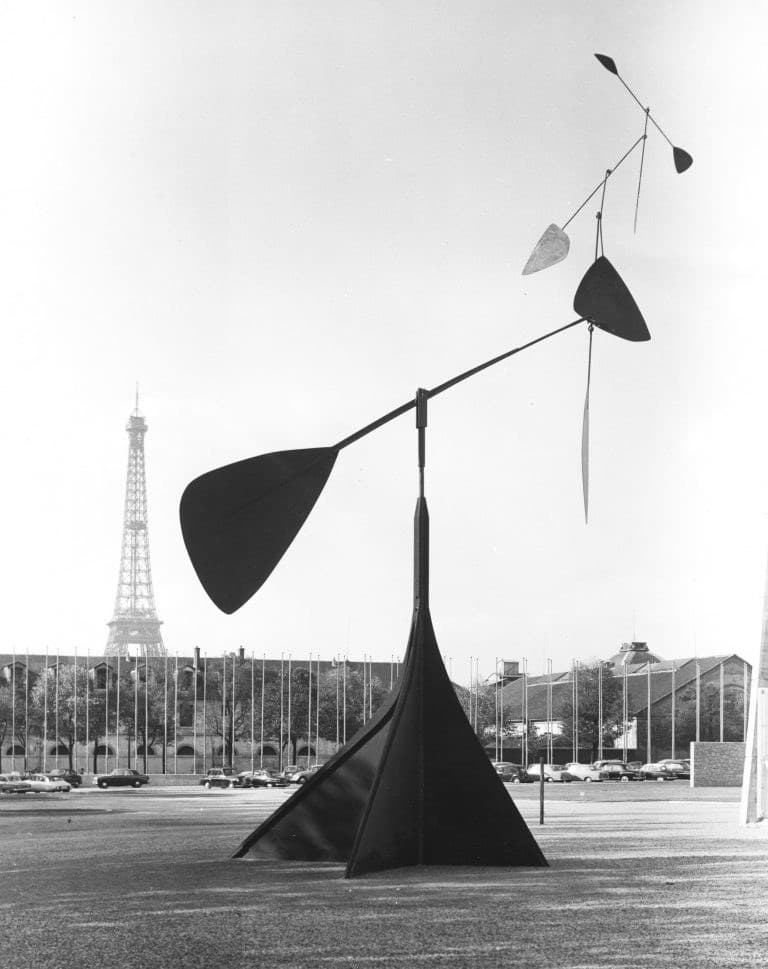
More by Alexander Calder
If you like Alexander Calder
Explore sculptors from the same movements and circles.
Arman
French-American artist, lifelong friend of Yves Klein, and a founder of New Realism.
View artist
Jean Arp
Strasbourg-born sculptor and poet — Hans in German, Jean in French, both all his life — who co-founded Dada at the Cabaret Voltaire in 1916, composed collages by dropping torn paper 'according to the laws of chance', and settled at Meudon outside Paris in a house his wife Sophie Taeuber-Arp designed.
View artist
Frédéric Auguste Bartholdi
Frédéric Auguste Bartholdi was a French sculptor best known for designing the Statue of Liberty, dedicated in New York Harbor in 1886. Born in Colmar and based in Paris, he created public monuments that gave visible form to ideas of freedom, resistance and national memory. His other major works include the Lion of Belfort and the fountain in Lyon's Place des Terreaux.
View artist
References
The sources below include collection records, catalogues, scholarly research, and primary materials that informed this page. They document La Grande Vitesse, its making, and its place in cultural history.


1La Grande Vitesse (1969) — catalogue entry
WebsiteCalder FoundationUsed forWeb source consulted for documented facts and historical context presented on the La Grande Vitesse page.
2La Grande Vitesse
WebsiteWikipediaUsed forWeb source consulted for documented facts and historical context presented on the La Grande Vitesse page.
3Introduction to Alexander Calder
WebsiteCalder FoundationUsed forWeb source consulted for documented facts and historical context presented on the La Grande Vitesse page.
4La Grande vitesse in Grand Rapids, MI
WebsitePublic Art ArchiveUsed forWeb source consulted for documented facts and historical context presented on the La Grande Vitesse page.
These references provide the documented foundation for this work's history and interpretation. Claim-level citations remain attached to the specific claims they support.
 Explore more resources