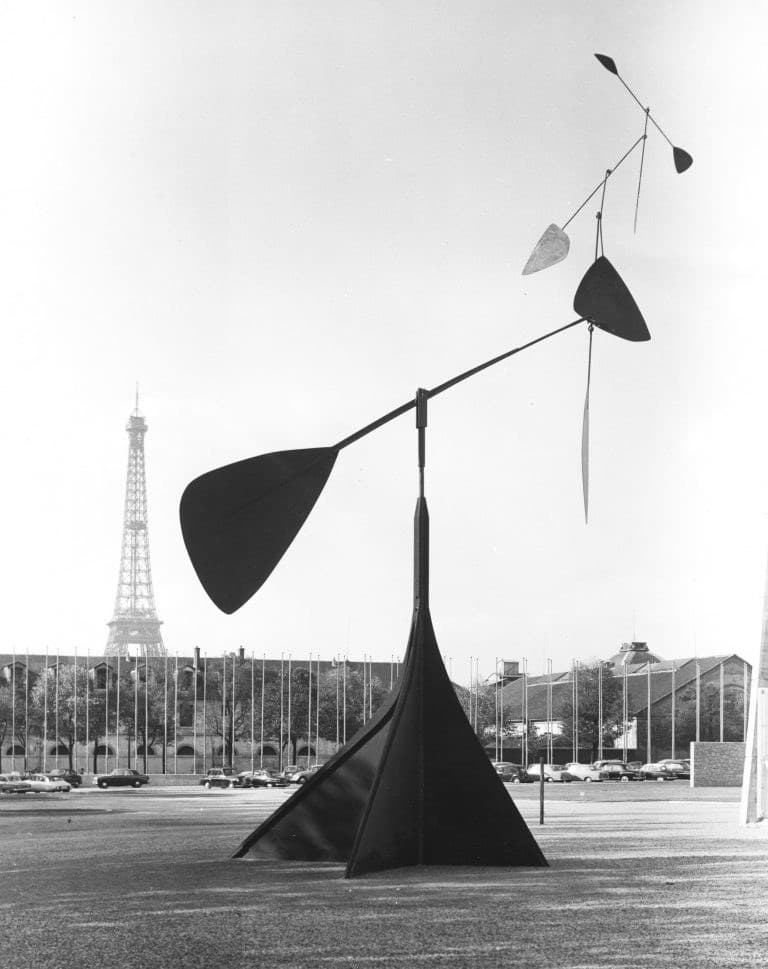
Spirale
Calder's ten-metre standing mobile for the UNESCO headquarters, installed in Paris in 1958 — his permanent work in the city that made him.
- 1958
- Steel, about ten metres tall
About Alexander Calder
Paris keeps a Calder
When UNESCO built its Paris headquarters in the seventh arrondissement, it commissioned art from the leading modernists — Picasso, Miró, Moore — and from Calder, who had become an artist in the city three decades earlier. Spirale, installed in 1958, stands about ten metres tall: a fixed pylon carrying an upper spiral of blades that turn with the wind.
It remains Calder's permanent public work in Paris, a short walk from the École Militaire, with the Eiffel Tower — built by the engineers' Paris he loved — in view across the Champ de Mars.
Close reading
Reading the work, detail by detail
A grounded support carries an ascending chain of balanced elements. The photograph lets us compare its broad base, fine upper rods, and the distant Eiffel Tower.
1.The grounded base
The broad footprint gives the sculpture a firm visual foundation. Above it, the structure quickly narrows, making the upper assembly look especially light.
2.The pivot
The meeting of upright and diagonal is the transition from support to balance. This small junction helps explain how the large forms can extend so far on either side.
3.The low broad shape
Its broad surface gives the left end visual weight. The form also provides a strong counterpoint to the much smaller pieces climbing toward the right.
4.The ascending chain
Successive branches become thinner and more widely separated against the sky. The eye moves upward through their intervals, giving the still photograph a sense of gradual lift.
5.An edge-on blade
Seen nearly edge-on, the hanging piece becomes a fine line. It reminds us that a mobile's visible shapes depend on their angle at the moment of looking.
6.The distant tower
The tower offers another structure that narrows as it rises. Its distant lattice contrasts with Calder's flat, dark planes, while the two silhouettes share the open sky.
Where to see it
A viewing location has not yet been listed for this work.
Frequently asked questions
What is Spirale?
A monumental standing mobile Alexander Calder made for the UNESCO headquarters in Paris, installed in 1958 — a fixed steel pylon carrying a wind-turned spiral of blades, about ten metres tall.
Where exactly is Spirale?
At UNESCO's headquarters on the place de Fontenoy in the seventh arrondissement of Paris, near the École Militaire and the Champ de Mars.
Why did UNESCO commission Calder?
Its new 1958 headquarters was decorated by the leading modern artists — Picasso, Miró and Henry Moore among them — and Calder, formed as an artist in 1920s Paris, made the kinetic contribution.
Does Spirale move?
Yes. The lower structure is fixed, and the upper spiral of paddle-shaped blades rotates with the wind — a mobile at architectural scale.
Can visitors see Spirale?
It stands in UNESCO's grounds; sightlines from the surrounding streets show it, and UNESCO's visits and open days allow a closer look.
More by Alexander Calder
If you like Alexander Calder
Explore sculptors from the same movements and circles.
Arman
French-American artist, lifelong friend of Yves Klein, and a founder of New Realism.
View artist
Jean Arp
Strasbourg-born sculptor and poet — Hans in German, Jean in French, both all his life — who co-founded Dada at the Cabaret Voltaire in 1916, composed collages by dropping torn paper 'according to the laws of chance', and settled at Meudon outside Paris in a house his wife Sophie Taeuber-Arp designed.
View artist
Frédéric Auguste Bartholdi
Frédéric Auguste Bartholdi was a French sculptor best known for designing the Statue of Liberty, dedicated in New York Harbor in 1886. Born in Colmar and based in Paris, he created public monuments that gave visible form to ideas of freedom, resistance and national memory. His other major works include the Lion of Belfort and the fountain in Lyon's Place des Terreaux.
View artist
References
The sources below include collection records, catalogues, scholarly research, and primary materials that informed this page. They document Spirale, its making, and its place in cultural history.


1Spirale (1958) — catalogue entry
WebsiteCalder FoundationUsed forWeb source consulted for documented facts and historical context presented on the Spirale page.
2Calder, Alexander: Spirale, 1958 — the UNESCO works of art collection
WebsiteUNESCOUsed forWeb source consulted for documented facts and historical context presented on the Spirale page.
3Introduction to Alexander Calder
WebsiteCalder FoundationUsed forWeb source consulted for documented facts and historical context presented on the Spirale page.
4List of Alexander Calder public works
WebsiteWikipediaUsed forWeb source consulted for documented facts and historical context presented on the Spirale page.
These references provide the documented foundation for this work's history and interpretation. Claim-level citations remain attached to the specific claims they support.
 Explore more resources