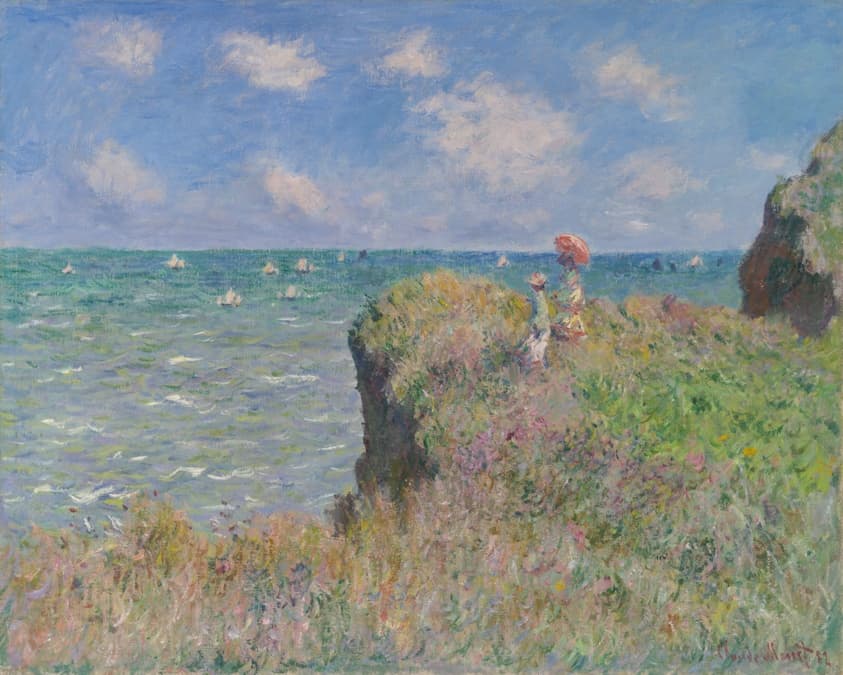
Cliff Walk at Pourville
by Claude Monet
Two young women on a clifftop above the Channel at Pourville, painted in 1882 during a Normandy campaign that was also an escape from grief, money trouble and the quarrels breaking up the Impressionist group.
- 1882
- Oil on canvas
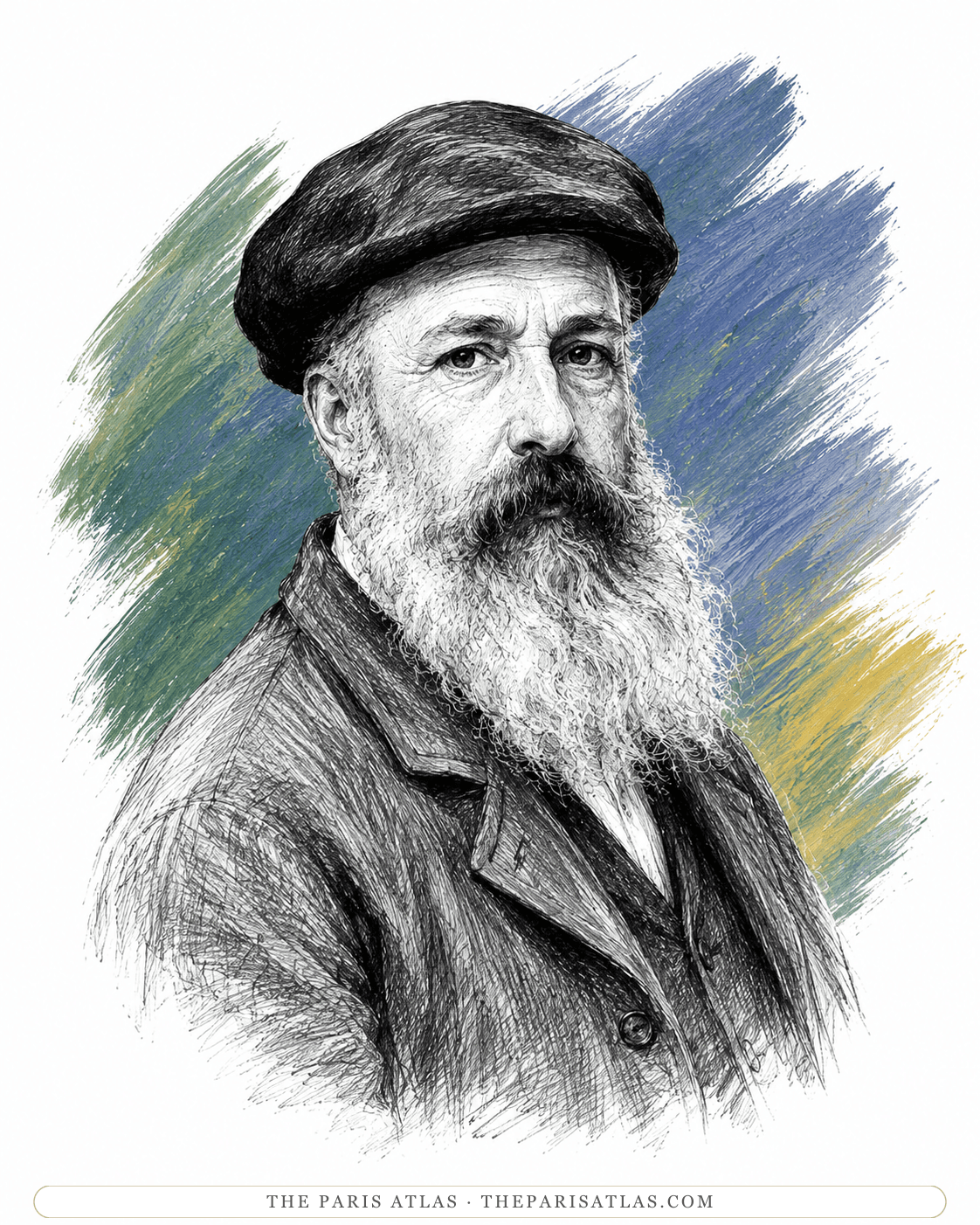
About Claude Monet
Grass, wind, and a long drop
The two figures stand near the edge with parasols, on a clifftop covered in wind-flattened grass and scattered flowers. Below and beyond them the Channel runs out to the horizon, pale green and blue, with sails on it. The land occupies the left and lower part of the canvas and simply stops; the drop is implied rather than described, which is what makes the picture faintly alarming.
The figures are probably Marthe and Blanche Hoschedé, the two eldest daughters of Alice Hoschedé. Monet gave himself a specific technical problem here — how to put people into a landscape without their breaking the surface of it — and solved it by painting them in the same touch, and largely the same palette, as the grass they are standing on.
What he was getting away from
Monet went to Normandy in February 1882, one of many such trips that decade, and the reasons were not only pictorial. His wife Camille had died in 1879. He had entered a domestic arrangement with Alice Hoschedé, whom he would marry in 1892 after her husband's death. France was in a long recession that had cut into his sales. And he had lost patience with the seventh Impressionist exhibition, then being organised amid deepening splits in the group — he handed responsibility for his own contribution to his dealer, Paul Durand-Ruel, and stayed away.
He tried Dieppe first and found it too urban. He settled instead in the fishing village of Pourville and stayed until mid-April, writing to Alice and the children about how good the country was becoming and wishing they could see it. They joined him there in June.
Close reading
Reading the work, detail by detail
The picture feels effortless because the wind connects everything: dresses, grass, clouds, and sea all lean or flicker together. These details show how carefully that apparent spontaneity is organized.

1.Two figures braced against the weather
The women are not posed like portrait sitters. Their bodies tilt into the slope and their clothing breaks into the same quick strokes as the grass. Monet makes them participants in the weather rather than observers placed above it.
2.The cliff is built from separate strokes
At this scale the ground stops pretending to be smooth turf. It is a mesh of green, yellow, brown, and blue marks, many left visibly apart. Their directions follow the slope and make the land seem to stream toward the sea.
3.A headland made of atmosphere
The distant cliff has almost no edge. Pale violet land, blue-green water, and clouded sky meet through shifts of temperature rather than line. Distance here is not drawn smaller; it is painted less certain.
4.Tiny sails mark the open water
Small white triangles and short bright strokes interrupt the blue-green water. Their narrow size places the boats well below and beyond the cliff. The light accents also break up an otherwise broad area of sea without competing with the much larger forms on the headland.
5.A pink parasol stands above the grass
The pink parasol rises above the grassy edge as a compact patch of warm color. Pale clothing below it breaks into green and violet strokes near the ground. That contrast makes the parasol easy to find while allowing the figures' lower outlines to blend into the slope.
6.The clouds spread across an open blue field
White patches spread across pale blue in uneven groups. Some cloud edges are distinct, while others merge into the surrounding blue. The open spaces between them give the sky a lighter rhythm than the dense, overlapping strokes of the grass below.
Timeline
1879
Camille Monet dies.
1882
Monet goes to Normandy in February, finds Dieppe too urban, and settles at Pourville until mid-April; the Hoschedé family joins him in June.
1892
Monet marries Alice Hoschedé.
1933
Enters the Art Institute of Chicago with the Coburn Memorial Collection.
Where to see it
Art Institute of Chicago
111 South Michigan Avenue, Chicago, IL 60603, United States
Displays and loans can change. Check whether this work is on view before making a special trip.
Plan your visit on the museum’s official website (opens in a new tab)Frequently asked questions
Who are the two women on the cliff?
Most likely Marthe and Blanche Hoschedé, the eldest daughters of Alice Hoschedé, who joined Monet at Pourville in June 1882.
Where is Pourville?
On the Normandy coast just west of Dieppe, facing the English Channel. Monet worked there repeatedly in the early 1880s.
Why did Monet skip the 1882 Impressionist exhibition?
He had become unenthusiastic about it as divisions within the group hardened, and delegated the selection of his own contribution to his dealer Paul Durand-Ruel while he painted in Normandy.
Where is the painting now?
At the Art Institute of Chicago, in the Mr. and Mrs. Lewis Larned Coburn Memorial Collection (accession number 1933.443).
More by Claude Monet

If you like Claude Monet
Explore painters from the same movements and circles.
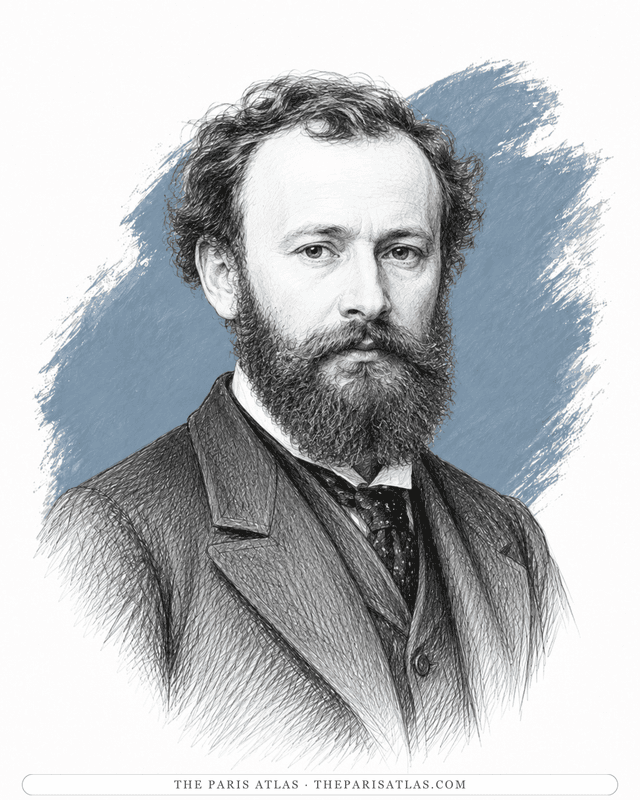
Édouard Manet
The admired elder of the independents — he painted beside Monet, befriended Morisot, and refused to show in all eight of the group's exhibitions.
View artist
Tarsila do Amaral
Brazilian painter who spent the 1920s moving between São Paulo and Paris, studied Cubism under André Lhote, Albert Gleizes and Fernand Léger, and used what she learned to paint Brazilian towns, railways, plants and bodies. Her 1928 painting Abaporu prompted the manifesto that gave the Anthropophagic movement its name.
View artist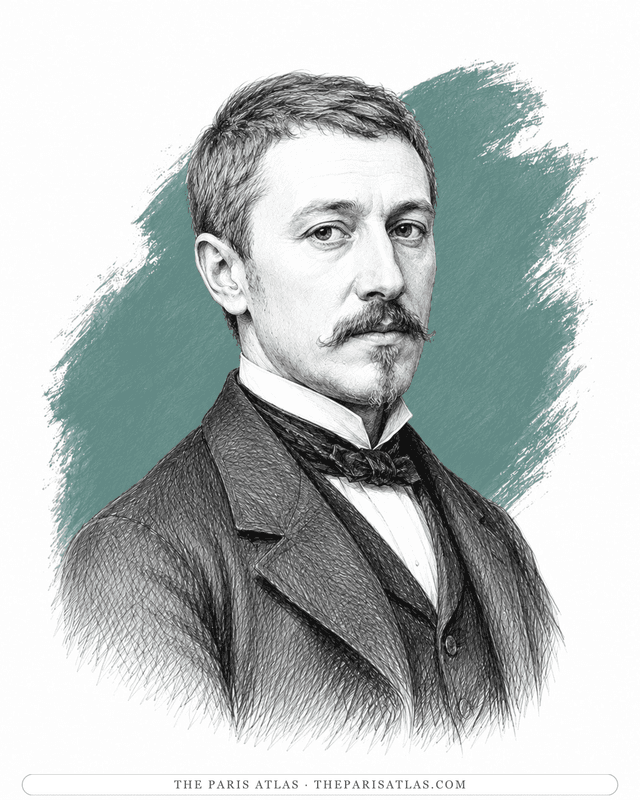
Gustave Caillebotte
Painter of Haussmann's geometry and the group's organizer-financier; his bequest of Impressionist paintings forced the French state to take the movement in.
View artist
References
The sources below include collection records, catalogues, scholarly research, and primary materials that informed this page. They document Cliff Walk at Pourville, its making, and its place in cultural history.


1Cliff Walk at Pourville — Art Institute of Chicago
WebsiteArt Institute of ChicagoUsed forWeb source consulted for documented facts and historical context presented on the Cliff Walk at Pourville page.
2Claude Monet (1840–1926) — The Metropolitan Museum of Art
WebsiteThe Metropolitan Museum of Art, 2004Used forWeb source consulted for documented facts and historical context presented on the Cliff Walk at Pourville page.
3Timeline — Maison et jardins de Claude Monet, Giverny
WebsiteFondation Claude MonetUsed forThe Fondation Claude Monet chronology places the 1882 Normandy campaign within Monet's life and travels.
4Claude Monet — Musée Marmottan Monet
WebsiteMusée Marmottan MonetUsed forThe Musée Marmottan Monet collection provides independent museum context for Monet's landscape practice and legacy.
These references provide the documented foundation for this work's history and interpretation. Claim-level citations remain attached to the specific claims they support.
 Explore more resources