Water Lilies
by Claude Monet
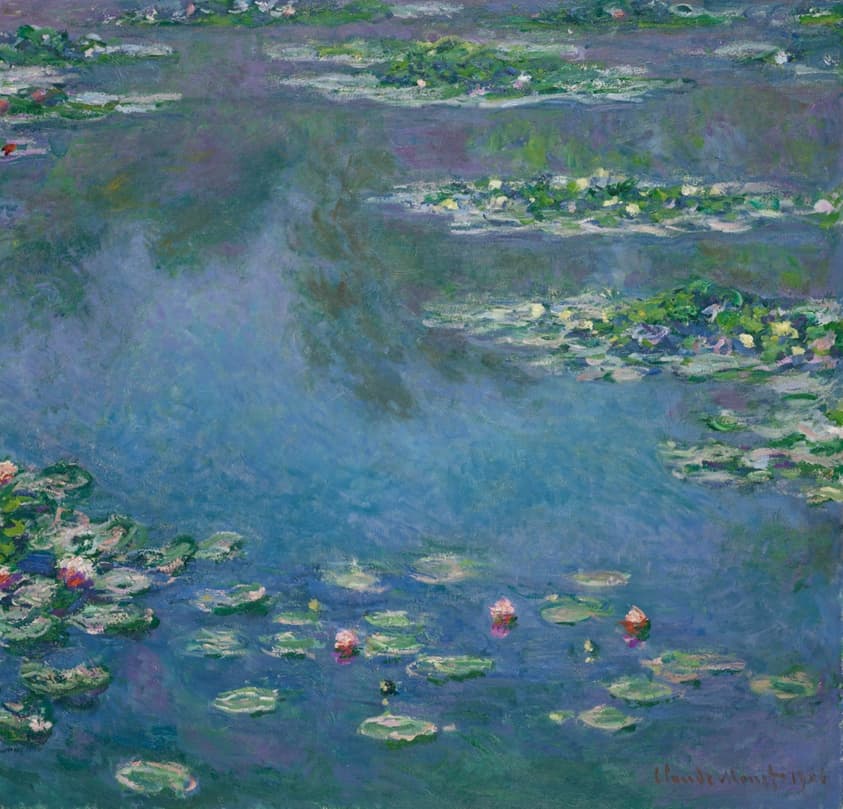
A near-square canvas from the middle of Monet's water-lily years, in which the bridge, the bank and the sky have all gone and only the surface of the pond is left — the step that leads directly to the Orangerie murals.
- 1906
- Oil on canvas
About Claude Monet
Only the water
Clusters of lilies sit at the lower left and the upper right, and between them the water opens into a pale channel running diagonally through the picture. Reflected trees darken the edges; reflected cloud lights the middle. Nothing anchors the view — there is no bank, no bridge, no horizon and no sky except as something mirrored.
The nearly square format matters. Monet's earlier pond pictures had divided into bands of land, water and air; here he has thrown out that structure entirely and painted the water's surface as the whole of the visible world. The picture reads as both a flat decorated plane and a deep space, and it will not settle into either.
The midpoint of an obsession
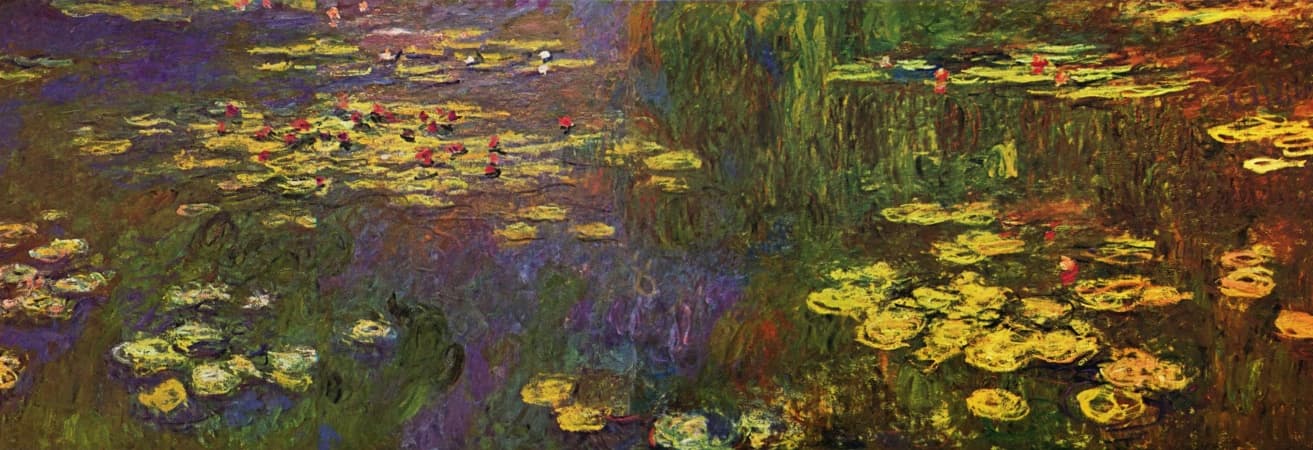
Monet painted the water garden roughly 250 times over two and a half decades. The sequence runs from relatively straightforward views of the pond and its Japanese bridge in the 1890s to the vast, near-abstract compositions he made between 1914 and 1926 for the murals now installed at the Musée de l'Orangerie in Paris.
This canvas, from a group painted between 1903 and 1908, sits at the hinge. The spatial experiment that produces the Orangerie rooms is already complete here; what remains to change is the scale.
Changes under the surface
The floating, effortless quality of the finished picture is misleading. Monet himself described the water-lily paintings as an obsession, and technical examination of this canvas has found a great many significant alterations made while the work was in progress — the composition was argued with, repeatedly, before it arrived at its apparent ease.
It sold well and quickly. Durand-Ruel and Bernheim-Jeune bought it jointly from Monet in June 1909 for 14,000 francs; it went to the playwright Henri Bernstein for 20,000, returned to Durand-Ruel that August, and eventually entered the Art Institute of Chicago in 1933 with the Ryerson collection.
Close reading
Reading the work, detail by detail
By 1906 Monet had removed the bridge, bank, and horizon from the water garden. Enlargement shows a painting that is still observational but organized almost entirely as a surface.

1.The lilies hold their shape against moving water
The blossoms are compact touches of pink and cream; the pads are flatter green ovals. Around them, blue and violet strokes run more freely. Their different handling lets the flowers seem to rest on a surface that never stops shifting.
2.Vertical reflections interrupt horizontal water
Dark vertical bands descend through the pond, contradicting the horizontal spread of pads. The crossing directions make the surface feel deep and flat at once: a plane of paint carrying the image of space above it.
3.The frame cuts a fragment from an endless field
Nothing closes the pond at the top or establishes a foreground at the bottom. Pads enter and leave at the edges. The cropping makes the canvas feel like one selected interval from water continuing beyond it.
4.Pink flowers rise above scattered pads
Small pink flowers rise from widely spaced green pads near the lower edge. Their compact upright shapes differ from the flatter leaves around them. The gaps of blue water make each blossom distinct, unlike the more crowded groups of pads higher in the painting.
5.A thin band of leaves crosses the upper edge
Closely spaced pads gather into a narrow band near the top. Pale edges pick out individual leaves within the green mass. Their smaller, crowded shapes contrast with the more widely separated foreground pads, creating a suggestion of distance even without a visible shore.
6.Thick marks collect around a close group of pads
Green pads collect along the left edge, with pale and pink touches rising between them. Some leaves are outlined by thick light strokes; others merge into darker paint. Their varied edges keep the group from becoming a single flat shape and distinguish it from the open blue water beside it.
Timeline
1903
Monet begins the group of water-lily canvases to which this painting belongs.
1909
Bought jointly from the artist by Durand-Ruel and Bernheim-Jeune in June for 14,000 francs.
1914
Monet begins the large-scale water-lily panels intended for the state, later installed at the Musée de l'Orangerie.
1933
Enters the Art Institute of Chicago with the Ryerson collection.
Where to see it
Art Institute of Chicago
111 South Michigan Avenue, Chicago, IL 60603, United States
Displays and loans can change. Check whether this work is on view before making a special trip.
Plan your visit on the museum’s official website (opens in a new tab)Frequently asked questions
How many water lily paintings did Monet make?
Around 250, made between the late 1890s and his death in 1926 — all of them from the water garden he had built at Giverny.
How does this relate to the Orangerie murals in Paris?
It is a direct precursor. The Orangerie panels, painted between 1914 and 1926 and installed in two oval rooms in the Tuileries, take the idea visible here — the water's surface as the entire subject — and expand it to room scale.
Why is the canvas almost square?
The square format removes the horizontal banding of land, water and sky that a landscape shape encourages, which let Monet concentrate the whole picture on the surface of the pond.
Where is this painting now?
At the Art Institute of Chicago, in the Mr. and Mrs. Martin A. Ryerson Collection (accession number 1933.1157).
More by Claude Monet

If you like Claude Monet
Explore painters from the same movements and circles.
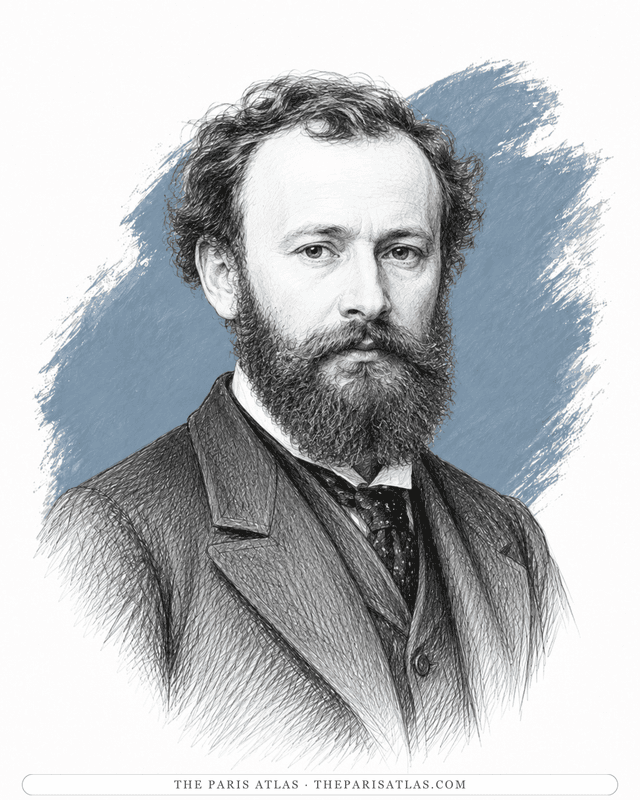
Édouard Manet
The admired elder of the independents — he painted beside Monet, befriended Morisot, and refused to show in all eight of the group's exhibitions.
View artist
Tarsila do Amaral
Brazilian painter who spent the 1920s moving between São Paulo and Paris, studied Cubism under André Lhote, Albert Gleizes and Fernand Léger, and used what she learned to paint Brazilian towns, railways, plants and bodies. Her 1928 painting Abaporu prompted the manifesto that gave the Anthropophagic movement its name.
View artist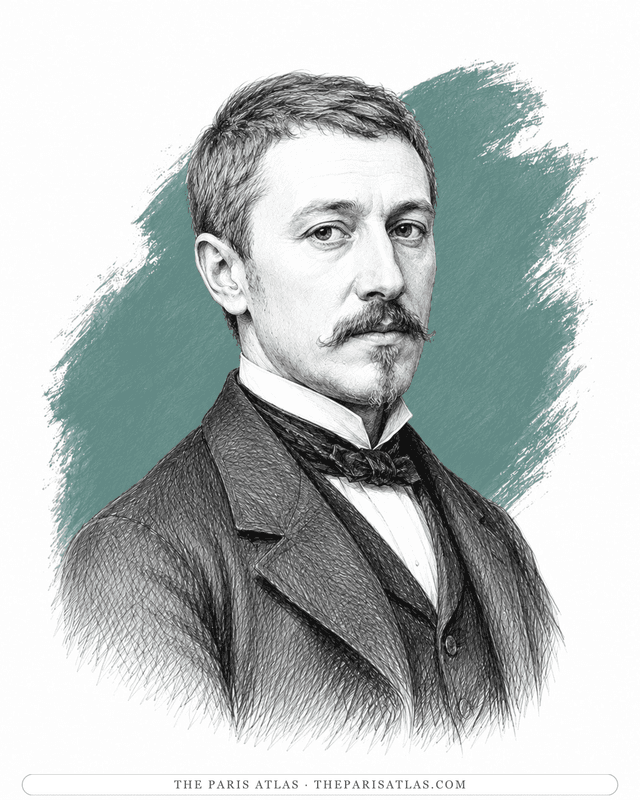
Gustave Caillebotte
Painter of Haussmann's geometry and the group's organizer-financier; his bequest of Impressionist paintings forced the French state to take the movement in.
View artist
References
The sources below include collection records, catalogues, scholarly research, and primary materials that informed this page. They document Water Lilies, its making, and its place in cultural history.


1Water Lilies — Art Institute of Chicago
WebsiteArt Institute of ChicagoUsed forWeb source consulted for documented facts and historical context presented on the Water Lilies page.
2Musée de l'Orangerie — official site
WebsiteUsed forWeb source consulted for documented facts and historical context presented on the Water Lilies page.
3Claude Monet (1840–1926) — The Metropolitan Museum of Art
WebsiteThe Metropolitan Museum of Art, 2004Used forThe Metropolitan Museum's scholarly essay supplies independent context for Monet's Giverny garden and Water Lilies series.
4Timeline — Maison et jardins de Claude Monet, Giverny
WebsiteFondation Claude MonetUsed forThe Fondation Claude Monet chronology anchors the 1906 canvas within the long development of Monet's water garden paintings.
These references provide the documented foundation for this work's history and interpretation. Claim-level citations remain attached to the specific claims they support.
 Explore more resources