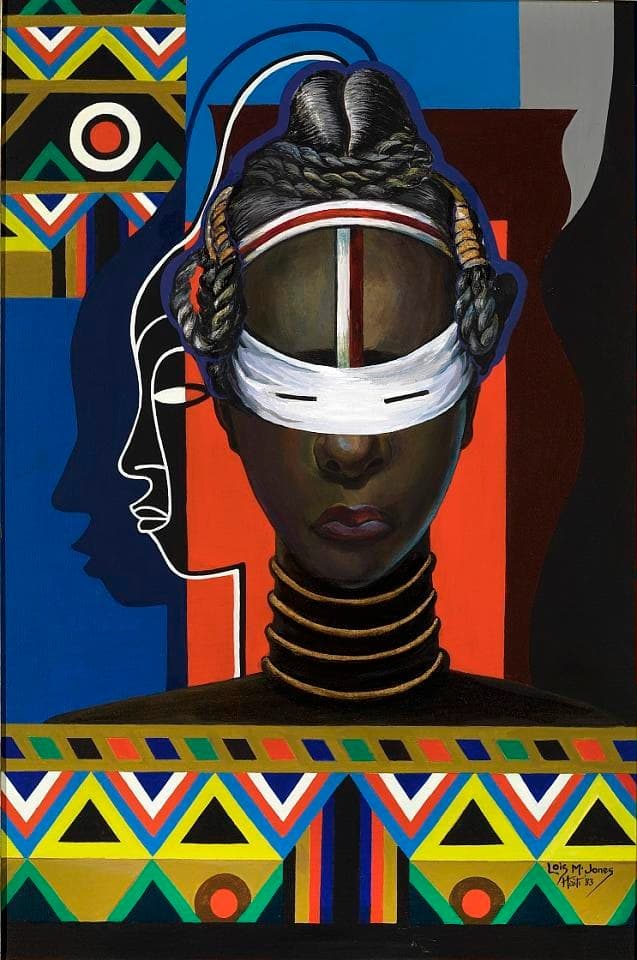
Initiation, Liberia
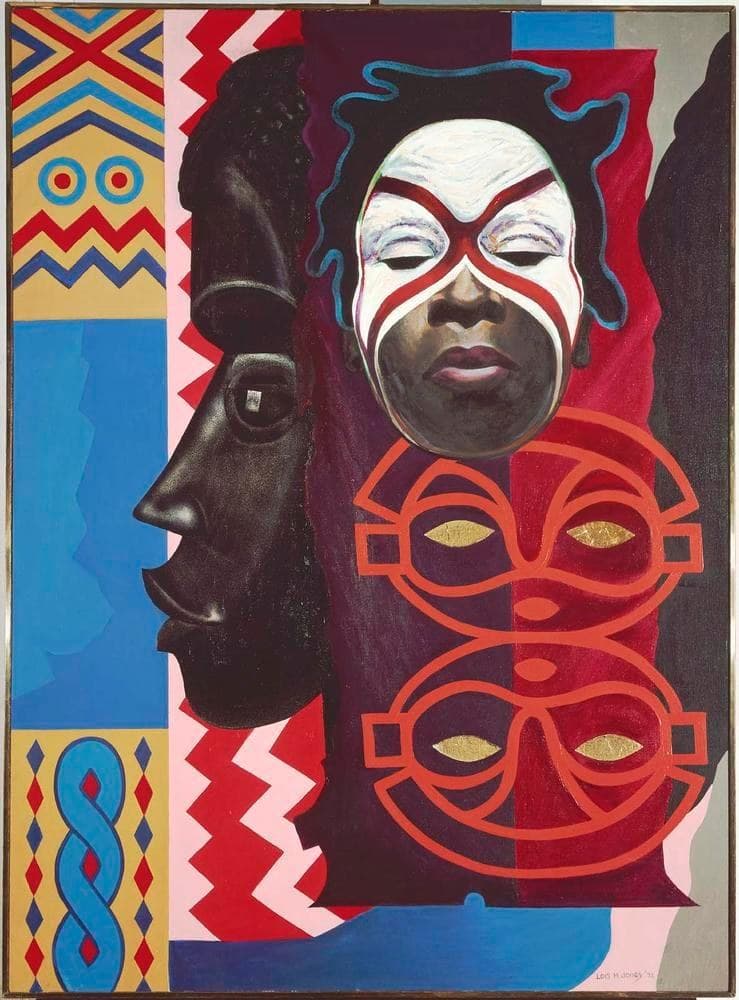
Masked figures and hard-edged pattern drawn from Liberian initiation traditions, painted at seventy-seven — Jones's late style at full strength, now in the Smithsonian American Art Museum.
- 1983
- Acrylic on canvas
About Loïs Mailou Jones
The late style at full strength
Painted in 1983, when Jones was seventy-seven, the canvas builds Liberian initiation imagery — helmet masks, processional figures — into a hard-edged design of flat, saturated colour. The brushy Paris manner of her thirties is half a century behind; what remains is structure, pattern and heat.
The painting belongs to the long series she made after her 1970 African journeys, in which specific traditions are named in the titles and translated into her own graphic language. The Smithsonian American Art Museum holds it in Washington, the city where she taught for forty-seven years.
Close reading
Reading the work, detail by detail
Jones places a carefully modeled face among flat bands, outlines, and geometric patterns. These six views follow the shifts between a particular person and the surrounding graphic forms.
1.The covered eyes
The bright band interrupts the modeled face with a nearly horizontal shape. Its narrow openings withhold the direct gaze that a frontal portrait usually offers.
2.Braids and parting
Fine highlights make the hair's individual strands and interwoven sections visible. This dense texture contrasts with the flat blue field immediately behind the head.
3.The central stripe
The vertical marking meets the horizontal eye band at a strong central axis. The crossing gives the face a graphic structure without erasing its rounded volume.
4.The mouth and chin
Subtle changes in light shape the lips and jaw. This carefully modeled lower face gives the person physical presence amid the surrounding hard-edged designs.
5.Profiles beside the face
The profiles reduce a face to its edge, unlike the fully modeled head beside them. Their repeated contours turn looking at a person into a comparison of different ways to draw one.
6.The patterned lower border
The border holds many colors in repeated geometric units. Its firm horizontal edge anchors the shoulders and gives the central head an emphatic frame.
Where to see it
A viewing location has not yet been listed for this work.
Frequently asked questions
What does Initiation, Liberia depict?
Masked figures from Liberian initiation traditions — dark helmet masks and processional silhouettes — set into flat, hard-edged fields of saturated colour and pattern.
When did Loïs Mailou Jones paint Initiation, Liberia?
In 1983, at seventy-seven, deep into the Pan-African style she had built after her 1970 journey across the continent.
How does it differ from her Paris work?
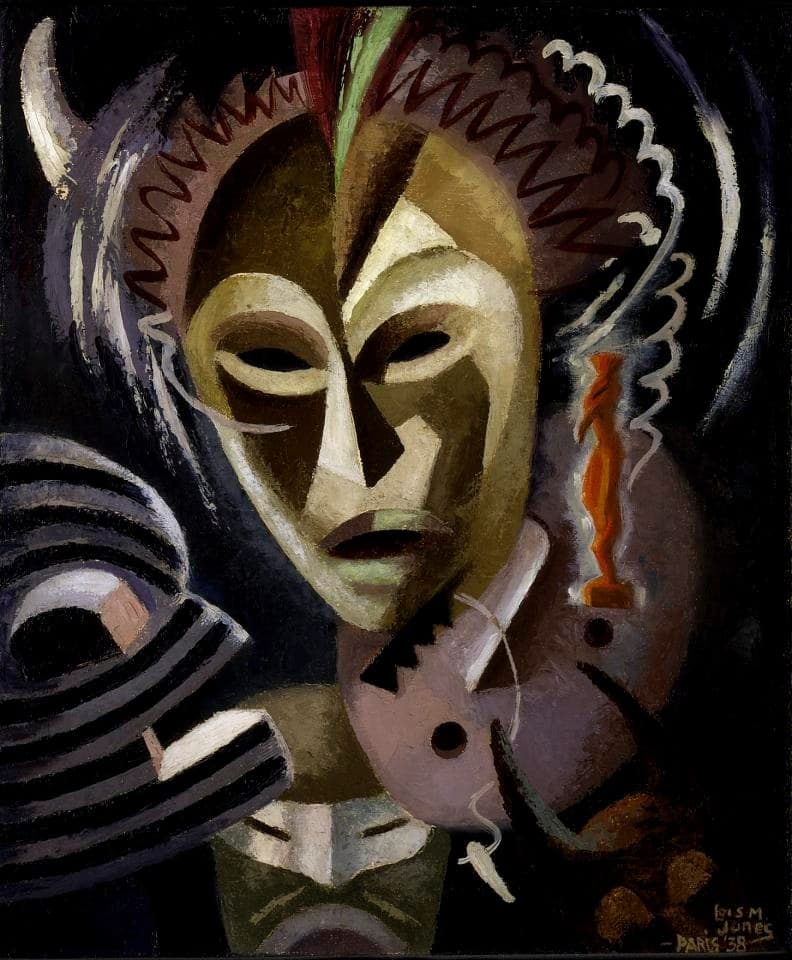
The 1938 Paris canvases are brushy oils in muted tones; by 1983 she painted in flat acrylic planes with razor edges. The African sources remain; the language is entirely her own late design.
Where is Initiation, Liberia now?
In the Smithsonian American Art Museum in Washington, D.C.
Why is the painting significant in her career?
It shows the late style at full power and the continuity of her project: from Les Fétiches in 1938 to this canvas forty-five years later, the same claim — African form as her inheritance — carried across a lifetime.
More by Loïs Mailou Jones
If you like Loïs Mailou Jones
Explore painters from the same movements and circles.
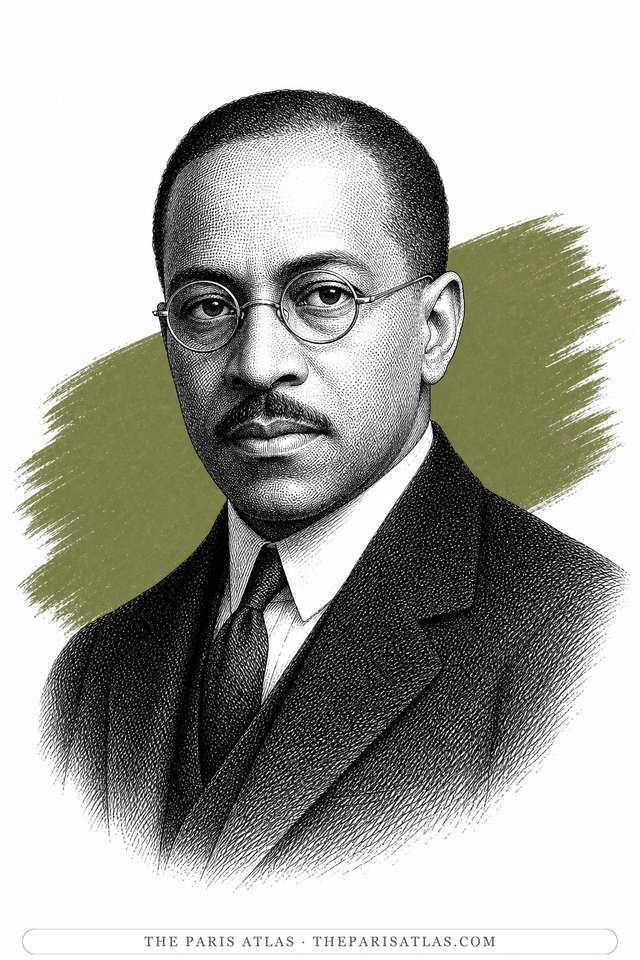
Aaron Douglas
The painter who gave the Harlem Renaissance — the flowering of Black American writing, music and art between the world wars — its look, in flat purple silhouettes in profile, ringed by bands of light. He moved to Harlem in 1925 with Paris as the eventual destination, got there in 1931, spent a year at the Académie Scandinave, a private art school in the city, and came home to paint the four murals that are still the centrepiece of the Schomburg Center, the New York Public Library's Harlem research library on Black history.
View artist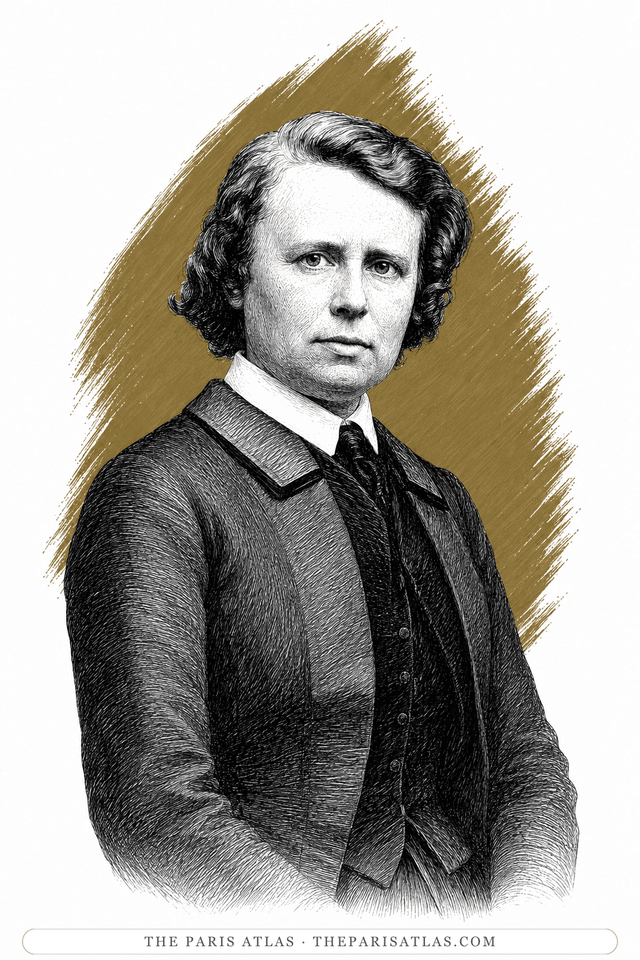
Rosa Bonheur
At the horse markets of Paris and in her studio beside the forest of Fontainebleau, Rosa Bonheur gave animals the presence of great portrait subjects. The success of The Horse Fair helped her build a life shaped by her work, financial independence, and the women she loved.
View artist
Thomas Eakins
American realist painter and influential Pennsylvania Academy teacher of Henry Ossawa Tanner.
View artist
References
The sources below include collection records, catalogues, scholarly research, and primary materials that informed this page. They document Initiation, Liberia, its making, and its place in cultural history.


1Initiation, Liberia — collection entry
WebsiteSmithsonian American Art MuseumUsed forWeb source consulted for documented facts and historical context presented on the Initiation, Liberia page.
2Loïs Mailou Jones — artist page
WebsiteSmithsonian American Art MuseumUsed forWeb source consulted for documented facts and historical context presented on the Initiation, Liberia page.
3Loïs Mailou Jones — artist profile
WebsiteNational Museum of Women in the ArtsUsed forWeb source consulted for documented facts and historical context presented on the Initiation, Liberia page.
4Lois Mailou Jones — Encyclopaedia Britannica
WebsiteEncyclopaedia BritannicaUsed forWeb source consulted for documented facts and historical context presented on the Initiation, Liberia page.
These references provide the documented foundation for this work's history and interpretation. Claim-level citations remain attached to the specific claims they support.
 Explore more resources