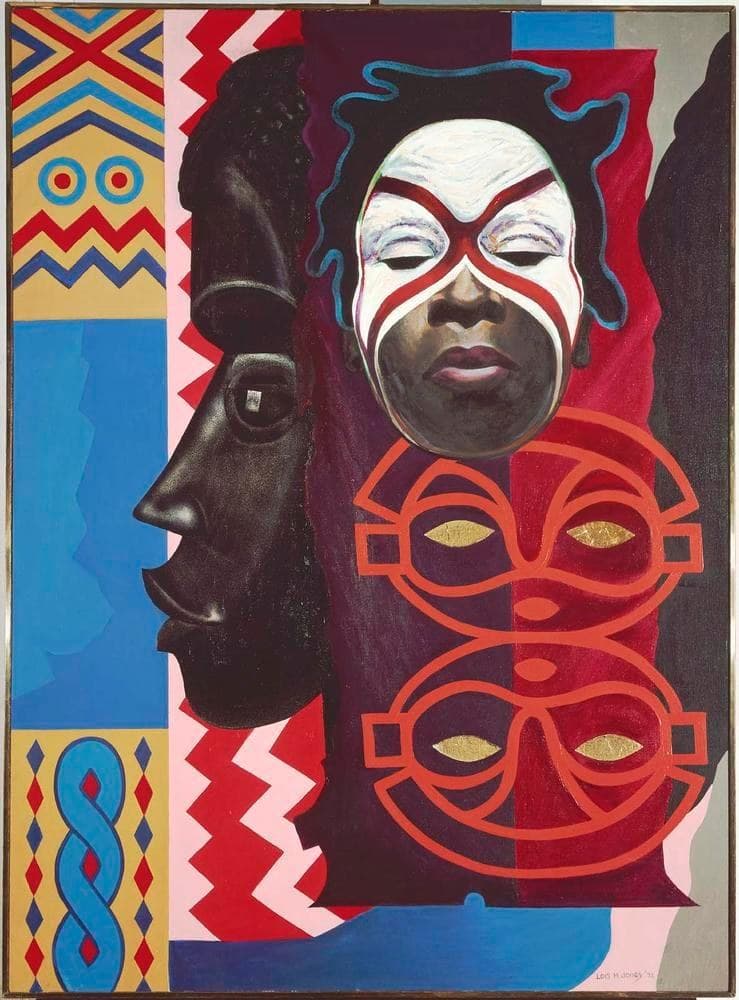
Ubi Girl from Tai Region
A young woman's face painted for initiation, set beside Congolese masks and bold pattern — the centrepiece of Jones's post-1970 African canvases, now at the Museum of Fine Arts, Boston.
- 1972
- Acrylic on canvas
About Loïs Mailou Jones

Painted from a journey
In 1970 Jones travelled through Africa on a research grant, photographing and sketching in eleven countries. The painting distils the trip: the face of a young woman from the Taï region of Côte d'Ivoire, painted for initiation into womanhood, rendered realistically amid flat masks and pattern.
Two carved masks from Congo flank the face. Jones sets the living girl and the sculpted traditions side by side, joining West and Central Africa on one canvas — her statement of a unified African inheritance.
Boston's Jones
The Museum of Fine Arts, Boston — the museum whose school trained her in the 1920s — holds the painting, and has made it a centrepiece of its modern displays. For the museum of her home city to anchor its account of her with this canvas closes a circle Jones herself often pointed out.
Close reading
Reading the work, detail by detail
Jones combines a frontal painted face, a dark profile, and repeated mask designs. Six views show how these distinct forms of representation share one tightly patterned surface.
1.The painted face
The red bands converge above the nose and sweep outward around the eyes. They emphasize the face's symmetry while the shading below preserves its rounded physical presence.
2.The dark profile
The projecting nose and lips make the profile readable through its outline. Its dark volume contrasts with both the frontal face's bright markings and the flat blue field beside it.
3.The repeated masks
Repetition turns the face into a graphic unit. Small differences in internal divisions keep the two designs from reading as exact copies.
4.The upper pattern strip
The pattern builds its own rhythm from repeated angles and circles. Its small scale gives the eye a measured counterpoint to the much larger faces.
5.The white zigzag
The alternating points create a strong vertical pulse. This sharply cut band separates the patterned border from the overlapping faces without becoming a neutral gap.
6.The blue outline
The line loosely encloses the face without copying its exact contour. Its irregular movement contrasts with the rigid chevrons and repeated mask outlines elsewhere in the painting.
Where to see it
A viewing location has not yet been listed for this work.
Frequently asked questions
What does Ubi Girl from Tai Region show?
The face of a young woman from the Taï region of Côte d'Ivoire, marked with red initiation paint, beside two carved Congolese masks and fields of bold pattern. The realistic face and the flat masks share one surface.
When did Loïs Mailou Jones paint Ubi Girl from Tai Region?
In 1972, from material gathered on her 1970 research journey through eleven African countries.
What does the painting's title mean?
It identifies the sitter: a girl who spoke the Ubi dialect, from the Taï region of Côte d'Ivoire, whose face is painted for initiation into womanhood.
Where is Ubi Girl from Tai Region now?
At the Museum of Fine Arts, Boston — the museum whose school had trained Jones in the 1920s.
Why does the painting combine a face with masks?
To join the living present and the sculptural traditions of Africa in one image. Jones placed West African face painting beside Central African carving as a single inheritance — the theme of her whole late career.
More by Loïs Mailou Jones
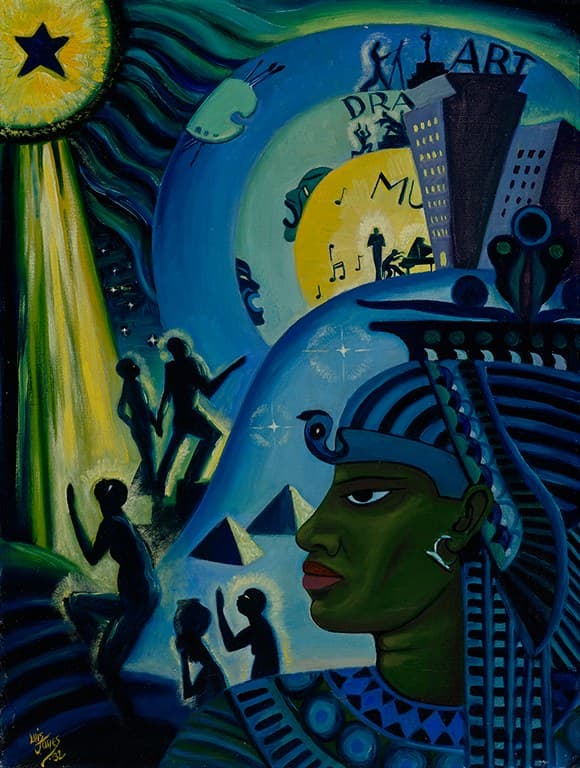
If you like Loïs Mailou Jones
Explore painters from the same movements and circles.
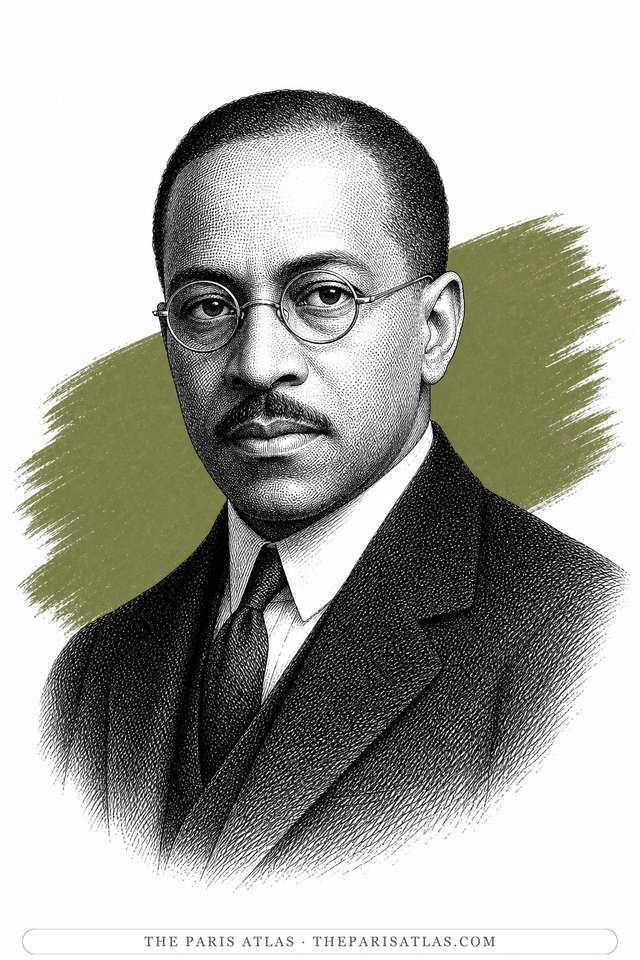
Aaron Douglas
The painter who gave the Harlem Renaissance — the flowering of Black American writing, music and art between the world wars — its look, in flat purple silhouettes in profile, ringed by bands of light. He moved to Harlem in 1925 with Paris as the eventual destination, got there in 1931, spent a year at the Académie Scandinave, a private art school in the city, and came home to paint the four murals that are still the centrepiece of the Schomburg Center, the New York Public Library's Harlem research library on Black history.
View artist
Rosa Bonheur
At the horse markets of Paris and in her studio beside the forest of Fontainebleau, Rosa Bonheur gave animals the presence of great portrait subjects. The success of The Horse Fair helped her build a life shaped by her work, financial independence, and the women she loved.
View artist
Thomas Eakins
American realist painter and influential Pennsylvania Academy teacher of Henry Ossawa Tanner.
View artist
References
The sources below include collection records, catalogues, scholarly research, and primary materials that informed this page. They document Ubi Girl from Tai Region, its making, and its place in cultural history.


1Ubi Girl from Tai Region — collection entry
WebsiteMuseum of Fine Arts, BostonUsed forWeb source consulted for documented facts and historical context presented on the Ubi Girl from Tai Region page.
2Ubi Girl from Tai Region — collection story
WebsiteMuseum of Fine Arts, BostonUsed forWeb source consulted for documented facts and historical context presented on the Ubi Girl from Tai Region page.
3Loïs Mailou Jones — artist page
WebsiteSmithsonian American Art MuseumUsed forWeb source consulted for documented facts and historical context presented on the Ubi Girl from Tai Region page.
4Lois Mailou Jones — Encyclopaedia Britannica
WebsiteEncyclopaedia BritannicaUsed forWeb source consulted for documented facts and historical context presented on the Ubi Girl from Tai Region page.
These references provide the documented foundation for this work's history and interpretation. Claim-level citations remain attached to the specific claims they support.
 Explore more resources