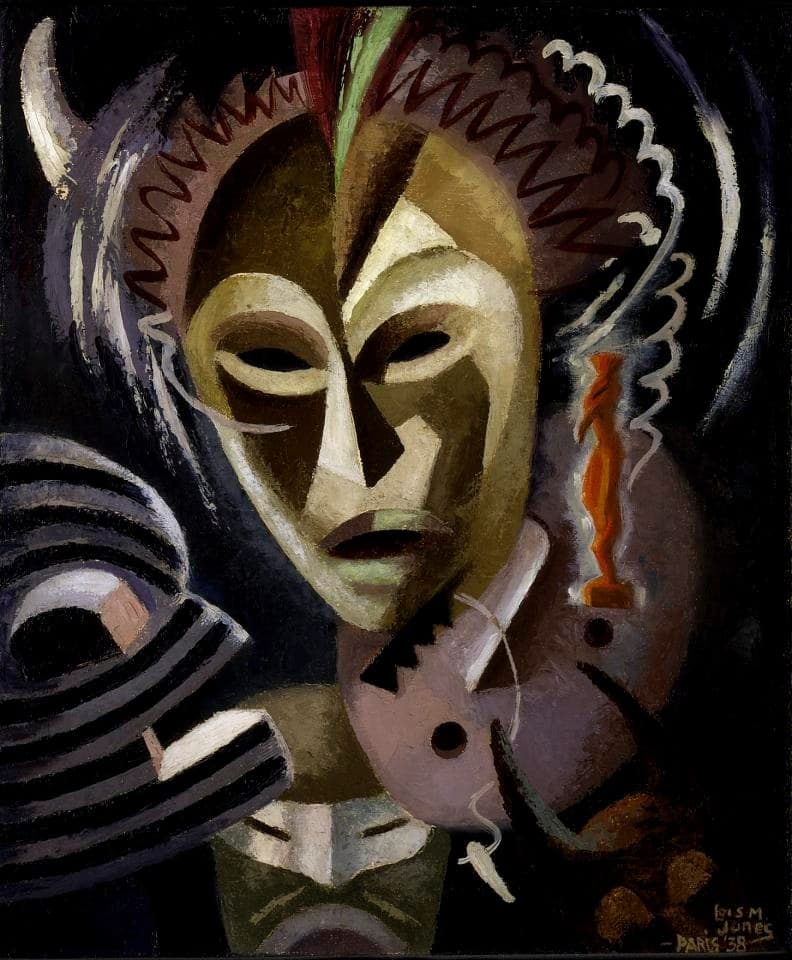
Les Fétiches
Five African masks turning through a dark void, painted in Paris in 1938 during Jones's Académie Julian year. Now in the Smithsonian American Art Museum, it marks the turn of her career toward African design.
- 1938
- Oil on linen
About Loïs Mailou Jones
Five masks in a dark space
Five African masks tilt and overlap in a dark field, painted close to the picture surface, with a small red fetish figure glowing near the lower edge. Nothing frames them as museum objects. They move like presences, not exhibits.
Jones painted the canvas in Paris in 1938, in the year she spent at the Académie Julian on sabbatical from Howard University. Paris was then full of African art — in the ethnographic collections, in the studios, and in the Négritude writing of students from the colonies — and the painting joins that conversation from a Black American's side of it.
The turn in her career
Les Fétiches marked her break from the New England and French landscapes of her first decade. Challenged for changing course, she answered that the sources were her inheritance too, later recalling that she had to remind doubters of Modigliani and Picasso — Europeans praised for borrowing the same forms.
The painting entered the Smithsonian American Art Museum's collection in 1990. It is now among the most reproduced American paintings of its decade, and the pivot it records ran through the rest of her career.
Close reading
Reading the work, detail by detail
The painting brings several masks into close, overlapping contact. Light, scale, and direction make them distinct without separating them into a tidy display.
1.The central eyes
The openings stay dark while the raised rims catch light. That contrast makes the face compelling to look at even though no living eyes return the gaze.
2.Planes of the nose
The abrupt changes of color describe a projecting form through broad facets. The mask's volume is built from edges and adjacent planes rather than a smoothly blended surface.
3.The radiating crest
The repeated points and curves push outward from the face. Their directional energy helps the central mask dominate a composition crowded with competing forms.
4.The striped profile
The stripes follow the projecting brow, nose, and mouth. Cropped by the canvas edge, this mask appears very close and gives the composition a forceful foreground.
5.The mask below
Its reduced scale creates a lower register without a clear shelf or ground. The overlap makes the masks feel assembled in pictorial space rather than lined up in a cabinet.
6.The right-hand forms
Round holes and sharp mouth shapes punctuate these quieter colors. Partial concealment keeps the eye searching for where one mask ends and another begins.
Where to see it
A viewing location has not yet been listed for this work.
Frequently asked questions
Who painted Les Fétiches?
Loïs Mailou Jones, in Paris in 1938, during her sabbatical year at the Académie Julian. She was thirty-two and already a decade into her teaching career at Howard University.
What does Les Fétiches show?
Five stylized African masks turning through a dark space, with a small red fetish figure below them. The masks draw on forms from several African traditions rather than copying a single object.
Why is Les Fétiches important?
It marks the moment a leading Black American painter claimed African form as her own inheritance, in the Paris of the Négritude movement. It also marks the turn in Jones's career from landscape toward the African design language she developed for the rest of her life.
Where is Les Fétiches now?
In the Smithsonian American Art Museum in Washington, D.C., which acquired it in 1990.
What did Jones say about painting African subjects?
When her change of direction was questioned, she pointed to the Europeans who had mined the same sources with acclaim — recalling that she had to remind them of Modigliani and Picasso. The remark became shorthand for the double standard she painted against.
More by Loïs Mailou Jones
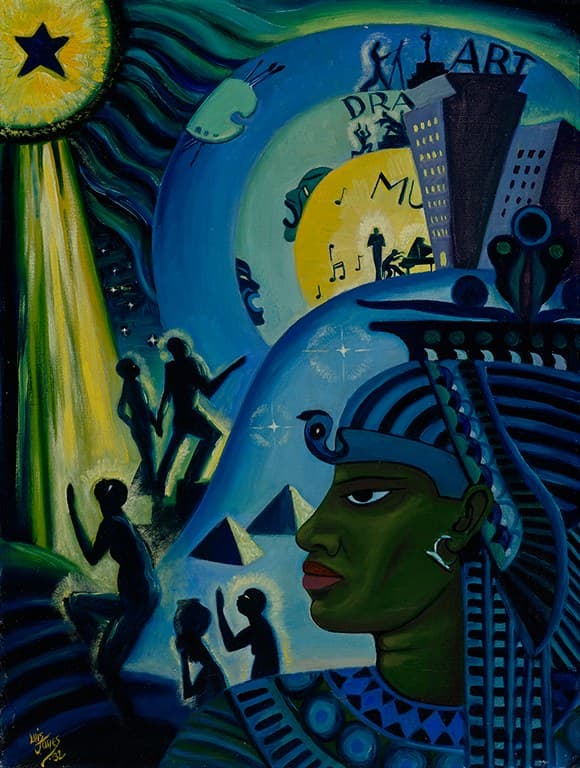
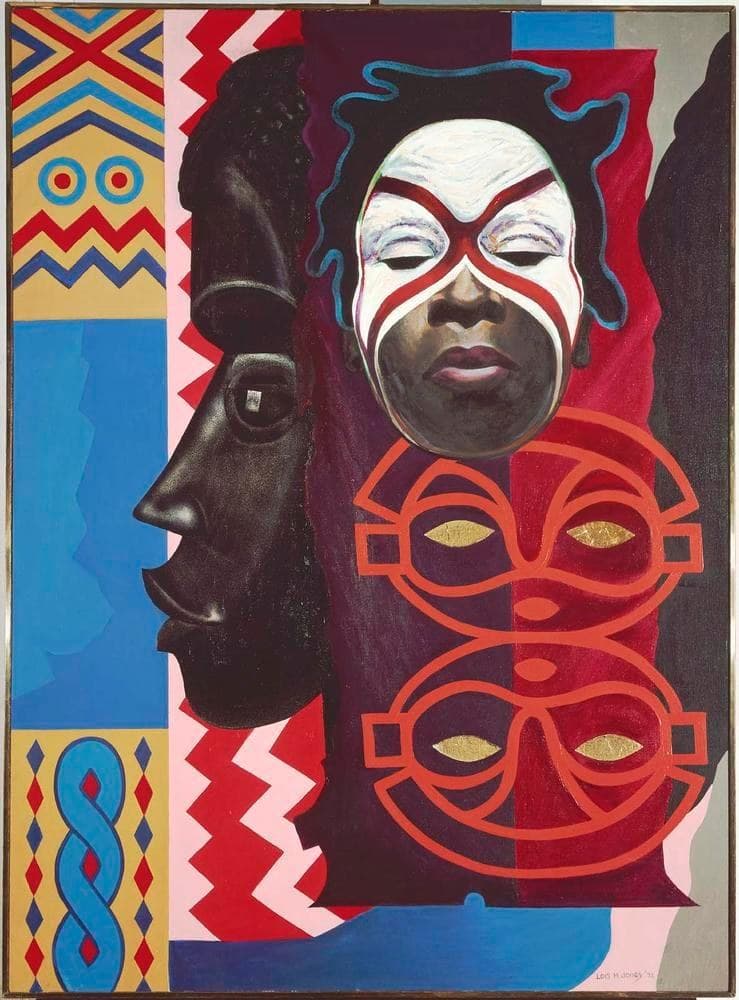
If you like Loïs Mailou Jones
Explore painters from the same movements and circles.
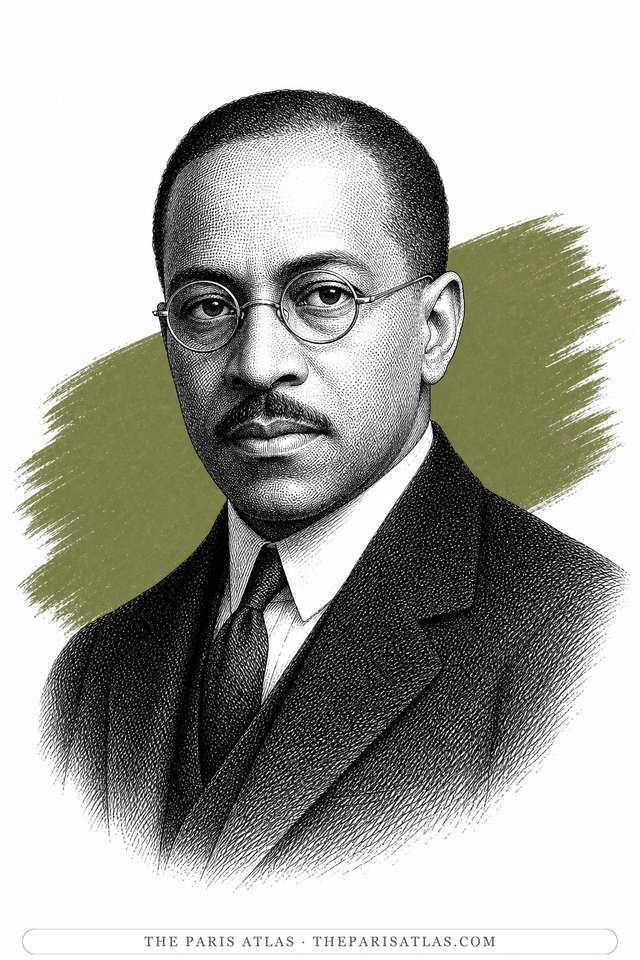
Aaron Douglas
The painter who gave the Harlem Renaissance — the flowering of Black American writing, music and art between the world wars — its look, in flat purple silhouettes in profile, ringed by bands of light. He moved to Harlem in 1925 with Paris as the eventual destination, got there in 1931, spent a year at the Académie Scandinave, a private art school in the city, and came home to paint the four murals that are still the centrepiece of the Schomburg Center, the New York Public Library's Harlem research library on Black history.
View artist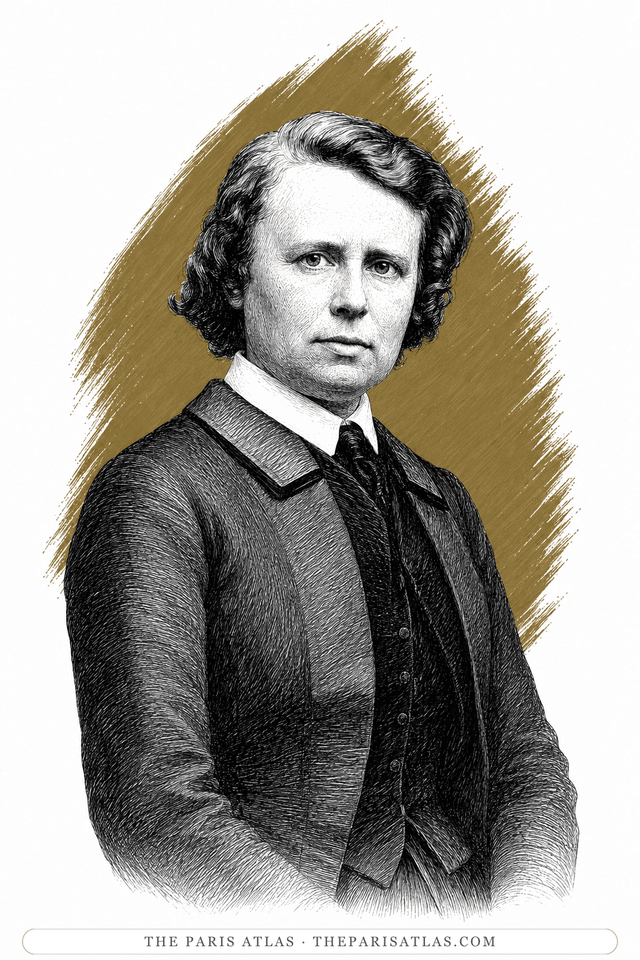
Rosa Bonheur
At the horse markets of Paris and in her studio beside the forest of Fontainebleau, Rosa Bonheur gave animals the presence of great portrait subjects. The success of The Horse Fair helped her build a life shaped by her work, financial independence, and the women she loved.
View artist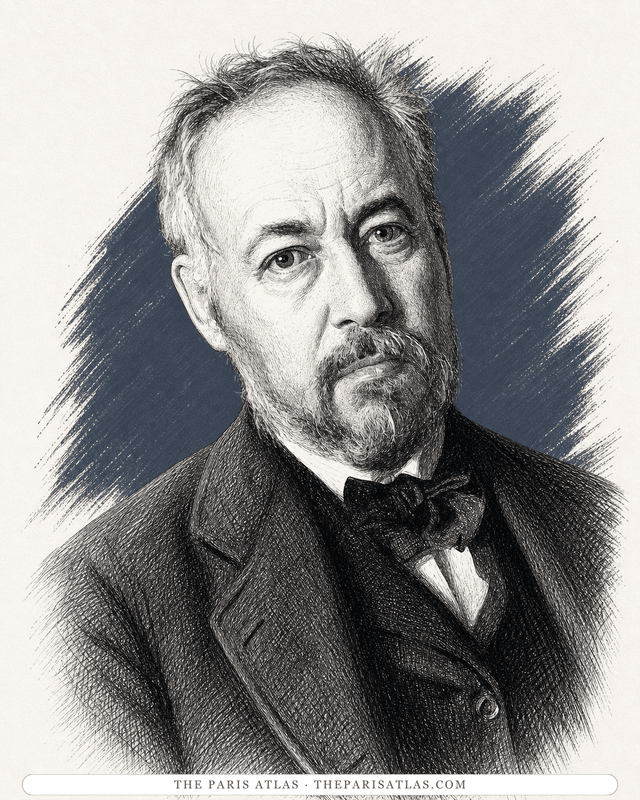
Thomas Eakins
American realist painter and influential Pennsylvania Academy teacher of Henry Ossawa Tanner.
View artist
References
The sources below include collection records, catalogues, scholarly research, and primary materials that informed this page. They document Les Fétiches, its making, and its place in cultural history.


1Les Fétiches — collection entry
WebsiteSmithsonian American Art MuseumUsed forWeb source consulted for documented facts and historical context presented on the Les Fétiches page.
2Les Fétiches
WebsiteWikipediaUsed forWeb source consulted for documented facts and historical context presented on the Les Fétiches page.
3Loïs Mailou Jones — artist page
WebsiteSmithsonian American Art MuseumUsed forWeb source consulted for documented facts and historical context presented on the Les Fétiches page.
4Loïs Mailou Jones — artist profile
WebsiteNational Museum of Women in the ArtsUsed forWeb source consulted for documented facts and historical context presented on the Les Fétiches page.
These references provide the documented foundation for this work's history and interpretation. Claim-level citations remain attached to the specific claims they support.
 Explore more resources