

Notes of a Dirty Old Man
The underground newspaper column where this mode of Bukowski prose was invented.
Read our take
The stories that made France love him first — half of the notorious 1972 collection, under the title the world kept.
Tales of Ordinary Madness, published by City Lights in 1983, collects half of Charles Bukowski's 1972 story collection Erections, Ejaculations, Exhibitions and General Tales of Ordinary Madness, which City Lights divided into two volumes — this one and The Most Beautiful Woman in Town. The stories are the wildest form of Bukowski's prose: drunks, prostitutes, madmen, writers, and Los Angeles landlords, told with a looseness the novels discipline. In French, as Contes de la folie ordinaire, the collection helped make Bukowski famous in France before America caught up — and an Italian film adaptation arrived in 1981, directed by Marco Ferreri, before this English edition existed.
The stories run from autobiographical sketches barely fictionalized to grotesque invention: racetrack afternoons, drunk tanks, sexual disasters, and writers behaving badly at readings. The register swings between the comic and the genuinely disturbing, sometimes inside one story — this is Bukowski with the novel's structural restraints removed.
The collection's publication history is its own story. The 1972 original appeared from City Lights under the title Erections, Ejaculations, Exhibitions and General Tales of Ordinary Madness; in 1983 City Lights split that volume in two, and the halves have circulated under the split titles since. The French translation of the material, Contes de la folie ordinaire, was central to Bukowski's European fame in the late 1970s.
The beach gives Sneed room to remember without freeing him from the habit of measuring his life as a failure. His remaining money becomes a cruel summary of sixty years, while the young people's mockery turns that inward judgment into a public spectacle. Yet their questions about whether he is human expose the brutality of the judges rather than proving his worthlessness. The narration has already given readers access to memories and perceptions the group refuses to acknowledge. Their laughter cannot cancel the person the story has allowed us to accompany.
Mrs Conners's offer interrupts the story's cruelty with an ordinary act of care, but the narration refuses an easy rescue. Her confidence in the soup contrasts with Sneed's silent inspection of it; the gap between giver and recipient remains even while she tries to help. He thanks her, then disposes of it privately. The scene does not make her another tormentor. Instead, its restraint shows kindness failing to reach someone whose withdrawal is already profound. The returning sound of the sea links his last solitude to the opening landscape.
Without the novels' autobiographical spine, the prose goes where the poems and novels do not — funnier, uglier, and stranger.
This is the book, in translation, that French readers knew him by when he landed in Paris in 1978.
The separate stories allow abrupt changes of narrator and situation that a sustained Chinaski novel cannot accommodate as freely.
1972
City Lights publishes the original combined collection under its full title.
1981
Marco Ferreri's film adaptation appears, with Ben Gazzara.
1983
City Lights splits the 1972 volume; Tales of Ordinary Madness takes the title the world keeps.

The underground newspaper column where this mode of Bukowski prose was invented.
Read our take

A collection of Charles Bukowski's wildest short stories — drunks, madmen, writers and Los Angeles low life — published by City Lights in 1983 as half of his 1972 collection Erections, Ejaculations, Exhibitions and General Tales of Ordinary Madness, which was split into two volumes.
City Lights divided it in 1983 into Tales of Ordinary Madness and The Most Beautiful Woman in Town; the two split volumes have carried the stories since.
Its French translation, Contes de la folie ordinaire, was one of the books that made him a cult figure in France in the late 1970s — the readership that brought him to Paris in September 1978.
Yes — Marco Ferreri's 1981 film, with Ben Gazzara playing a Bukowski-like poet, adapted the material two years before this English split edition appeared.
Some are barely fictionalized sketches from Bukowski's life; others are grotesque invention. The collection swings between the two without labeling which is which.
Yes — Marco Ferreri's 1981 Italian production, released in the United States in 1983, with Ben Gazzara playing a poet named Charles Serking. Bukowski disliked the result, though it won four David di Donatello awards in Italy.
Explore authors with a similar voice, perspective, and influence.

The doctor of the Paris slums who wrote the century's blackest, funniest novel — and changed the sound of French prose.
View author
The Brooklyn dropout who arrived in Paris broke at thirty-eight and wrote the exuberant, banned books that ended American censorship.
View author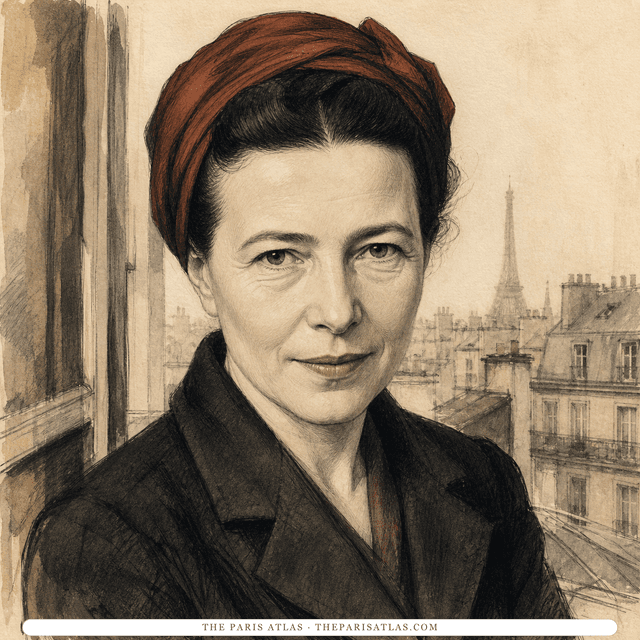
French writer and philosopher whose novels, memoirs, and social analysis examined freedom, gender, responsibility, aging, and the material conditions that shape a life.
View authorThe sources below include the primary text, editions, scholarship, archival materials, and other records that informed this page. They document Tales of Ordinary Madness, its publication, and its place in literary history.


Biographical and bibliographic backbone: the career arc, the Black Sparrow relationship, and the book's place in it.
Publication dates, publishers, and chronology checked against the bukowski.net timeline.
Bibliographic details cross-checked against the Verdant Press checklist.

Official record used to verify names, dates, institutional details, or other factual information on this page.
Complete reprint of A Dollar and 20 Cents in Roland 5, printed pp. 28–30; not a collation of the complete collection.
The primary text is the baseline reference for every book page. Additional references document publication history, interpretation, and historical context where that evidence is available.
 Explore more resources