
Mrs. Fiedke
An elderly tourist whose belief that her nephew will appear draws Lise closer to Richard.
To meet the nephew she believes she will recognize at the right moment.
The book

At a glance
- Tourist waiting for her nephew
- Richard
- Slippers and a curved paper knife
- Companion, witness, and link to Richard
Who they are in the book
Spoiler-freeMrs. Fiedke is a small, elderly traveler waiting for her nephew. She meets Lise while shopping and joins her through cafés and stores. Her poor hearing and eyesight limit what she notices, yet her memory will still matter to the investigation.
She believes she can sense that her nephew is near and that he will appear after a special event. Lise listens because the nephew may be the man she wants. Mrs. Fiedke eventually recognizes Richard at the Hotel Tomson.
Her gentleness does not mean she understands Lise. Like the other witnesses, she sees only part of the day. The slippers, gloves, pink tissue, and curved paper knife around her become ordinary objects caught in a fatal design she cannot see.
How Mrs. Fiedke Is Portrayed
- Small, neat, and agileShe is old but moves with surprising energy through the shop, café, and streets.
- A deeply wrinkled faceThe narration describes her age directly without presenting her as helpless.
- Dim sight and hearingShe sometimes misses what is said or shown, which makes her later witness account necessarily partial.
- A gentle voiceHer calm manner contrasts with Lise's sharp changes in tone.
- A yellow cotton dressHer plain summer clothing makes a quiet visual contrast with Lise's clashing colors.
- Gloves wrapped in pink tissueShe carefully handles small purchases and personal objects while moving through the stores.
Mrs. Fiedke identifies Richard as her nephew at the Hotel Tomson. The paper knife she buys later becomes the weapon Lise gives him. Mrs. Fiedke does not understand the plan she helps bring together.
If you like The Driver’s Seat


If you like Muriel Spark
Explore authors with a similar voice, perspective, and influence.

Albert Camus
French Algerian novelist, essayist, journalist and playwright who used the absurd and revolt to ask how people should live without false consolation.
View author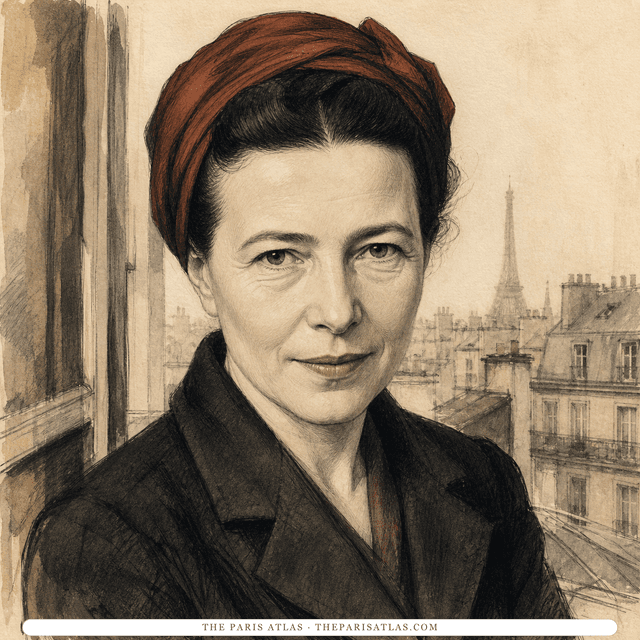
Simone de Beauvoir
French writer and philosopher whose novels, memoirs, and social analysis examined freedom, gender, responsibility, aging, and the material conditions that shape a life.
View author
John Steinbeck
American novelist of the California fields and of the Dust Bowl migration — the exodus of farming families driven off the drought-ruined southern plains in the 1930s — awarded the Nobel Prize in Literature in 1962. In the summer of 1954 he moved into 1 avenue de Marigny in Paris and wrote for the Paris daily newspaper Le Figaro. Some of that work reached French readers in translation long before it was ever printed in his own English: one story waited sixty-five years.
View author