
The Good Soldier
Both novels disclose catastrophe through broken chronology and partial testimony, forcing readers to rebuild responsibility from unstable accounts.
Read our take
by Muriel Spark
A woman enters a foreign city, makes sure strangers remember her, and searches for the man she has chosen to end her life.
Lise is a thirty-four-year-old office worker who leaves her unnamed northern European home for a holiday in an unnamed southern city. Her clashing clothes, sharp conversations, and strange purchases seem random at first. They are not. Lise wants witnesses to remember her, and she is looking for a particular man—her ‘type’—whom she intends to direct toward killing her. Muriel Spark tells readers early that Lise will die, so the suspense comes from discovering how deliberately she arranges the route and how little control she finally has over another person. The result is a short, unsettling novel about self-destruction, responsibility, appearances, and the dangerous difference between planning an event and controlling it.[1]
Lise has worked in the same office since she was eighteen. After a sudden breakdown at work, she takes leave and flies south in an outfit designed to be noticed. She argues with shop assistants, displays a paperback wherever people can see it, moves between hotels and stores, and buys objects that will later appear in police evidence. The narration repeatedly jumps forward to what witnesses will say after her death, making ordinary errands part of an investigation that has not yet happened.[1]
Several men cross Lise's path, but she rejects each as the wrong person. Bill, a macrobiotic traveler, follows her from the airplane and later sexually assaults her. Carlo, a garage owner, also assaults her after she enters his car. Neither attack begins or explains her plan; she was already building the route toward her death. She keeps going until she locates Richard, a frightened twenty-four-year-old man she first noticed at the airport.[1]
Lise drives Richard to a park after midnight and tells him what to do. He protests and tries to pull away, but she continues to direct him. Richard then chooses to kill her. Lise's final scream breaks through the calm script she has tried to impose. Spark leaves both facts in view: Lise planned her death and pressured Richard toward it, while Richard remains the person who commits the murder.[1]
Lise prepares for a holiday by shopping for clothes. A saleswoman suggests a stain-resistant dress, and Lise reacts furiously because she thinks the fabric implies carelessness or poor hygiene. She chooses instead a lemon-yellow top, a skirt patterned with bright orange, mauve, and blue shapes, and a red-and-white striped coat. The outfit clashes deliberately and makes her easy to describe.[1]
At the office, Lise has a sudden laughing and crying episode. The narration says she has not had an episode like it for five years. She leaves work for her trip, carrying a paperback with a vivid cover and placing it where other travelers can notice it. The book never identifies her country or destination by name.[1]
At the airport and on the plane, Lise studies the men around her. She notices Richard, a sturdy young man in a dark suit who becomes visibly frightened when she approaches. She also meets Bill, a bespectacled traveler carrying a bag of rice. He follows a macrobiotic diet, talks obsessively about achieving orgasm, and begins attaching himself to her plans.[1]
In the southern city, Lise moves through a hotel, department stores, cafés, and streets. She buys a scarf, a blender, and a zippered travel bag. She meets Mrs. Fiedke, an elderly tourist who buys slippers and a curved paper knife. Lise repeatedly asks whether men are her ‘type’ and says she is looking for a boyfriend, but her questions are part of a more specific search.[1]
Mrs. Fiedke believes that the nephew she is waiting for will appear at a special moment. She and Lise travel together for part of the afternoon. Their wandering gives Lise another witness who can describe her purchases, statements, and movements. Lise becomes impatient whenever a man fails to match the person she expects to find.[1]
Lise goes to a garage and enters a red car belonging to Carlo, the proprietor. Carlo sexually assaults her. She drives away in his car and later parks it outside the Hilton, where it is stolen. At the Metropole she meets Bill again. He takes her to the Pavilion and assaults her, but Swedish tourists interrupt them. Lise escapes in the car Bill has borrowed, and the police later arrest him.[1]
The attacks are not a hidden explanation for Lise's behavior. Her destination, conspicuous clothing, witness trail, and search for Richard were already in motion. Spark refuses to give a single medical diagnosis or past event that would make her plan easy to explain.[1]
After midnight, Lise finds Richard at the Hotel Tomson. Mrs. Fiedke has identified him as the nephew she expected. Richard has previously served two years in prison and spent six years in treatment after stabbing a woman who survived. Lise drives him away from the hotel and toward the Pavilion.[1]
In the park, Lise produces the scarf and paper knife and gives Richard detailed instructions. Richard says he does not want to do it and tries to move away. Lise insists that he is the man she selected and pressures him to complete her plan. The narration has already told readers that police will investigate her death, but the final scene shows how that death actually occurs.[1]
Richard kills Lise with the paper knife. The prose does not dwell on the wound, but it makes his action unmistakable. He is not an innocent tool: Lise planned the encounter and pushed him toward it, and Richard still makes the choice to commit murder.
As the blade descends, Lise screams. That reaction matters because it shows that an imagined death and the physical fact of dying are not the same. Her detailed plan cannot make the last moment orderly or fully hers.
The witness trail now becomes legible. Her clothes, paperback, hotel registrations, purchases, cars, and encounters allow police to reconstruct much of the day. Bill's arrest gives him an alibi for the time of the murder, while the investigation moves toward Richard.
The title remains deliberately unsettled. Lise sits in the literal driver's seat and directs the route, but she cannot control Richard's mind, the violence itself, or the evidence left behind. Richard exercises agency in killing her, and the police will give the event another structure after her death.
Lise does not try to disappear. She makes herself easy to remember. The bright outfit, public arguments, exposed paperback, hotel changes, and unusual purchases all give strangers details they can repeat. Each encounter seems awkward or comic in the moment, then reappears as future police testimony.
This structure turns the reader into an investigator. We know the result before we understand the design, so we watch for connections among objects, statements, and people. Lise controls what witnesses see, but she cannot control everything they remember or how the police will interpret it.
Spark announces Lise's death instead of building a conventional mystery around whether she will survive. The important question becomes why the day is arranged this way and who is responsible. Every ordinary scene acquires a second meaning because readers know it will later become evidence.
The forward jumps also prevent Lise from owning the story completely. She designs her public image, but shop assistants, hotel staff, tourists, suspects, and investigators all produce accounts of her. The person at the center of the case becomes a collection of other people's partial memories.
Lise drives the car, chooses the destination, carries the objects, finds Richard, and supplies instructions. In that limited sense, she directs the plot. Yet another person cannot be controlled like a vehicle. Richard fears her plan, resists it, and then acts. His hesitation does not erase his responsibility for the murder.
The title therefore describes a struggle rather than a victory. Lise tries to author her death. Richard controls his own decision. The police later control the official reconstruction. Spark makes these forms of agency overlap without pretending they are morally equal.
Bill and Carlo assault Lise during the day. These scenes are disturbing and should not be minimized. They also should not be turned into a simple cause for the ending. Lise planned the journey, chose the conspicuous outfit, and began searching for Richard before either attack occurred.
Spark withholds the reassuring explanation that one event made Lise self-destructive. The novel mentions an earlier illness and a previous breakdown but offers no diagnosis. Readers can describe the plan and its consequences without claiming a certainty about Lise's mind that the book does not provide.
Lise behaves as though precision can turn death into a completed personal project. She selects a man with a known history of violence, places the necessary objects in reach, and tries to dictate the final movements. Her plan uses Richard's vulnerability and violent past while treating his will as something she can command.
The final scream breaks that illusion. Spark does not use it to cancel Lise's earlier intention. Instead, the moment shows that a plan made in language cannot contain bodily fear, another person's choice, or death itself. Control fails precisely where Lise expects it to become complete.
The novel never names Lise's northern home or the southern city. Readers and adaptations often associate the journey with travel from northern Europe to Rome, but the text keeps the geography general. Airports, modern hotels, department stores, garages, and tourist sights make the city recognizable without fixing it to one map.
That choice makes Lise both highly visible and strangely unplaced. Her clothes can be described exactly while her national identity remains uncertain. The tourist setting also keeps producing brief contacts among people who do not know one another well enough to understand what they are witnessing.
Spark writes in short, exact scenes and moves quickly through shops, transport, hotels, cars, and streets. Dialogue often begins as ordinary service talk and turns abruptly strange. The speed makes the book readable in a sitting, while the repeated objects reward slower attention.
The narration moves backward and forward in time. A person speaks to Lise in the present, and the next sentence may tell us what that person will later report to police. Because the future is treated as already known, suspense comes from assembling causes rather than waiting for a surprise ending.
The tone mixes comedy, irritation, and dread. Lise's disputes over fabric, food, luggage, and hotel rooms can be funny, but the promised death changes the pressure underneath them. Spark does not offer a long clinical explanation of Lise. She lets patterns of speech, objects, and movement carry the meaning.
The novella is often published alone because its compactness is central to its effect. Some later editions include introductions discussing Spark’s use of predestination, narrative time, and Catholic ideas, although the book remains understandable without that theoretical background.
The 1974 film, also known as Identikit, was directed by Giuseppe Patroni Griffi and stars Elizabeth Taylor as Lise, with Ian Bannen, Mona Washbourne, and Guido Mannari. The film gives the unnamed journey a visible Italian setting and adds an actor's physical presence where Spark's prose keeps shifting among evidence and memory.
National Theatre of Scotland presented the first stage adaptation in 2015. Laurie Sansom adapted and directed it, with Morven Christie as Lise. A stage version must make Lise continuously visible, while the novel repeatedly disperses her among future testimony, objects, and changes in narrative time.
Knowing Lise's fate does not remove suspense. It shifts attention to her design, the witnesses, and the moral responsibility of the man she selects.
Clothes, a paperback, a scarf, a bag, and a paper knife move from ordinary purchases into evidence with remarkable economy.
The quick first reading follows Lise's movement; a second reveals how early Spark placed the route, witnesses, and future testimony in view.

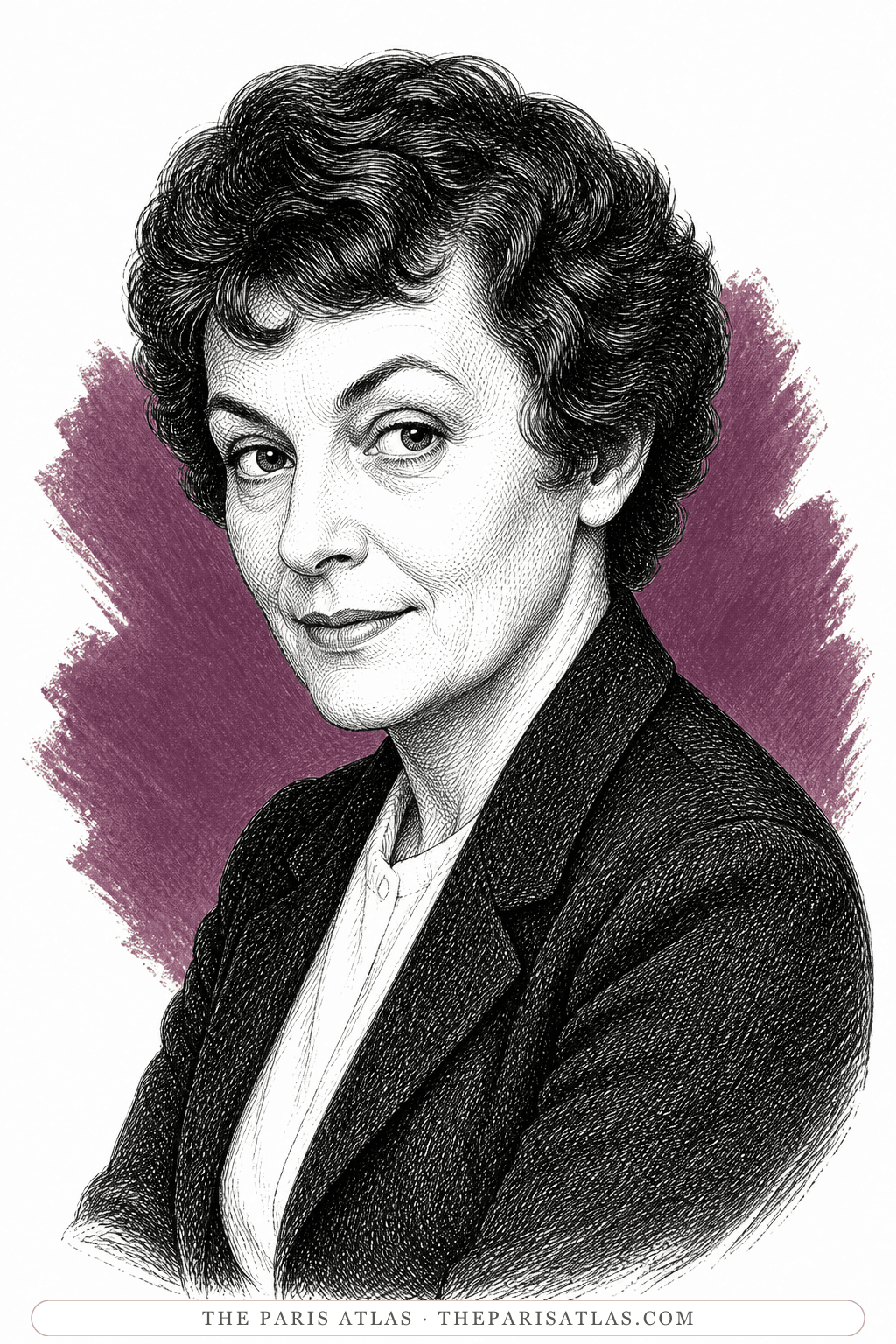
The thirty-four-year-old office worker who turns a holiday into a carefully witnessed search for the man she wants to kill her.
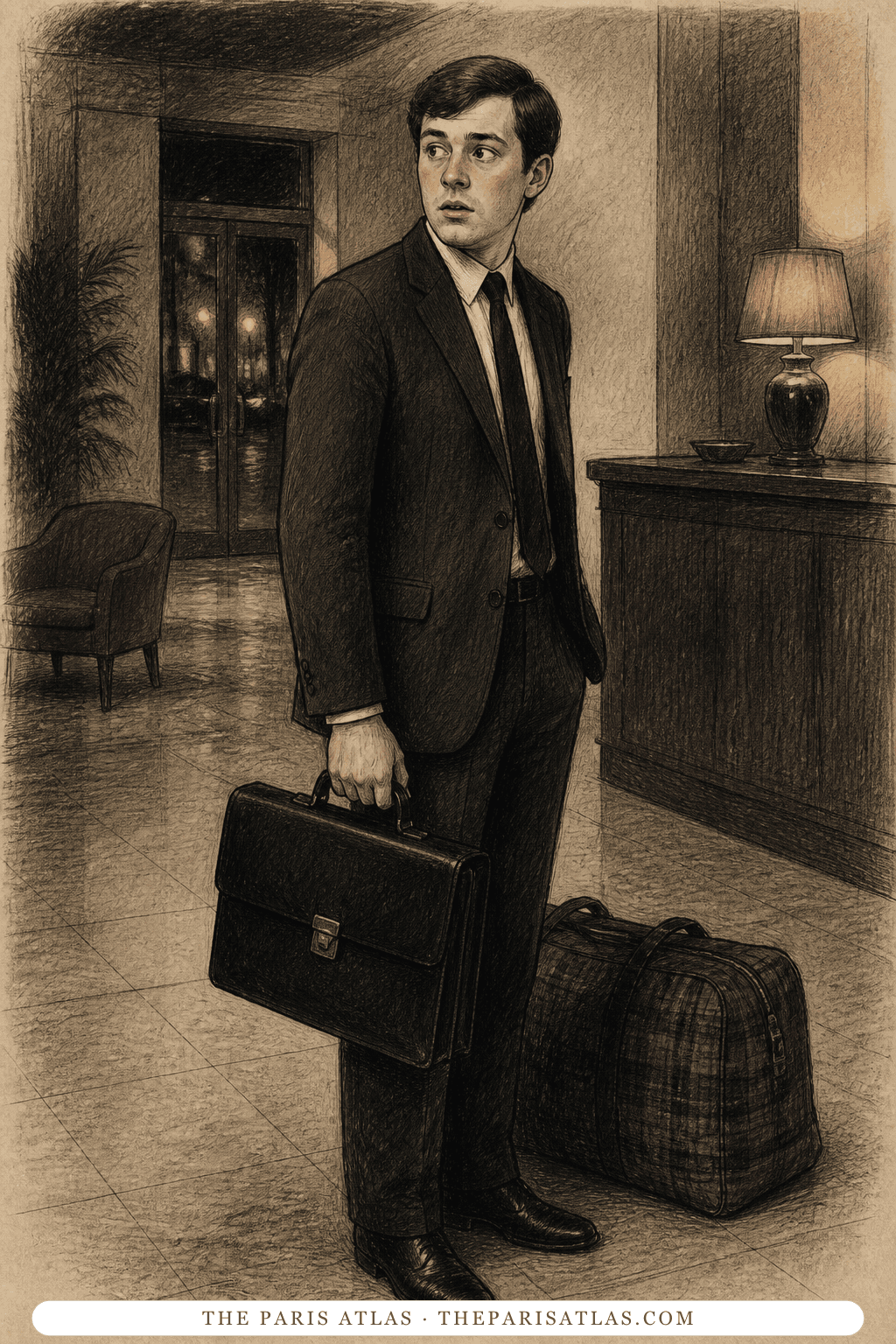
The frightened young man Lise identifies as her ‘type,’ whose resistance ends in the choice to murder her.

An elderly tourist whose belief that her nephew will appear draws Lise closer to Richard.

A macrobiotic traveler who follows Lise, assaults her, and becomes an obvious but mistaken suspect.

A garage proprietor whose assault of Lise and missing red car add another violent encounter to the police trail.

Shop workers who remember Lise's clothes, arguments, and purchases and later supply the investigation with exact details.

The unseen organizing force that turns testimony, purchases, cars, and hotel records into the official account of Lise's death.
1970
The New Yorker publishes The Driver's Seat in its 16 May issue, and Macmillan publishes the first British book edition in London.
1974
Giuseppe Patroni Griffi directs a film adaptation, also known as Identikit, starring Elizabeth Taylor as Lise.
1994
New Directions publishes a 106-page American paperback edition.
2006
Penguin Modern Classics publishes a 128-page edition with an introduction by John Lanchester.
2010
The novel appears on the six-book shortlist for the Lost Man Booker Prize, a one-time public vote for books published in 1970.
2014
New Directions issues the 112-page paperback and ebook used for the current American edition record.
2015
National Theatre of Scotland presents the first stage adaptation, adapted and directed by Laurie Sansom and starring Morven Christie.
2025
Penguin Modern Classics publishes a new 128-page paperback edition in the United Kingdom.


Both novels disclose catastrophe through broken chronology and partial testimony, forcing readers to rebuild responsibility from unstable accounts.
Read our take
Highsmith also makes travel, clothes, hotels, social performance, and a police investigation part of a tense study of identity and murder.
Read our take
Gide's short novel likewise follows a traveler whose private desire challenges the explanations and moral language available to the people around him.
Read our take
Both books center a highly observant woman in psychological crisis, but Plath provides social and medical context that Spark deliberately withholds.
Read our takeIt follows Lise, a thirty-four-year-old office worker who travels to a southern city, makes herself memorable to witnesses, and searches for a man she intends to direct toward killing her.
Yes. The narration tells readers early that Lise will be murdered. The suspense comes from understanding her plan, the evidence she creates, and the responsibility of the man who kills her.
She deliberately seeks her own murder, but Spark refuses to reduce her to a conventional clinical explanation. The novel is interested in the plan and its strange logic more than in supplying a diagnosis.
She wants strangers to remember and describe her. The exact colors become part of the witness trail police use after her death.
Richard kills Lise with the paper knife she provides. She plans and pressures him toward the act, but he chooses to commit the murder and remains responsible for it.
The scream shows the gap between planning death and experiencing its physical reality. It does not erase her intention; it reveals the limit of the control she thought the plan would give her.
No. Bill sexually assaults Lise and is arrested, but the timing of that arrest gives him an alibi for the murder. Richard is the killer.
Spark leaves both Lise's northern home and the southern destination unnamed. Rome is a common association, especially because of the film, but the novel itself does not identify the city.
The title points toward control. Lise appears chaotic, yet she is trying to control the final event of her life and put herself, perversely, in the ‘driver’s seat’ of her own destruction.
The sentences and scenes are clear and the book is short, but its jumps into future police testimony require attention. Readers know the outcome early and gradually learn how the pieces connect.
Yes. A 1974 film also known as Identikit stars Elizabeth Taylor, and National Theatre of Scotland presented the first stage adaptation in 2015 with Morven Christie as Lise.
Explore authors with a similar voice, perspective, and influence.
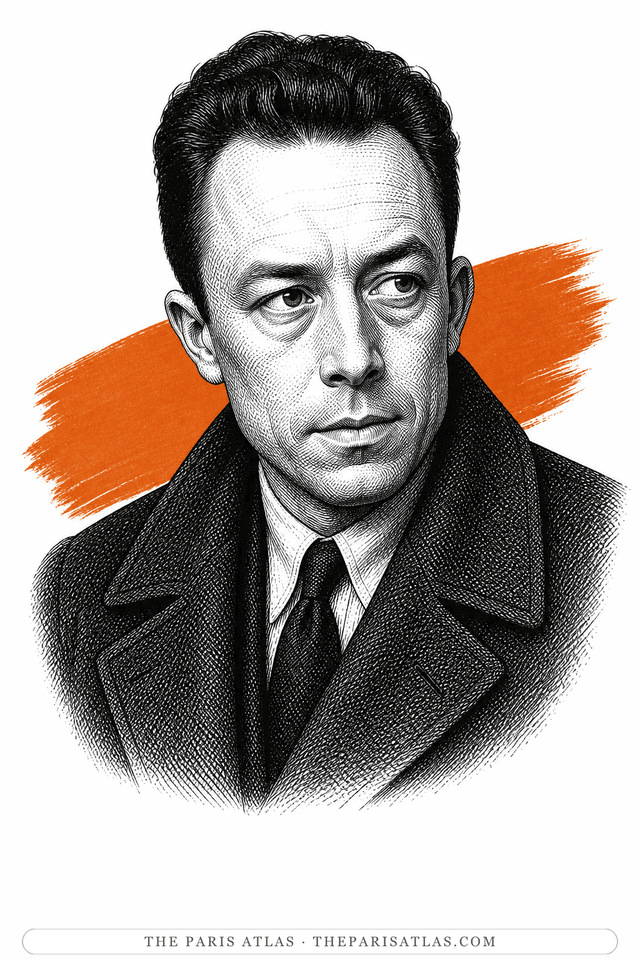
French Algerian novelist, essayist, journalist and playwright who used the absurd and revolt to ask how people should live without false consolation.
View author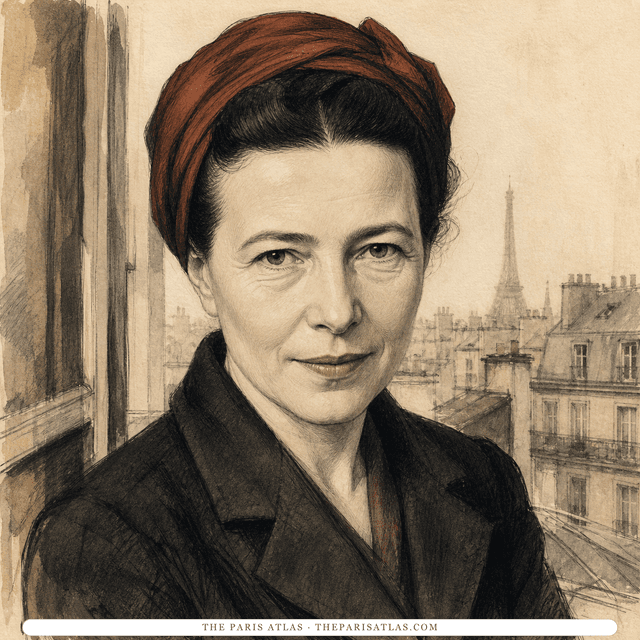
French writer and philosopher whose novels, memoirs, and social analysis examined freedom, gender, responsibility, aging, and the material conditions that shape a life.
View author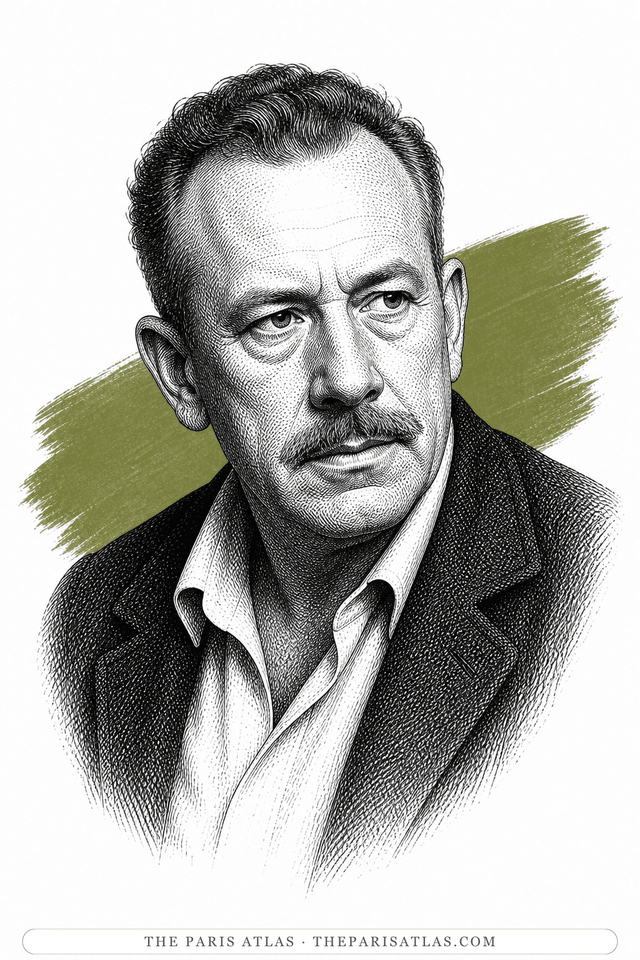
American novelist of the California fields and of the Dust Bowl migration — the exodus of farming families driven off the drought-ruined southern plains in the 1930s — awarded the Nobel Prize in Literature in 1962. In the summer of 1954 he moved into 1 avenue de Marigny in Paris and wrote for the Paris daily newspaper Le Figaro. Some of that work reached French readers in translation long before it was ever printed in his own English: one story waited sixty-five years.
View authorThe sources below include the primary text, editions, scholarship, archival materials, and other records that informed this page. They document The Driver’s Seat, its publication, and its place in literary history.


Publisher record used for the 1994 and 2014 American editions, ISBNs, dates, and page counts.

Primary text used to verify the plot, ending, chronology, character details, objects, and the novel's deliberately unnamed geography.
Publisher record used for the 2006 Penguin Modern Classics edition and its John Lanchester introduction.
Publisher record used for the 2025 Penguin Modern Classics edition, ISBN, publication date, and page count.
Booker Prize Foundation record used to cross-check the 1970 publication and novel summary.
Official prize history used to verify the Lost Man Booker shortlist and result.
BFI record used to verify the 1974 film's alternate title, director, runtime, country, language, and principal cast.
Theatre company record used to verify the first stage adaptation, dates, adapter-director, and lead performer.
Open Library ISBN catalogue retained as a cross-check for alternate edition metadata.
Google Books catalogue retained as a cross-check for edition metadata.
Internet Archive catalogue retained for edition discovery and library availability.
Library of Congress catalogue retained for bibliographic cross-checking.
The primary text is the baseline reference for every book page. Additional references document publication history, interpretation, and historical context where that evidence is available.
 Explore more resources