
The Castle
Kafka’s later novel follows another outsider seeking recognition through employment, documents and personal introductions.
Read our take
by Franz Kafka
A young migrant looks for steady work in an America where each welcome can become another form of dependence.
Karl Rossmann, a German-speaking teenager from Prague, arrives in New York after his parents send him away. A wealthy uncle initially offers protection, but that refuge disappears. Kafka’s first novel follows Karl through encounters with traveling companions, hotel employers and a theater recruiting workers, in an imagined America he tries repeatedly to understand.
Karl’s arrival begins with a forgotten umbrella and an encounter with a ship’s stoker. He takes up the worker’s complaint against a superior, believing he can persuade the officers to listen. The unexpected appearance of his uncle changes Karl’s prospects before the dispute is settled.
The new country is full of movement, noise and impressive equipment. Streets, offices and hotels promise opportunity, but the rules governing entry and advancement keep slipping beyond Karl’s grasp. His wish to learn does not protect him from people who can reinterpret what he does.
Karl wants useful work and a secure place to live. He also wants his conduct understood fairly, which becomes harder whenever he must depend on someone else. Even those who offer help can expect obedience in return or accept accusations he believes he can answer.
Karl’s uncle welcomes him into a prosperous New York household and provides lessons. After Karl visits the country home of the uncle’s associate Pollunder, a letter cuts him off. The punishment follows a visit for which permission had seemed to be given, leaving Karl to dispute how the decision was made.
On the road, Karl quarrels with Delamarche and Robinson after they open his suitcase. His parents’ photograph goes missing. At the Hotel Occidental, head cook Grete Mitzelbach offers him work as an elevator boy, but a drunken visit from Robinson puts that position at risk.
Karl leaves his post briefly to get Robinson into a bed. He has arranged informal cover but has not obtained the required permission. Dismissal follows an inquiry that expands into unsupported accusations. Later, Delamarche shelters him from police pursuit, then prevents him from leaving the household he shares with Brunelda.
In the later theater chapter, Karl answers an advertisement promising to accept everyone. After passing through several recruitment offices, he is taken on for technical work. He meets Giacomo, a former hotel colleague, and the two travel together by train toward Oklahoma.
The journey offers a new sense of possibility, but the surviving passage does not show their arrival or establish Karl’s future. Kafka left the novel unfinished. The theater episode and separate fragments do not provide a continuous, completed account of how every earlier situation is resolved.
The opening encounter with the stoker shows Karl attempting to make a worker's grievance intelligible to people in command. His confidence in explanation precedes his knowledge of the ship's hierarchy. His uncle's intervention changes his own circumstances before the complaint he has adopted receives a conclusive answer.
Later disputes place Karl in the position of the person struggling to be heard. At the hotel, a specific unauthorized absence expands into accusations that exceed it. Giving a detailed account does not guarantee that the people entitled to decide will distinguish an actual breach from an unsupported allegation.
The uncle's protection supplies lessons, comfort and prospects, but continued belonging depends on compliance with conditions Karl cannot reliably interpret. The disputed visit to Pollunder turns an apparently permitted action into grounds for exclusion. Hospitality proves less secure than the welcome initially suggests.
Delamarche later uses shelter from pursuit to justify control over Karl's movements. The two situations differ in social setting and degree of coercion, yet each exposes a danger in dependence: assistance may be retrospectively described as a contract whose terms the recipient never understood.
The opening Statue of Liberty holds a sword, and the America that follows should not be treated as a traveler's verified geography. Kafka's streets, offices and hotel operations magnify the newcomer's difficulty in locating himself within a system. Mechanisms and hierarchies appear impressive before their working rules become comprehensible.
Karl's willingness to learn does not make those rules stable. His vulnerability also belongs to the circumstances in which his family sent him away, including an adult servant's sexual coercion. The novel's scenes of opportunity should be read with that dispossession in view, rather than as tests administered to an entirely free and unburdened adventurer.
The theater advertisement appears to reverse the exclusions Karl has experienced by announcing that everyone can find a place. Recruitment nevertheless sends him through offices that classify his background before assigning work. The welcoming promise and the administrative procedure remain present together.
The train journey with Giacomo brings companionship and a widened view, but the surviving passage does not show an arrival or a settled career. Kafka left gaps between episodes and did not complete the novel. The theater offers a possibility whose consequences remain unwritten, so it cannot be confidently presented as either final rescue or a conclusively exposed fraud.
The German transcription: the stoker and uncle, the disputed Pollunder visit, the hotel dismissal, Delamarche's household and the complete theater fragment. It is not the selected modern English translation.
Composition, the separately published Stoker, and the unfinished novel's history.
It is impossible to defend oneself when there is no goodwill.Es ist unmöglich, sich zu verteidigen, wenn nicht guter Wille da ist
Everyone is welcome!Jeder ist willkommen!
Karl repeatedly looks for a position in which effort will lead to recognition. Each fresh start tests that belief under a different employer or protector.
The uncle, the head cook and Delamarche offer very different kinds of assistance. Following what each expects in return makes Karl’s dependence concrete.
The advertisement welcomes everyone but says nothing about wages. Karl is encouraged to apply, although the recruiters still sort applicants into official categories. Hope and uncertainty remain present together.

The fictional teenage migrant from Prague who seeks work, recognition and a place he can keep.
1912–1914
Kafka writes most of the surviving novel from late September 1912 to January 1913 and adds fragments in August–October 1914.
1913
Kurt Wolff publishes the opening chapter separately as Der Heizer, The Stoker, explicitly labeled a fragment.
1927
Kurt Wolff Verlag in Munich publishes the unfinished novel in December as Amerika, edited by Max Brod. Kafka’s own title for the project was Der Verschollene.
2011
Schocken issues the selected US paperback of Mark Harman’s translation on August 16.

Kafka’s later novel follows another outsider seeking recognition through employment, documents and personal introductions.
Read our take
The hotel inquiry anticipates the troubling gap between an accusation and a fair chance to answer it in Kafka’s later novel.
Read our take
Gregor Samsa’s story gives work and dependence a different setting inside a household.
Read our takeYes. Kafka called the project Der Verschollene. Brod supplied Amerika for the 1927 publication. The Missing Person and The Man Who Disappeared are English renderings of Kafka’s title, not separate novels.
The unfinished novel appeared in December 1927, three years after Kafka’s death, from Kurt Wolff Verlag in Munich. Its opening chapter, The Stoker, had already appeared separately in 1913.
No. He drew on accounts, images and other material available to him. Karl’s journey is fictional, and the novel’s geography should not be treated as a reliable travel map.
The theater chapter gives Karl a new job and an unusually hopeful journey with Giacomo. It does not show their arrival. Because Kafka left the manuscript unfinished, that hope is not a completed account of Karl’s future.
A sword, rather than the real statue’s torch, appears in the opening. It helps establish the unfamiliar America Karl sees. Its meaning is open to interpretation, but replacing it with a torch would change Kafka’s text.
The selected edition is Schocken’s 2011 paperback of Mark Harman’s restored-text translation, ISBN 9780805211610, 336 pages. The scene checks use a German PDF. Both English quotations are identified as Atlas translations.
Explore authors with a similar voice, perspective, and influence.
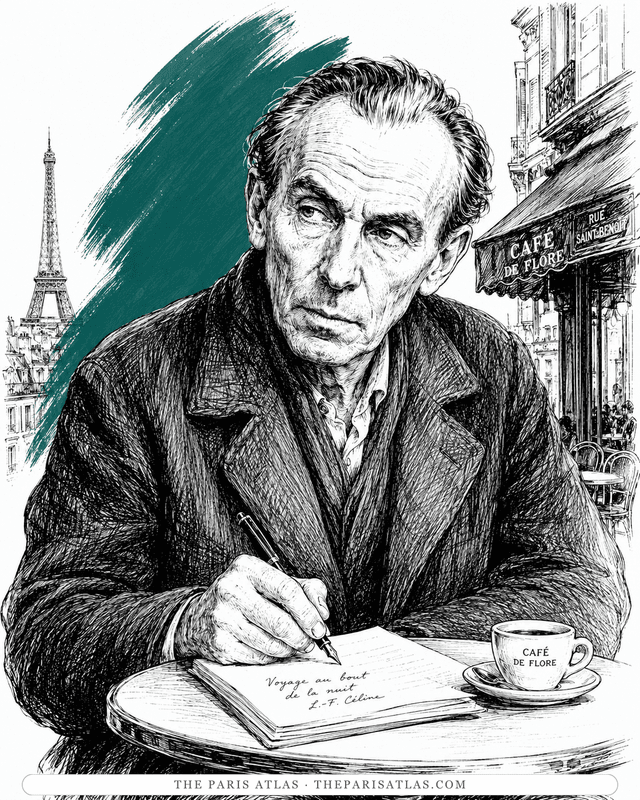
The doctor of the Paris slums who wrote the century's blackest, funniest novel — and changed the sound of French prose.
View author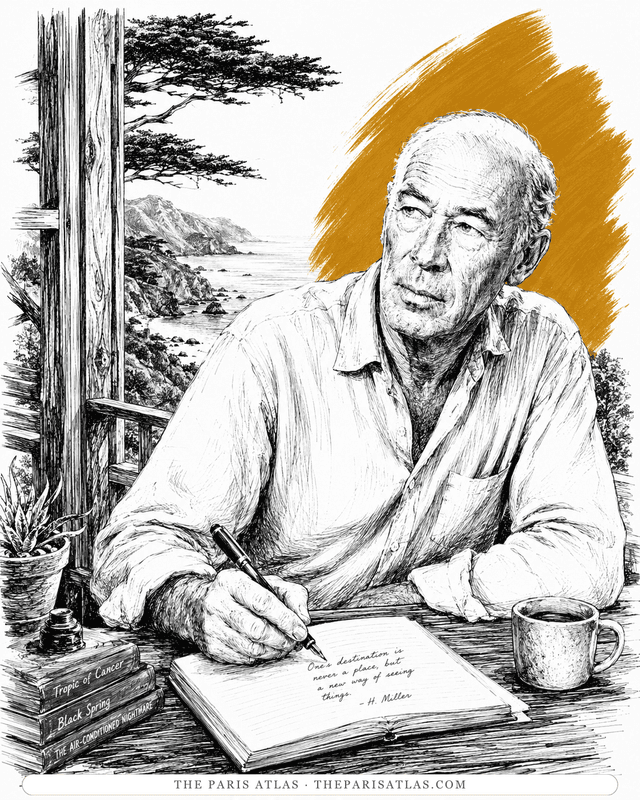
The Brooklyn dropout who arrived in Paris broke at thirty-eight and wrote the exuberant, banned books that ended American censorship.
View author
American novelist and composer whose expatriate fiction explores dislocation, unstable intimacy, fatalism, and North Africa.
View authorThe sources below include the primary text, editions, scholarship, archival materials, and other records that informed this page. They document Amerika, its publication, and its place in literary history.


The primary text represented by this page, used for descriptions of the work’s contents and for any quoted passages shown here.
Primary German passages checked for narrative claims, six Karl readings and the original wording of both quotations. The theater chapter was read in full; the entire novel was not. The PDF does not identify a critical edition and places separate fragments after the theater episode.
Publisher bibliography establishes the composition periods, Kafka’s title, Brod’s title and editorial role, and the December 1927 Munich first publication.
Publisher account verifies The Stoker’s separate 1913 publication and distinguishes Kafka’s imagined America from a journey he personally made.
Publisher metadata verifies Schocken’s August 16, 2011 paperback, Mark Harman translation, ISBN and 336-page extent. Harman’s text was not consulted for scene wording or quotations.
The primary text is the baseline reference for every book page. Additional references document publication history, interpretation, and historical context where that evidence is available.
 Explore more resources