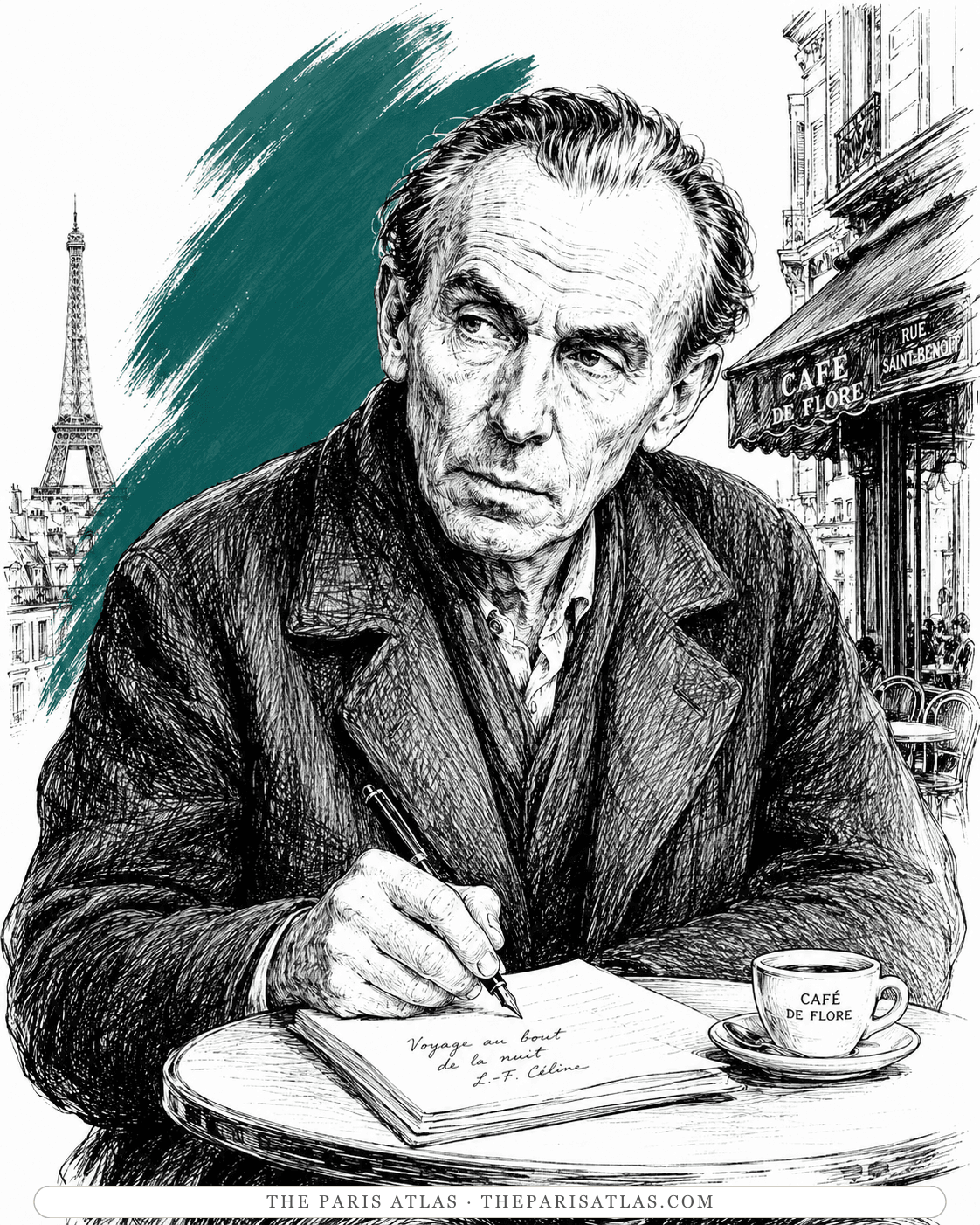

Louis-Ferdinand Céline's 1932 first novel, which follows one man from the First World War through colonial Africa and industrial America to the Paris slums.
One battered narrator, an indifferent world, and a voyage through the bottom of it — savage, funny, and unconsoled.
The picaresque is one of fiction's oldest engines: a rogue's first-person journey through the underside of a corrupt society, told episode by episode, surviving on wit rather than virtue. The name comes from the Spanish pícaro — rascal — and the form was born in sixteenth-century Spain with anonymous scandals like Lazarillo de Tormes (1554), in which a servant boy narrates his way through a parade of masters, each one a satire of some respectable institution.
The shape has stayed remarkably stable for four centuries: a low-born or déclassé narrator; a journey with no destination but survival; encounters that expose the society's hypocrisies one professional class at a time; and a voice — always the voice — that seduces the reader into complicity. The picaro doesn't reform and the world doesn't improve. The satire is the point; consolation is not on offer.
The Paris moderns revived the form with the volume turned all the way up. Journey to the End of the Night is the twentieth century's definitive picaresque — Bardamu tumbling from the war to colonial Africa to Ford's Detroit to the Paris slums, each stop a fresh indictment, the voice doing exactly what Lazarillo's did with four hundred more years of disillusionment behind it. Miller's Tropics run the same engine with the despair swapped for appetite: a broke rogue loose in Paris, living on wits and other people's dinners, narrating it all with disgraceful charm.
Read one and you'll recognize the genre everywhere — it's the ancestor of every road novel, every unreliable charmer, every satire narrated from the gutter looking up.
Louis-Ferdinand Céline's 1932 first novel, which follows one man from the First World War through colonial Africa and industrial America to the Paris slums.

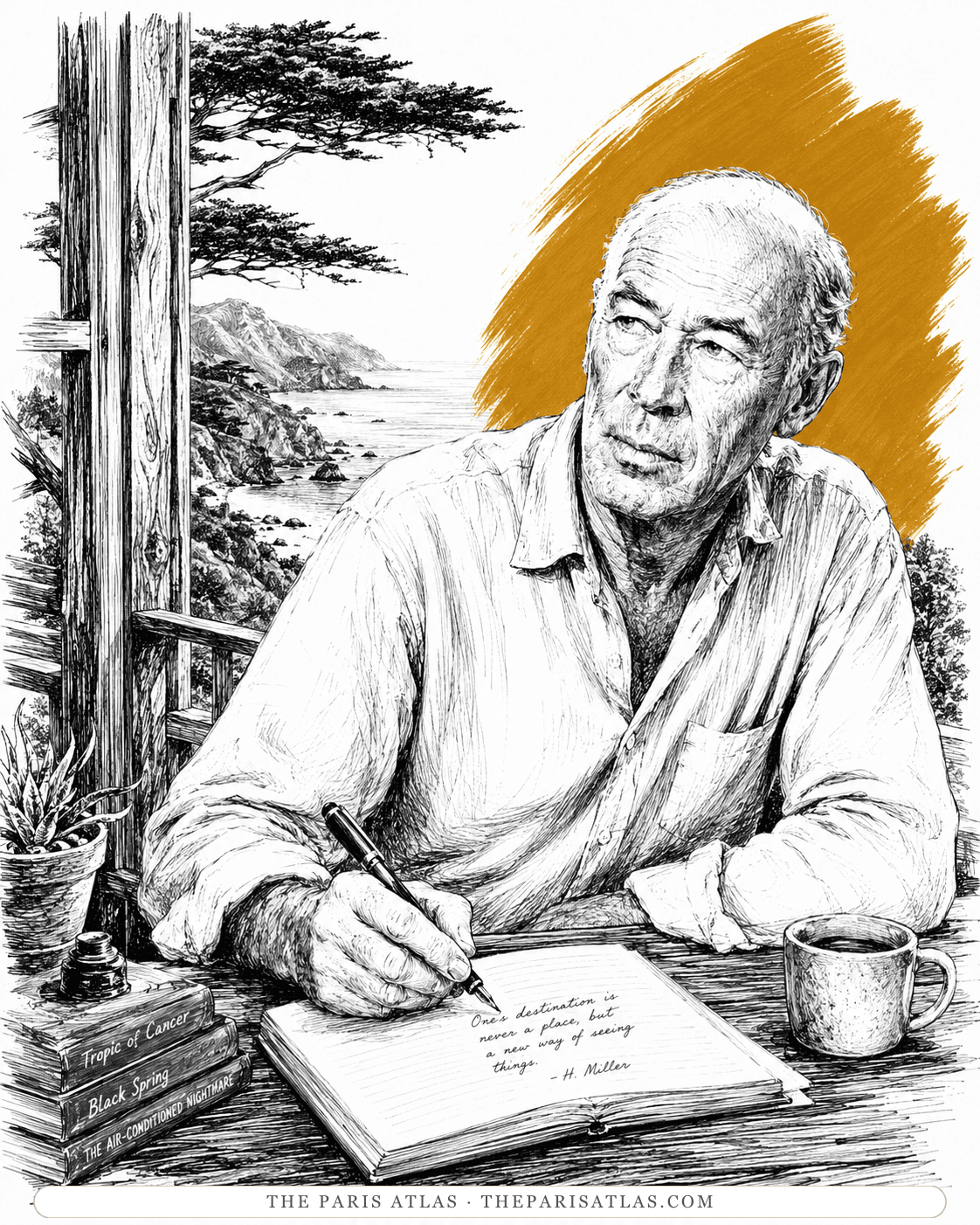
Broke, shameless, and ecstatically alive in 1930s Paris — the banned book that ended American censorship.

Before Paris: the Brooklyn years, the Cosmodemonic Telegraph Company, and the fury that made the flight necessary.

Céline's shrieking, hilarious portrait of a Belle Époque Paris childhood in the Paris arcades — poverty as opera.

Louis-Ferdinand Céline's 1944 novel — a wounded French veteran drops into a London underworld of pimps, prostitutes, musicians and eccentrics.

Louis-Ferdinand Céline's posthumous 1964 novel — Guignol's Band II picks up in wartime London with gas-mask experiments, a fourteen-year-old niece, and the criminal past that will not release Ferdinand.

Louis-Ferdinand Céline's recovered 2022 novel Londres, arriving in English as London on 13 October 2026 in Charlotte Mandell's New Directions translation — a French criminal underworld in wartime London destroys itself around Ferdinand.

A young psychiatrist frees the world's most dangerous patient and follows him into the abyss — the monster-novel Henry Miller pressed on everyone.

The Rosy Crucifixion, book two: married to Mona, done with jobs forever, and learning — expensively — how to become a writer.

The happiest of the Paris books: two broke friends in a Clichy flat, and the era remembered as pure appetite.

Djuna Barnes's first novel, published in New York in 1928 with twelve passages cut by her own publisher and replaced by rows of asterisks — a bawdy chronicle of a farm household run by one man, his mother, his wife and his mistress.

The Rosy Crucifixion begins: New York in the twenties, the marriage that must end, the woman who must be Mona — his most banned book.

The parody that burned a bridge on purpose: Hemingway lampoons his mentor Sherwood Anderson — and breaks a contract doing it.

Black seamen, drifters and musicians on the Marseille waterfront — the novel that gave Négritude its vocabulary, written by a Jamaican who preferred the docks to literary Paris.

The first bestseller by a Black American novelist — written in France, set in Harlem, and denounced by the movement it belonged to.

Jack Kerouac turns highways, jazz, friendship, poverty, and restless movement across America into the defining Beat novel.

J. P. Donleavy’s blackly comic novel of a charming American disaster drinking and scheming his way through postwar Dublin.

Henry Chinaski across wartime America, one abandoned job at a time — the American work ethic, refused politely and then not politely.

On a journey down the Mississippi, Huck's loyalty to Jim comes into conflict with what he has been taught is right.

A trusting young traveler keeps finding suffering where his teacher promised a perfectly ordered world.

A perceptive young Babylonian discovers that sound reasoning offers little protection from jealous rulers and judges who protect their own interests.

A young migrant looks for steady work in an America where each welcome can become another form of dependence.

Two Persian travellers loose in Paris, writing home about a city they cannot make sense of — and the household one of them left behind, coming apart while he is away.

An Irish orphan in Lahore walks the roads of India with an old Tibetan lama, and is quietly trained as a British spy.

A London gentleman bets half his fortune that he can circle the globe in eighty days, and takes a Parisian valet with him.

A Hartford factory boss wakes up near Camelot in the year 528, fakes a miracle with an eclipse, and tries to bring the nineteenth century to King Arthur's England.

A giant from a planet near Sirius and a dwarf from Saturn land on Earth, pick up a shipful of scientists, and ask them what a soul is.
Newsletter
The Friday letter explains one book at a time — what style it works in, why that matters, and where to go next.