
Naked Lunch
Grotesque sexual and bodily transgression appears in fragmented modernist prose.
Read our take
by Georges Bataille
Bataille’s short, controlled escalation of erotic obsession into surreal violence and transgression.
An unnamed teenage narrator and Simone push sexual dares into a private world of humiliation, violence, religious imagery, and death. Eyes, eggs, the sun, and other round white forms repeat until erotic imagery becomes a disturbing surreal system.
Simone and the narrator begin with sexual games and keep seeking stronger boundaries to violate. Marcelle, another young woman, is drawn into their world, suffers a psychological collapse, and later dies.[1]
After Marcelle’s death, the narrator and Simone flee with Sir Edmond. Spain’s bullfighting, Catholic ritual, heat, and spectacle intensify the association between pleasure and mortality.[1]
Bataille first published the novella under the pseudonym Lord Auch. It is explicitly pornographic, but its literary force comes from the controlled prose and the way recurring objects mutate through shocking new contexts.[1]
The unnamed narrator and Simone begin experimenting sexually while still adolescents. Their games are playful, aggressive, and increasingly organized around the excitement of crossing a taboo.[1]
Marcelle becomes involved in their activities. During an intense encounter she experiences a breakdown and is later confined in an institution. Her confinement makes the damage caused by Simone and the narrator impossible to dismiss as private fantasy.[1]
The narrator and Simone continue pursuing transgression and attempt to reconnect with Marcelle. Her suffering deepens, and her death draws mortality directly into the erotic system they have created.[1]
After Marcelle’s death, the narrator and Simone flee with the assistance of Sir Edmond. They travel to Spain, where bullfighting, Catholic ritual, bright heat, and public spectacle give Bataille’s recurring images a new setting.[1]
Inside a church they involve a priest in an extreme sequence of sexual violence, sacrilege, and murder. The scene pushes the repeated connection among eyes, eggs, white round objects, bodily fluids, sex, and death to its most literal conclusion.[1]
The priest dies during the final violent and sacrilegious encounter in the church. His death is not treated as a conventional climax in which moral order returns.
Simone and the narrator incorporate part of the priest’s body into their sexual game, bringing the eye motif to its most disturbing and literal form. Earlier visual associations suddenly become physical action.
The protagonists do not receive a conventional punishment. The novella stops after taking its symbolic system as far as it can go, leaving the reader with escalation rather than moral closure.
Bataille repeatedly collapses pleasure and mortality into the same image. Marcelle’s suffering and the Spanish sequence make it impossible to preserve a safe line between sexual experiment and destruction.
A taboo matters to the protagonists because crossing it creates intensity. Once a boundary has been violated, it loses force, so Simone and the narrator search for a stronger prohibition and a more dangerous spectacle.
Eyes, eggs, the sun, and other round white forms connect through shape, color, and bodily association rather than one fixed symbolic definition. Each repetition carries memory from the earlier objects and changes what the next one means.
In the passages from Roland Barthes’s essay reproduced by eNotes, the link between eye and egg depends on language as well as appearance: the French words œil and œuf share part of their sound. Barthes therefore follows a changing series rather than decoding each object as a disguise for one hidden meaning. This gives the reader a practical distinction: notice what a new image preserves from its predecessor, but also what its different name and use make possible.
Catholic ritual offers one of the strongest systems of prohibition available to the characters. The church sequence seeks intensity by attacking sacred space, clerical authority, and the boundary between ritual objects and bodies.
Objects change meaning through repetition and shocking juxtaposition. The novella’s logic is associative rather than realistic: one shape calls up another until familiar things become charged with an unstable combination of desire and fear.
Barthes’s account also distinguishes these associations from unrestricted randomness. He traces one sequence through rounded objects and another through flowing substances; sunlight can join them because the sun has a circular form while its light spreads. The unexpected connections depend on recurring qualities, not simply on placing anything beside anything else. His reading explains how the book can unsettle familiar categories while remaining formally controlled: the comparisons keep returning to a limited field of shapes and movements.
Sex is repeatedly staged as performance, exposure, or violation of privacy. Watching and being watched become part of the pursuit, connecting the literal eye to social shame and public spectacle.
Bataille’s prose is surprisingly controlled given the material. He often reports extreme actions in blunt, cool language instead of using decorative erotic description or lengthy psychological explanation.
That distance increases the shock. The novella reads less like a conventional realistic story than a concentrated surreal experiment in how images mutate when they are repeated through sex, violence, religion, and death.
Joachim Neugroschel’s translation is widely read in English. Editions differ in their illustrations and critical essays. Because the work appeared privately under the pseudonym Lord Auch, edition history and the distinction between Bataille’s text and later commentary are especially important.
There is no single canonical film adaptation. Visual artists, filmmakers, and musicians have drawn on the novella’s imagery, but influence should not be mislabeled as a direct adaptation of its plot.
Eyes, eggs, sunlight, and round white objects gather new meanings through repetition.
Controlled sentences make the escalating violence more disturbing rather than less.
The novella refuses a punishment plot that would restore the boundaries it has destroyed.

The adolescent boy who participates in Simone’s games and recounts their escalation.

The narrator’s fearless partner and the strongest force behind the escalating transgressions.

The vulnerable young woman whose collapse and death reveal the cost of Simone and the narrator’s games.

The wealthy Englishman who assists Simone and the narrator and enables their later travel and crimes.

The Spanish Catholic priest made the victim of the novella’s final sacrilegious violence.
1928
The novella is privately published in French under the pseudonym Lord Auch.
1940
Hans Bellmer illustrates a later edition.
1978
Joachim Neugroschel’s English translation appears in the United States.
1980s–2000s
City Lights and Penguin editions establish the novella as a modern transgressive classic.
2001
Penguin Modern Classics issues an edition with essays by Susan Sontag and Roland Barthes.


Grotesque sexual and bodily transgression appears in fragmented modernist prose.
Read our take
Decadence and taboo unfold through a more conventional narrative.
Read our take


It is explicitly pornographic and is also widely studied as surrealist and transgressive literature.
The narrator and Simone are adolescents. That fact is important and should not be minimized.
Bataille builds association through shared shape, color, and bodily imagery rather than assigning one fixed meaning.
Yes. Her death joins mortality to the erotic system the protagonists have created.
It is the pseudonym Bataille used for the novella’s first publication.
Later material titled ‘Coincidences’ connects some images to Bataille’s memories, but the plot is fiction.
Yes, although Bataille’s relationship with organized Surrealism and André Breton was contentious.
The prose is short and direct, but the sexual violence and extreme imagery are exceptionally challenging.
Explore authors with a similar voice, perspective, and influence.
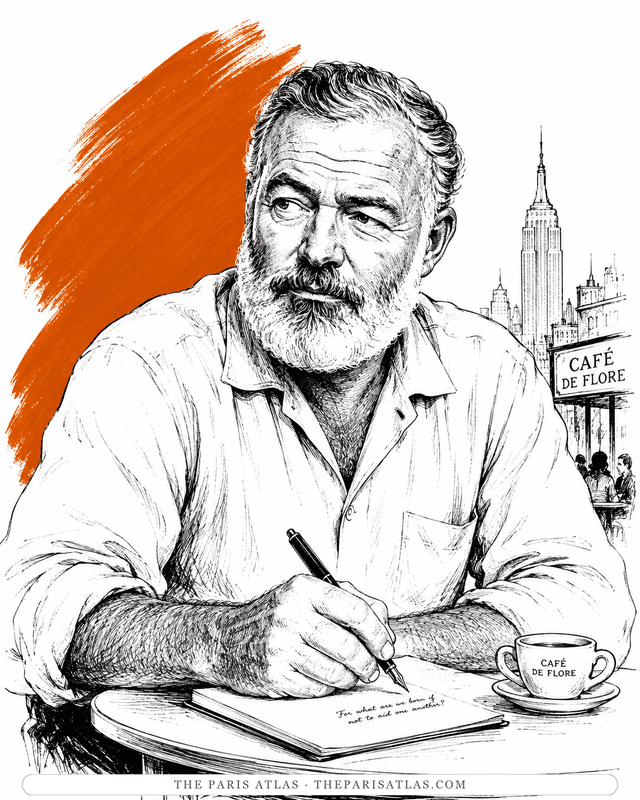
Author of The Sun Also Rises and A Moveable Feast; his pared-down style, developed in 1920s Paris, became the most imitated in American prose.
View author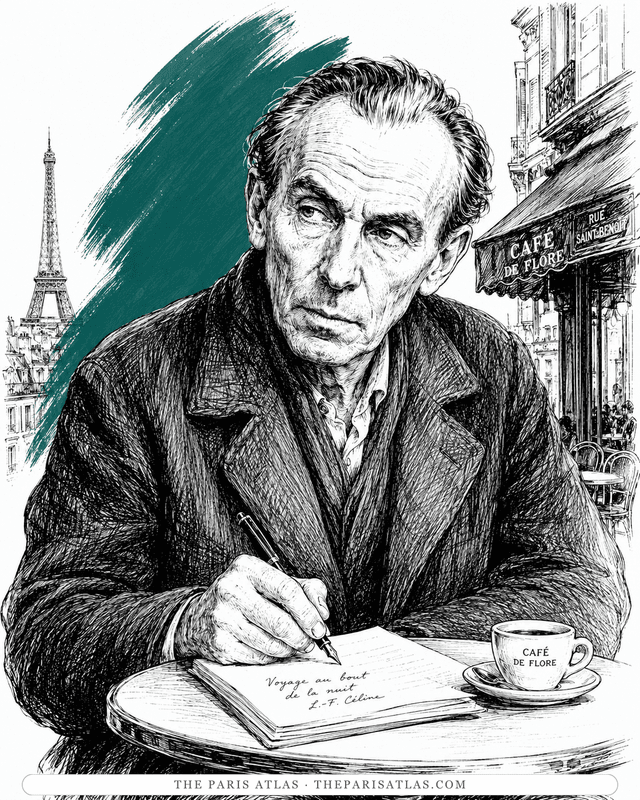
The doctor of the Paris slums who wrote the century's blackest, funniest novel — and changed the sound of French prose.
View author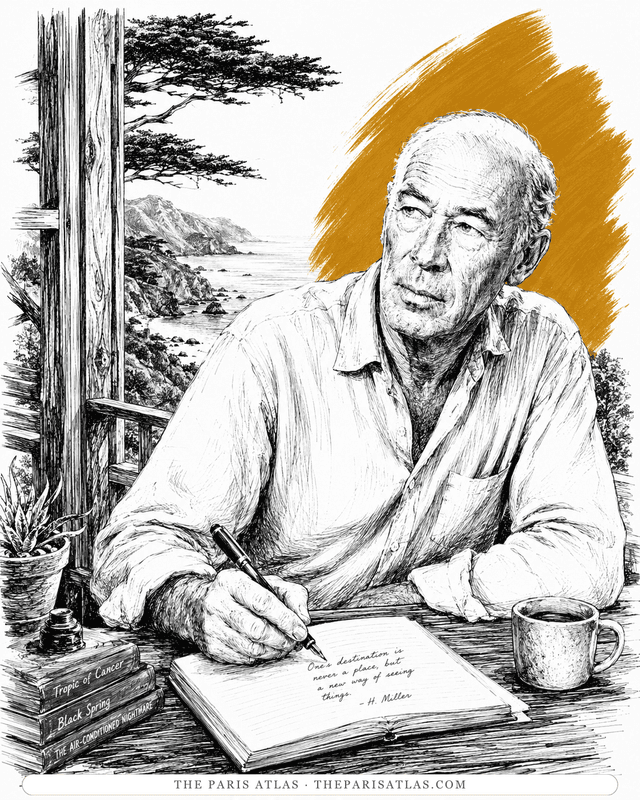
The Brooklyn dropout who arrived in Paris broke at thirty-eight and wrote the exuberant, banned books that ended American censorship.
View authorThe sources below include the primary text, editions, scholarship, archival materials, and other records that informed this page. They document Story of the Eye, its publication, and its place in literary history.


Google Books used to cross-check the 2001 edition and accompanying essays.
Internet Archive used to cross-check library holdings.
Library of Congress used to cross-check the bibliographic record.
Publisher page supplied for the translation, characters, plot, and critical framing.
Publisher page supplied for publication data and summary.

Publicly displayed selections from Roland Barthes’s essay in Richard Howard’s translation; used for the two attributed formal readings, not as a complete-novella source.
The primary text is the baseline reference for every book page. Additional references document publication history, interpretation, and historical context where that evidence is available.
 Explore more resources