
Danglars
The ship's purser who writes the denunciation, and the banker whose fortune the count takes apart with a telegraph and a bill of fare.
He wants money, and he wants the people around him to owe him for it.
The book

At a glance
- Purser of the Pharaon, Marseille
- Baron Danglars, banker, No. 7 Rue de la Chaussée d'Antin
- Wife Hermine; daughter Eugénie
Who they are in the book
Spoiler-freeDanglars is the purser of the Pharaon, twenty-five or twenty-six years old, disliked by the crew, and expecting the captaincy that the owner gives to Dantès instead. He is the brains of the conspiracy. He writes the denunciation, arranges for it to look like a joke, and lets Fernand do the posting.
In Paris he is Baron Danglars, a banker with a house on the Rue de la Chaussée d'Antin, a wife who speculates with a government minister's information, and a daughter, Eugénie, he means to marry into a title. The count opens an unlimited credit at his bank and then begins to spend it.
How Danglars Is Portrayed
- The purserIn Chapter 1 he is described as a man of twenty-five or twenty-six, of unprepossessing countenance, obsequious to his superiors and insolent to his subordinates, as much disliked by the crew as Dantès is loved.
- The left handIn Chapter 4 he writes the denunciation with his left hand so the writing cannot be traced, addresses it to the king's attorney, and tells Fernand it is only a joke.
- Unlimited creditIn Chapter 46 the count presents a letter from the house of Thomson and French opening an unlimited credit at Danglars's bank, and draws six million francs in the first year as a start.
- The false telegraphIn Chapter 61 a telegraph message reports that Don Carlos has escaped to Spain. Danglars sells his Spanish stock, the message is corrected the next day, and he has lost five hundred thousand francs.
- A conjugal sceneIn Chapter 65 he tells his wife exactly how much her speculations with the minister's secretary Debray have cost the bank, and the marriage is shown as a business account in deficit.
- The signatureIn Chapter 104 he signs a receipt for five million francs belonging to the Paris hospitals, hands the count his bonds, and leaves for Rome with the money the same night.
The bandit Luigi Vampa takes him on the road outside Rome and holds him in the catacombs of Saint Sebastian. Each meal costs a hundred thousand francs, and Danglars pays until fifty thousand remain and he is eating the matting on the floor. When he says he repents, a man in a cloak steps into the light and names himself: Edmond Dantès. The count forgives him and lets him keep the fifty thousand. Danglars is left by a stream at dawn and finds his hair has turned white.
If you like The Count of Monte Cristo


If you like Alexandre Dumas
Explore authors with a similar voice, perspective, and influence.

Mark Twain
The Missouri newspaperman who became America's most famous writer, and whose first book made its reputation partly out of Paris: in 1867 he arrived with a shipload of American tourists, renamed his guide Ferguson, watched the high-kicking can-can through his fingers and wrote it all down. He kept coming back — and was living in Paris in the mid-1890s, broke, while finishing the novel he considered his best, Personal Recollections of Joan of Arc.
View author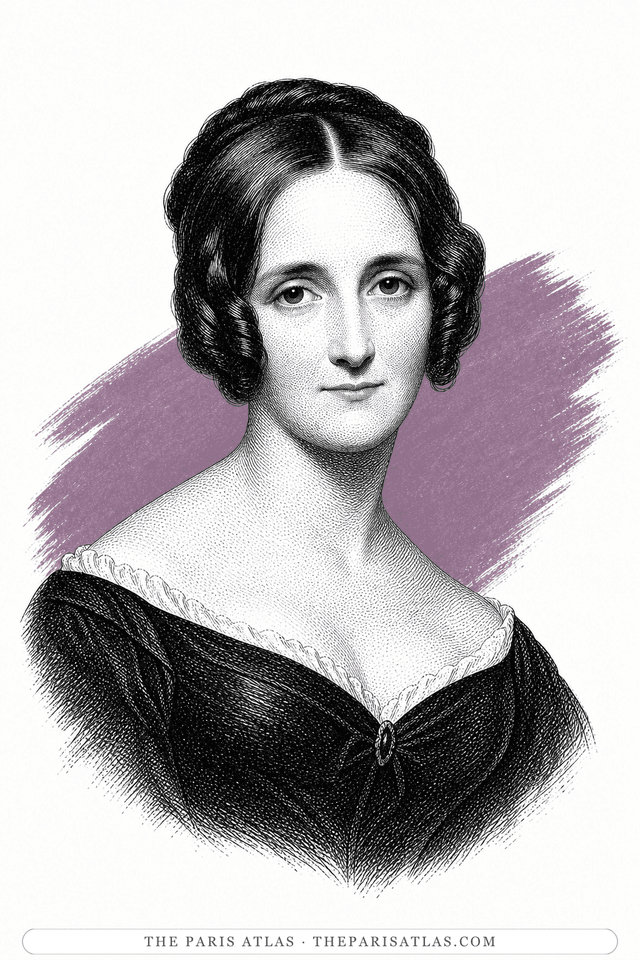
Mary Shelley
The author of Frankenstein, who first saw Paris at sixteen as a runaway. In the summer of 1814 she crossed from England to Calais with the poet Percy Bysshe Shelley and her stepsister Claire Clairmont, spent a week trapped in an expensive Paris hotel with no money, then bought a donkey and walked south-east across a France still wrecked by the Napoleonic wars. That journey became her first published book. Two years later, on a lake in Switzerland, she began her second.
View author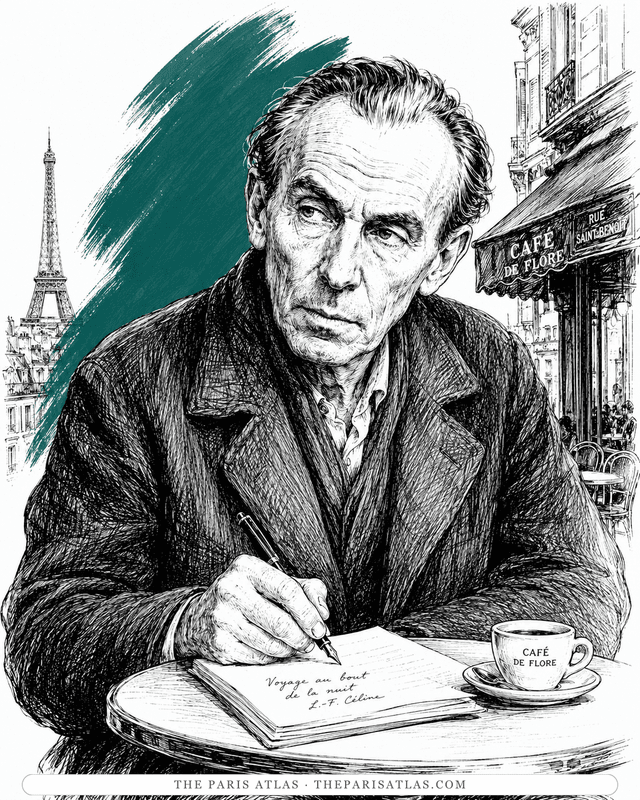
Louis-Ferdinand Céline
The doctor of the Paris slums who wrote the century's blackest, funniest novel — and changed the sound of French prose.
View author