
Fernand Mondego, Count of Morcerf
The Catalan fisherman who posts the denunciation, marries Mercédès, and rises to general and peer of France on a betrayal in Greece.
He wants Mercédès, and after he has her he wants never to be reminded of how he got her or how he got rich.
The book

At a glance
- A Catalan fisherman near Marseille
- Count of Morcerf, lieutenant-general, peer of France
- No. 27, Rue du Helder, Paris
- Married to Mercédès; father of Albert
Who they are in the book
Spoiler-freeFernand is Mercédès's cousin and a fisherman in the Catalan village. He has asked her to marry him and been refused, and he is drinking with Danglars and Caderousse on the night the denunciation is written. He carries the letter that Danglars pretends to throw away.
Twenty-three years later he is the Count of Morcerf, a lieutenant-general and a peer of France, with a mansion on the Rue du Helder. His fortune came from Greece, where he served Ali Pasha of Yanina. What he did there is the secret the count spends the second half of the book bringing into the open.
How Fernand Mondego, Count of Morcerf Is Portrayed
- The suitorIn Chapter 3 he is a tall young man of twenty or twenty-two in a Catalan cottage, pressing his cousin to marry him and hearing for the hundredth time that she loves someone else.
- The letterIn Chapter 4 Danglars writes the denunciation with his left hand as if in jest and crumples it into a corner. Fernand picks it up. The letter reaches the prosecutor the next day.
- How he roseIn Chapter 27 Caderousse recounts that Fernand was conscripted, served in Spain and then in Greece under Ali Pasha, and came home an officer with a fortune and a title, having married Mercédès in between.
- The Rue du HelderIn Chapter 41 he receives the count at home as the Count of Morcerf, a general and peer, and thanks him for saving Albert in Rome without any sign that he knows who stands in front of him.
- Haydée's accountIn Chapter 77 Haydée tells Albert and the count how her father Ali Pasha was betrayed to the Turks by a French officer named Fernand, and how she and her mother were sold into slavery.
- In the Chamber of PeersIn Chapter 86 a newspaper article about Yanina is read aloud in the Chamber, and the text describes moral wounds that never close as Fernand turns pale in front of his fellow peers.
Fernand Mondego, Count of Morcerf quotes
Moral wounds have this peculiarity,—they may be hidden, but they never close; always painful, always ready to bleed when touched, they remain fresh and open in the heart.
Haydée testifies before the Chamber of Peers with the deed of sale in her hand, and Fernand is disgraced. He goes to the count's house to fight and learns, when the count changes his clothes and appears as the sailor of 1815, whom he has been fighting all along. In Chapter 92 Mercédès and Albert leave him, and as their carriage passes the gate a pistol shot is heard from his room.
If you like The Count of Monte Cristo


If you like Alexandre Dumas
Explore authors with a similar voice, perspective, and influence.

Mark Twain
The Missouri newspaperman who became America's most famous writer, and whose first book made its reputation partly out of Paris: in 1867 he arrived with a shipload of American tourists, renamed his guide Ferguson, watched the high-kicking can-can through his fingers and wrote it all down. He kept coming back — and was living in Paris in the mid-1890s, broke, while finishing the novel he considered his best, Personal Recollections of Joan of Arc.
View author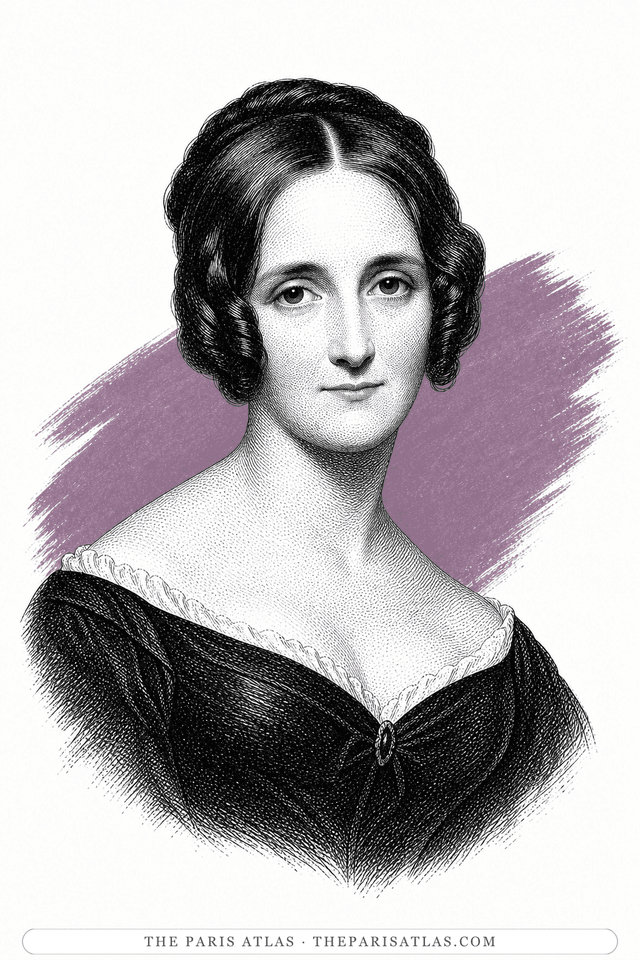
Mary Shelley
The author of Frankenstein, who first saw Paris at sixteen as a runaway. In the summer of 1814 she crossed from England to Calais with the poet Percy Bysshe Shelley and her stepsister Claire Clairmont, spent a week trapped in an expensive Paris hotel with no money, then bought a donkey and walked south-east across a France still wrecked by the Napoleonic wars. That journey became her first published book. Two years later, on a lake in Switzerland, she began her second.
View author
Louis-Ferdinand Céline
The doctor of the Paris slums who wrote the century's blackest, funniest novel — and changed the sound of French prose.
View author