
Athos
The Comte de La Fère, retired to Blois with his son Raoul, who ages ten years in a week when the boy sails for Africa.
To keep Raoul beside him, and failing that, not to survive him.
The book

At a glance
- Comte de La Fère; sixty-two
- His house at Blois, on the road to La Fère
- Grimaud, who goes to Africa with Raoul and brings back the news
Who they are in the book
Spoiler-freeAthos, the Comte de La Fère, has withdrawn from the court after breaking his sword before the king in the previous volume. He lives at Blois with his son Raoul de Bragelonne, whose fiancée Louise de La Vallière the king has taken. He has one wish, which is to keep Raoul alive, and the book denies it.
He is the moral measure of the four, and Dumas uses him to judge Aramis in one sentence and to insist that a masked prisoner be called monseigneur. His decline after Raoul leaves, in Chapter LVI, is written as a medical fact: a man of sixty-two who became old in a week.
How Athos Is Portrayed
- A great idea, a great errorIn Chapter XXVI Aramis tells him the plot in a few words, and Athos, sweating as he listens, calls it a great idea but a great error, and a capital crime. He then watches Aramis and Porthos ride off in white cloaks and says he has seen them for the last time.
- The silver plateIn Chapter XXXI, in the governor's garden on Sainte-Marguerite, a plate thrown from a barred window rolls to Raoul's feet. Athos reads the message scratched on it, drops the plate, and when a musket fires at them from the wall shouts at the cowards to come down.
- Say monseigneurIn Chapter XXXII, hidden on the stairs during a storm, he watches the masked man cross the gallery. When the governor tells the prisoner to come on, Athos calls out from the dark that he must say monseigneur, and the governor trembles.
- Until the ship disappearsIn Chapter XXXIII, when d'Artagnan is recalled to the Louvre, Athos refuses to leave Raoul until the day his vessel drops below the horizon. As long as the boy is in France he will not be separated from him.
- Old in a weekIn Chapter LVI, back at Blois without Raoul or Grimaud, he stays in bed with a book under his pillow that he does not read. He misses meals, walks his shaded path once a day, and sits up at night writing on parchment.
- One questionIn Chapter LVIII a horse gallops up the drive and Grimaud, white-haired and covered in dust, stands in the doorway. Athos asks whether Raoul is dead, hears yes, and dies that night. D'Artagnan finds him smiling and closes his eyes.
Athos quotes
I have conspired against the king; that conspiracy has failed, and, at this moment, I am doubtless pursued.
Athos—Porthos, farewell till we meet again! Aramis, adieu forever!
He dies in Chapter LVIII at Blois on the night Grimaud arrives with the news of Raoul's death at Gigelli, having already seen the death in a vision. D'Artagnan, arriving to tell him of Porthos, finds him dead and then finds two coffins in the hall, because Beaufort has had Raoul's body embalmed and sent home. Louise de La Vallière visits the double grave in Chapter LX.
If you like The Man in the Iron Mask


If you like Alexandre Dumas
Explore authors with a similar voice, perspective, and influence.

Mark Twain
The Missouri newspaperman who became America's most famous writer, and whose first book made its reputation partly out of Paris: in 1867 he arrived with a shipload of American tourists, renamed his guide Ferguson, watched the high-kicking can-can through his fingers and wrote it all down. He kept coming back — and was living in Paris in the mid-1890s, broke, while finishing the novel he considered his best, Personal Recollections of Joan of Arc.
View author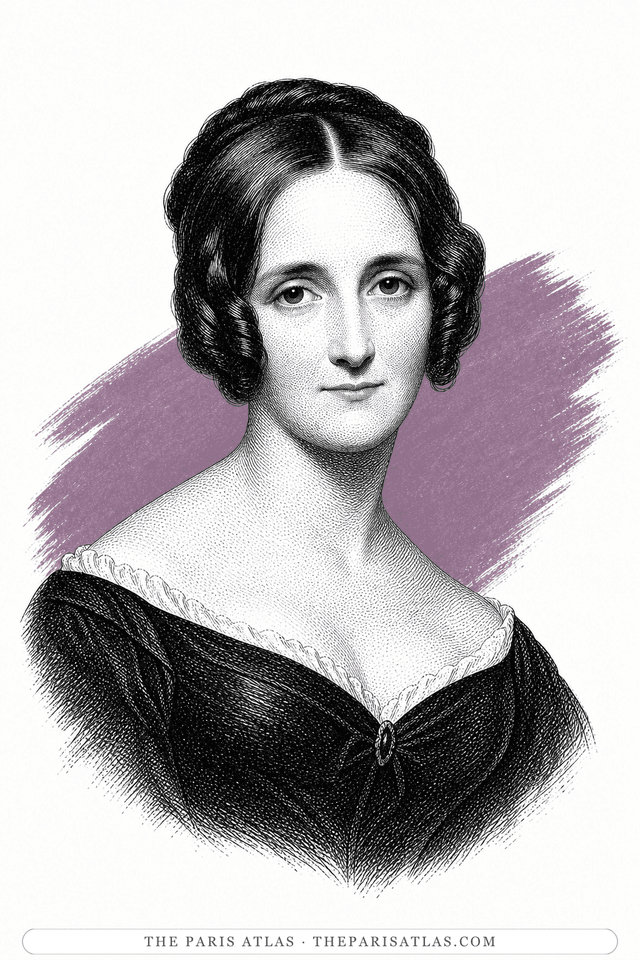
Mary Shelley
The author of Frankenstein, who first saw Paris at sixteen as a runaway. In the summer of 1814 she crossed from England to Calais with the poet Percy Bysshe Shelley and her stepsister Claire Clairmont, spent a week trapped in an expensive Paris hotel with no money, then bought a donkey and walked south-east across a France still wrecked by the Napoleonic wars. That journey became her first published book. Two years later, on a lake in Switzerland, she began her second.
View author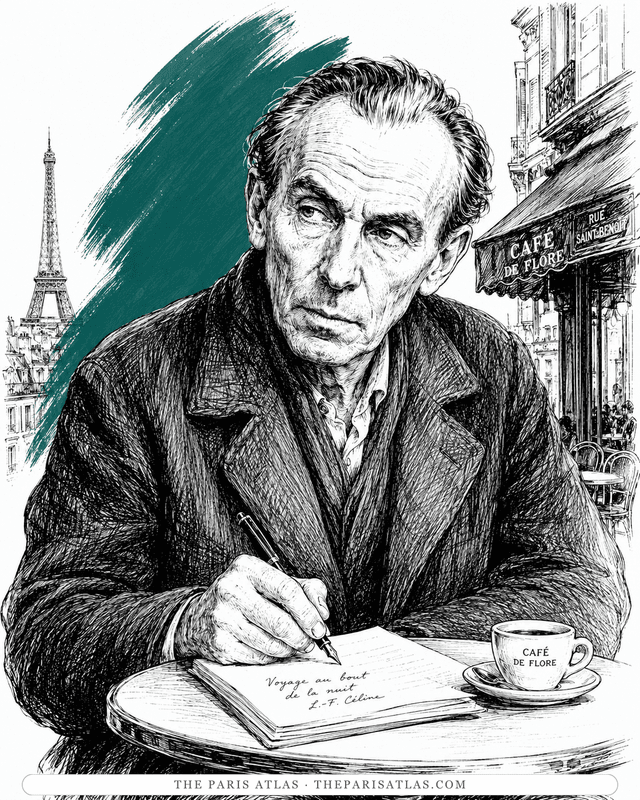
Louis-Ferdinand Céline
The doctor of the Paris slums who wrote the century's blackest, funniest novel — and changed the sound of French prose.
View author