
Aramis
Bishop of Vannes and secret general of the Jesuits, who plans to put the king's twin on the throne and make himself pope.
The tiara. He tells Philippe in Chapter X that the prince will have the throne of France and he will have the throne of Saint Peter, and that the whole universe will then be theirs.
The book

At a glance
- Bishop of Vannes; general of the Jesuits; Duc d'Almeda and Spanish ambassador in the Epilogue
- René d'Herblay, as the earlier novels give it
- The Bastille, Vaux, Blois, Belle-Île, the cave at Locmaria, Spain
Who they are in the book
Spoiler-freeAramis, once the musketeer who wanted to be a priest, is now René d'Herblay, Bishop of Vannes, and since the death of a Franciscan in the earlier volumes, general of the Society of Jesus. He has Fouquet's confidence, Baisemeaux's fear, and the secret of a prisoner in the Bastille who looks exactly like Louis XIV. He intends to use all three.
The plan is his alone, and so is the failure. He drags Porthos in without telling him the truth, misjudges Fouquet's sense of honour, and ends the book a fugitive who has cost his oldest friend his life. Dumas gives him the sharpest mind in the four novels and the coldest heart, then shows the heart breaking once, on a ship's rail at night.
How Aramis Is Portrayed
- The lantern in the BertaudièreIn Chapter I he takes the lantern from the governor at the cell door, cites the rule that a governor may not hear a confession, and goes in alone. Baisemeaux, who used to treat him as a respected guest, now calls him monseigneur and obeys.
- Seldon or MarchialiIn Chapter VIII he makes Baisemeaux read a release order for a prisoner named Seldon, then persuades him the name is Marchiali. He leaves with Philippe by the Rue Saint-Antoine gate and Bercy, and does not breathe until the last barrier closes.
- Crown and tiaraIn Chapter X, at night in the park at Vaux, he lays out the terms: cardinal, then first minister, then pope, with Fouquet kept comfortable and Louis removed by a plank that yields to a finger. Philippe asks him to be his father, and Aramis thinks: his Holy Father.
- Marchiali is madIn Chapter XVII he returns the true king to the Bastille and tells the governor the prisoner has been claiming to be king of France. Anyone who lets him speak to a soul, he adds, is under sentence of death.
- The confession to AthosIn Chapter XXVI he tells Athos in two sentences that he has conspired against the king, that the conspiracy has failed and that he is pursued. Athos calls it a great idea and a great error.
- The ringIn Chapter LI, taken by the frigate Pomona after Porthos's death, he walks up to the lieutenant, shows him the ring on his left hand, and is treated like an emperor. The ship is turned toward Corunna. The next morning the rail where his head rested is wet.
Aramis quotes
The whole universe is our own; for me the minds of men, for you their bodies.
I have conspired against the king; that conspiracy has failed, and, at this moment, I am doubtless pursued.
Athos—Porthos, farewell till we meet again! Aramis, adieu forever!
He escapes from Belle-Île after Porthos dies under the rock at Locmaria, using his authority as general of the order to command the frigate that captures his boat. Four years later, in the Epilogue, he returns to France as the Duc d'Almeda, ambassador of Spain, white-haired and bent, and embraces d'Artagnan at the king's hunt. He is the only one of the four who outlives the book.
If you like The Man in the Iron Mask


If you like Alexandre Dumas
Explore authors with a similar voice, perspective, and influence.

Mark Twain
The Missouri newspaperman who became America's most famous writer, and whose first book made its reputation partly out of Paris: in 1867 he arrived with a shipload of American tourists, renamed his guide Ferguson, watched the high-kicking can-can through his fingers and wrote it all down. He kept coming back — and was living in Paris in the mid-1890s, broke, while finishing the novel he considered his best, Personal Recollections of Joan of Arc.
View author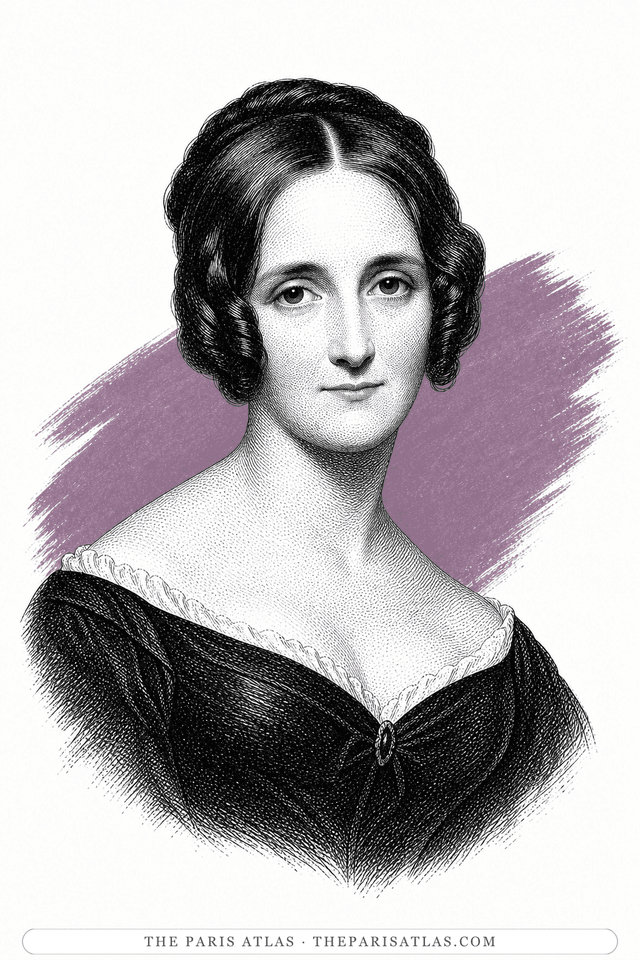
Mary Shelley
The author of Frankenstein, who first saw Paris at sixteen as a runaway. In the summer of 1814 she crossed from England to Calais with the poet Percy Bysshe Shelley and her stepsister Claire Clairmont, spent a week trapped in an expensive Paris hotel with no money, then bought a donkey and walked south-east across a France still wrecked by the Napoleonic wars. That journey became her first published book. Two years later, on a lake in Switzerland, she began her second.
View author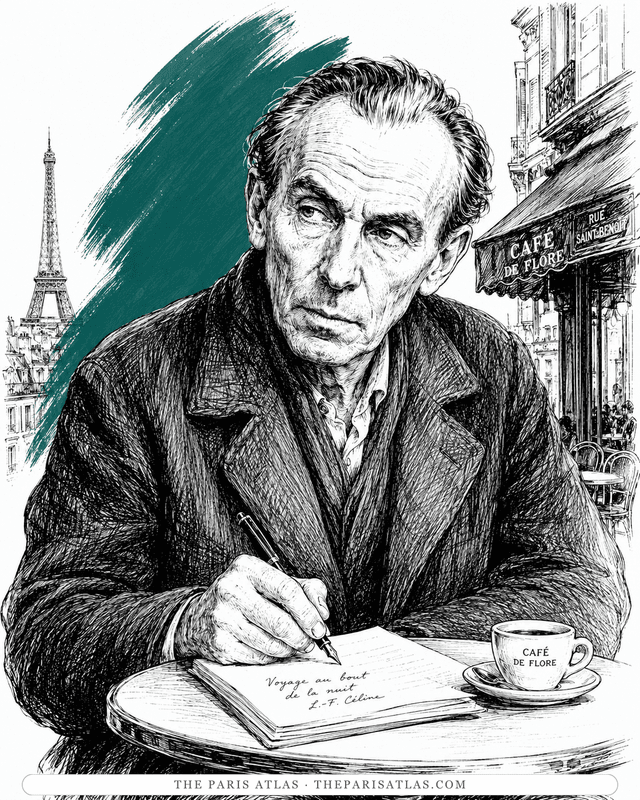
Louis-Ferdinand Céline
The doctor of the Paris slums who wrote the century's blackest, funniest novel — and changed the sound of French prose.
View author