
Jean-Baptiste Colbert
Mazarin's former clerk, now the king's intendant, who brings down Fouquet with a dead cardinal's letter and sends d'Artagnan his baton.
To administer the king's money alone, and to make France the first and richest country in the world with it.
The book

At a glance
- Intendant of finances, then minister
- Cardinal Mazarin's clerk
- Jean-Baptiste Colbert · 1619–1683 · Reims
Who they are in the book
Spoiler-freeColbert is the man who replaces Fouquet, and Dumas is fair to him. He begins as a jealous clerk with a letter of Mazarin's in his pocket and ends the book as the minister who will build harbours, libraries and a navy. D'Artagnan hates him, then shakes his hand, then receives from him the box with the marshal's baton.
How Jean-Baptiste Colbert Is Portrayed
- The letter and the sumIn Chapter XIV he gives the king Mazarin's letter about the thirteen million francs and, as if by accident, reminds him that Fontainebleau cost three. The text calls it a skilfully contrived piece of baseness.
- Granaries and academiesIn Chapter XLI, reconciled with d'Artagnan by the king, he explains that he wanted the finances alone because he intends to build cities, harbours, fleets, libraries and academies, and that Fouquet stood in the way.
- The king never forgetsIn the same chapter, when d'Artagnan says the king will tire and forget, Colbert answers that the king never forgets, and the king proves it by ordering Fouquet to the Bastille within a minute.
- The box at MaastrichtIn the Epilogue his letter names d'Artagnan marshal of France and his messenger carries the box he has had made for the baton. The cannonball that kills d'Artagnan breaks that box.
If you like The Man in the Iron Mask


If you like Alexandre Dumas
Explore authors with a similar voice, perspective, and influence.

Mark Twain
The Missouri newspaperman who became America's most famous writer, and whose first book made its reputation partly out of Paris: in 1867 he arrived with a shipload of American tourists, renamed his guide Ferguson, watched the high-kicking can-can through his fingers and wrote it all down. He kept coming back — and was living in Paris in the mid-1890s, broke, while finishing the novel he considered his best, Personal Recollections of Joan of Arc.
View author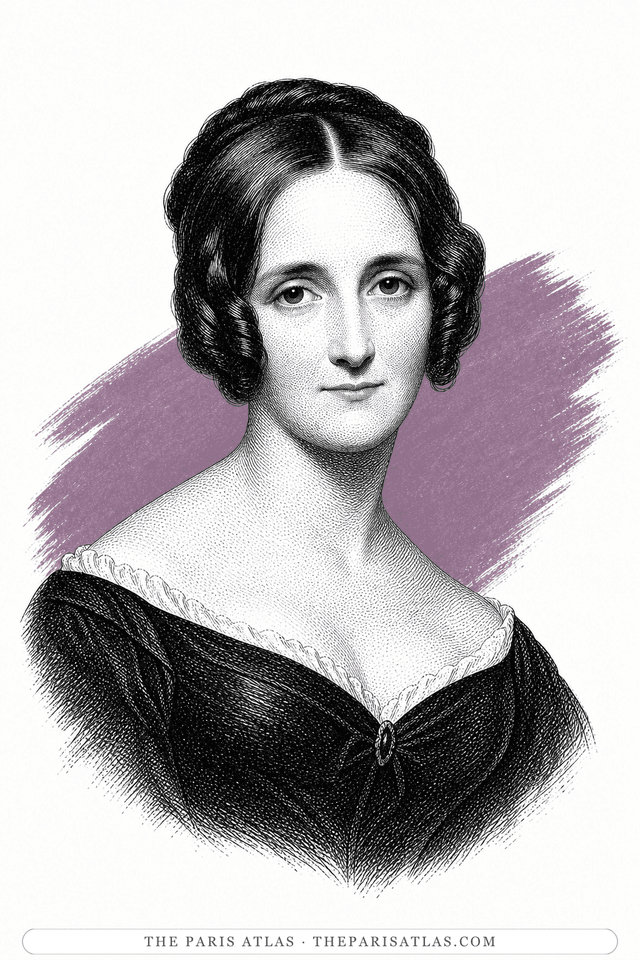
Mary Shelley
The author of Frankenstein, who first saw Paris at sixteen as a runaway. In the summer of 1814 she crossed from England to Calais with the poet Percy Bysshe Shelley and her stepsister Claire Clairmont, spent a week trapped in an expensive Paris hotel with no money, then bought a donkey and walked south-east across a France still wrecked by the Napoleonic wars. That journey became her first published book. Two years later, on a lake in Switzerland, she began her second.
View author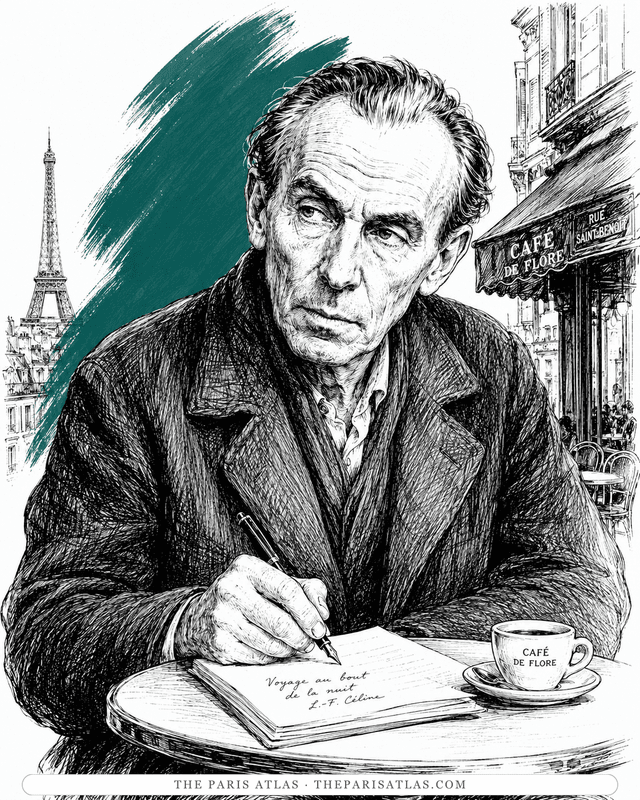
Louis-Ferdinand Céline
The doctor of the Paris slums who wrote the century's blackest, funniest novel — and changed the sound of French prose.
View author