
The Duc de Beaufort
The prince Athos once helped escape from Vincennes, who takes Raoul to Africa and writes the letter that reaches a dead man.
To make a marshal of France out of Raoul, whom he judges to have the stuff of one.
The book

At a glance
- Prince of the blood; commander of the expedition to Gigelli
- Prisoner at Vincennes in Twenty Years After
- François de Bourbon-Vendôme, duc de Beaufort · 1616–1669 · Paris
Who they are in the book
Spoiler-freeFrançois de Vendôme, Duc de Beaufort, is the prince whose escape from Vincennes the four friends managed in Twenty Years After. He arrives at Blois by torchlight, drinks Athos's Vouvray, and asks for Raoul for his expedition against Gigelli. He is loud, kind, and the wrong man to keep a boy alive who wants to die.
How The Duc de Beaufort Is Portrayed
- Torches on the Blois roadIn Chapter XXVI his party arrives with flambeaux and a dozen horses minutes after Aramis and Porthos have vanished down the same road in their white cloaks.
- A hundred pistoles for GrimaudIn Chapter XXVII he says his will is made, that he has brought a hundred pistoles for Grimaud as a legacy, and that the boy will rust at home. Athos answers that Raoul will never accept anything of the king.
- I have saved your lifeIn Chapter LIX, at Gigelli, he refuses to let Raoul carry an order to the frigates; the sergeant who goes instead is shot on the beach, and Beaufort tells Raoul to report the rescue to his father.
- A thousand louis eachIn the same report he promises two surgeons a thousand louis apiece if they save the wounded Raoul, and writes to Athos that a great misfortune has struck them amid a great triumph. The letter reaches a dead man.
If you like The Man in the Iron Mask


If you like Alexandre Dumas
Explore authors with a similar voice, perspective, and influence.

Mark Twain
The Missouri newspaperman who became America's most famous writer, and whose first book made its reputation partly out of Paris: in 1867 he arrived with a shipload of American tourists, renamed his guide Ferguson, watched the high-kicking can-can through his fingers and wrote it all down. He kept coming back — and was living in Paris in the mid-1890s, broke, while finishing the novel he considered his best, Personal Recollections of Joan of Arc.
View author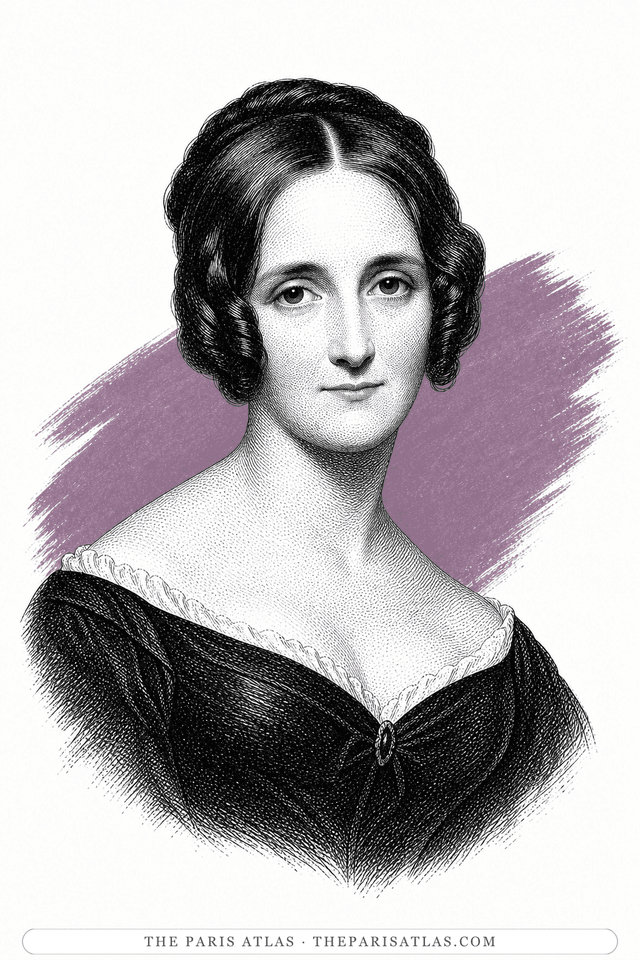
Mary Shelley
The author of Frankenstein, who first saw Paris at sixteen as a runaway. In the summer of 1814 she crossed from England to Calais with the poet Percy Bysshe Shelley and her stepsister Claire Clairmont, spent a week trapped in an expensive Paris hotel with no money, then bought a donkey and walked south-east across a France still wrecked by the Napoleonic wars. That journey became her first published book. Two years later, on a lake in Switzerland, she began her second.
View author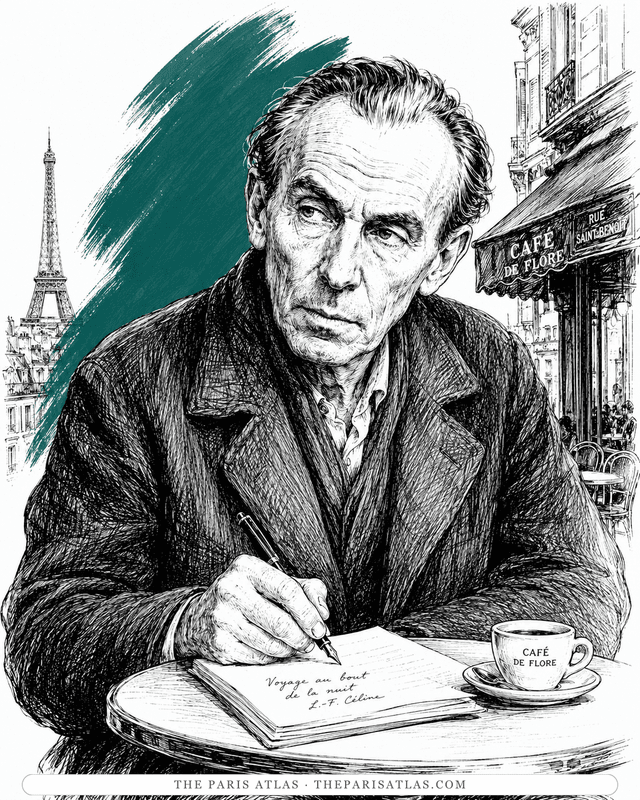
Louis-Ferdinand Céline
The doctor of the Paris slums who wrote the century's blackest, funniest novel — and changed the sound of French prose.
View author