

The Sheltering Sky
Bowles’s best-known North African novel follows American travelers who discover that movement through another country does not mean understanding it.
Read our take
by Paul Bowles
A Moroccan teenager and an American writer meet in Fez as resistance to French rule turns the city dangerous.
Fez, 1954. Morocco is still ruled as a French protectorate, Sultan Mohammed V has been forced into exile, and resistance is spreading through the old city. Amar, a poor fifteen-year-old from a devout Muslim family, hopes independence will restore justice. John Stenham, an American writer who has lived in Morocco for years, opposes French rule but fears that political change will destroy the Fez he loves. Their lives cross as strikes, police raids, and street violence make it impossible for either of them to remain only an observer. Paul Bowles moves between Amar’s view from inside the medina and Stenham’s view from a comfortable hotel, showing how two people can share a city and still misunderstand what the other needs.[1]
The novel is set during several tense days in Fez in 1954. Morocco had been a French protectorate since 1912. In 1953 French authorities removed the widely supported Sultan Mohammed V and sent him into exile, which strengthened public anger and the independence movement. In the book, the pressure appears in ordinary life: shops close, rumors travel faster than facts, police search homes, and families try to decide whether staying in the city is safe.[1]
Bowles gives the book two main centers. Amar is fifteen, poor, unable to read, and serious about his religion. Stenham is a middle-aged American writer who speaks Moroccan Arabic and thinks his years in the country have taught him how Moroccans think. The long separate sections devoted to each man make their eventual meeting important. By then, readers understand that the apparent expert and the supposedly unschooled boy are both intelligent, both proud, and both wrong about parts of the world around them.[1]
Bowles began the novel in Tangier in the summer of 1954 and finished it in what was then Ceylon, now Sri Lanka, in March 1955. In a later preface he said he had planned to describe traditional daily life in Fez but realized that the political crisis was changing that life while he wrote. The result is his most openly political novel, although its real subject is personal: the stories people tell themselves to feel secure, and what happens when events expose those stories as fragile.[1]
John Stenham leaves a late visit with a Moroccan family and walks back through a dark, uneasy Fez. He notices signs that something is wrong but tries to treat the tension as separate from the old city he admires. At the Mérinides Palace, a comfortable hotel based on the real Palais Jamaï, he returns to a circle of foreign residents that includes the English painter Alain Moss and the American traveler Lee Veyron, who was born Polly Burroughs.[1]
The story then leaves Stenham for a long section and follows Amar. He is a fifteen-year-old boy from a poor, religious household in the medina. His father is a healer and holy man who distrusts politics. Amar wants the French gone and sometimes mistakes revenge for justice. He works for a potter, fights with another boy, runs into an orchard, and is taken into a house controlled by Moulay Ali, a nationalist organizer whose followers suspect Amar may be a spy.[1]
Amar is impressed by the organizer’s power but disturbed by what he sees. Moulay Ali and his associates use religious language to rally support, yet their conduct does not match Amar’s idea of faithful Muslim life. He begins to see that opposition to French rule contains several aims. Some people want religious renewal, some want a modern nation, some want power, and some simply want an end to humiliation.[1]
Amar eventually meets Stenham and Lee. Stenham is fascinated because the boy seems to embody the older Fez he wants to preserve. Lee is more enthusiastic about independence and modernization. Both adults ask Amar questions and try to fit his answers into ideas they already hold. Amar also misreads them: their clothes, money, private relationship, and casual way of discussing religion confuse him.[1]
As violence spreads, Stenham, Lee, Amar, and Amar’s friend Mohammed leave Fez for Sidi Bou Chta, a religious celebration in the mountains during Eid al-Adha. Stenham treats the journey as access to a traditional Morocco tourists rarely see. Amar experiences it as part of his own religious world. Lee enjoys the spectacle but cannot enter its meaning. Nationalist organizers arrive and try to turn the gathering toward political action.[1]
Amar and Mohammed return toward Fez. Amar learns that his family has fled to relatives in Meknes, so he again turns to Moulay Ali. The organizer finds news of the family, but during a police raid his household escapes and leaves Amar behind. Amar gets out over the roof. The experience confirms his courage and deepens his distrust of leaders who expect others to accept danger for them.[1]
Stenham and Lee become lovers and decide to leave. Political violence has finally destroyed Stenham’s fantasy that he can live close to Moroccan life while remaining outside its consequences. He still knows more about the country than most visitors, but knowledge does not automatically make him dependable when a Moroccan person asks for practical help.[1]
Amar finds Stenham and Lee as they are preparing to leave Fez. Relieved to see someone he knows, he asks Stenham to drive him toward Meknes so that he can rejoin his mother and sister. It is a limited, urgent request: he does not ask the American to solve the political crisis, only to help him reach his family.
Stenham refuses. He and Lee make excuses, get into their vehicle, and leave Amar behind. The boy who has spent the novel surrounded by adults claiming to understand religion, freedom, Morocco, or one another is left to find his own way.
The ending does not say whether Amar reaches Meknes. It shows exactly what Stenham’s sympathy is worth when it becomes inconvenient. He loves Fez, speaks Arabic, and feels affection for Amar, but he uses the foreigner’s ability to leave. Amar has intelligence and courage, but no car, money, or protected route out. Their final separation turns the book’s political argument into one clear human failure.
Morocco was not independent when the story begins. France had controlled most of it as a protectorate since 1912, while Spain controlled other zones. The sultan remained the official ruler, but French authorities held the decisive power. In August 1953 they removed Sultan Mohammed V, who had become a symbol of Moroccan unity, and sent him into exile. The replacement sultan lacked broad support, and resistance grew more intense.
Istiqlal means independence. It was the name of the major nationalist party, but the novel does not present every opponent of French rule as having the same beliefs. Amar hopes independence will strengthen religious justice. Secular organizers imagine a modern state. Other people join because of poverty, anger, fear, or revenge. Bowles makes these disagreements part of the plot instead of treating resistance as a single voice.
The historical outcome lies just beyond the novel. Mohammed V returned in November 1955, and France recognized Moroccan independence in March 1956. The characters do not know that future. They live in the period when the old arrangement is visibly failing but nobody can be certain what will replace it.
The nationalist activists and propagandists Amar encounters do not represent one simple ideology: their modernizing plans do not always match his religious hopes for independence. Opposing them are French colonial police and officials, the coercive power behind arrests and political violence intended to suppress the movement. The novel keeps both groups visible without pretending that either is a single fully unified voice.
Stenham believes that long residence and knowledge of Arabic separate him from ordinary tourists. He is right in one sense: he notices more, knows real families, and understands local routines. The problem is that expertise becomes part of his pride. He enjoys being the foreigner who can explain Morocco to other foreigners, and he sometimes listens to Amar mainly to confirm what he already believes.
Amar is not a simple guide to the country either. He is fifteen, poor, devout, and angry. His judgments about foreigners, Jewish Moroccans, politics, and other Muslims can be harsh. Giving him a full interior life does not make him a spokesman for every Moroccan. It makes him a particular young person trying to understand a crisis with the beliefs and experience available to him.
For Amar, Islam is not a private opinion added to daily life. It explains family authority, charity, justice, food, prayer, and political action. He is believed to possess baraka, a spiritual blessing associated in Moroccan religious life with holiness and beneficial power. The belief gives other people expectations about him that he does not fully control.
Amar hopes that resistance to French rule will restore the religious order his father values. His meetings with organizers complicate that hope. People who speak in the name of Islam drink, manipulate crowds, or treat individuals as expendable. The novel is not saying that faith and independence are opposed. It shows Amar learning that a political movement can borrow religious language without sharing his idea of moral duty.
The title comes from verse 29:41 of the Quran, which compares reliance on protectors other than God to a spider making the weakest of houses. Bowles places a translation before the novel. The image is not simply a statement that Fez is weak. It points to every structure the characters trust as though it cannot fail.
The novel is long, deliberate, and built from separate points of view. The opening belongs to Stenham. Then he nearly disappears while Bowles spends more than a hundred pages establishing Amar’s family, work, faith, anger, and movements through the medina. When the plots meet, readers already know how much each man cannot see about the other.
Bowles writes physical settings with unusual precision. Alleys slope, water runs behind walls, gates divide the medina from the French-built new town, and darkness changes familiar routes. These details are not decoration. The geography controls who can move safely, who becomes trapped, and why a short distance can become impossible during a police closure.
The book contains long conversations about religion, revolution, modernization, and the difference between observing a culture and belonging to it. Readers looking for a conventional thriller may find those talks slow. Readers who enjoy watching intelligent people expose their own blind spots will find that the talk is where much of the action happens.
Moroccan Arabic and French words appear without always being translated immediately. Context usually makes their basic meaning clear, but a modern reader may need to pause. The unfamiliar language preserves the fact that the foreigners are not at the center of every conversation, even when they imagine they are.
Random House published the American first edition on November 4, 1955. The first British edition appeared from Macdonald in 1957. The novel was a finalist for the 1956 National Book Award for Fiction; John O’Hara’s Ten North Frederick won. The current Ecco paperback uses ISBN 9780061137037 and runs 432 pages.
The novel has not received a major film or television adaptation. Much of its force comes from long interior passages, alternating viewpoints, and political arguments that would be difficult to compress without making the story simpler than it is. It remains best known as the third of Bowles’s major North African novels, after The Sheltering Sky and Let It Come Down.
Black Sparrow Press issued a notable American reprint in 1986, part of the later publishing history that kept Bowles’s less famous third novel available beside The Sheltering Sky and Let It Come Down.
Bowles gives a poor Moroccan teenager more interior space than any foreign traveler. Amar is intelligent, devout, angry, prejudiced, brave, and capable of changing his mind. He is not background scenery for an expatriate adventure.
French rule, nationalism, and independence matter because they decide whether shops open, whether a family can remain together, and whether a boy can pass through a city gate.
The American spends hundreds of pages talking about Morocco and the limits of foreign understanding. One request from Amar reveals more about him than all those arguments.

A poor fifteen-year-old from the Fez medina whose faith, anger, and sharp judgment make him the novel’s most important viewpoint.

A middle-aged American writer who opposes French rule, speaks Moroccan Arabic, and still mistakes long residence for full understanding.

An American traveler using her married French name, eager for political change and for an experience more intense than ordinary tourism.

A prosperous English painter in the expatriate hotel circle, observant enough to challenge Stenham but insulated from the life Amar knows.

A nationalist organizer whose protected house first impresses Amar and then teaches him that political authority and religious integrity are not the same thing.

A minor member of the foreign hotel circle whose presence helps show how expatriates discuss Fez from a position of relative safety.

Amar’s friend and fellow traveler, one of the few people beside the boy who experiences the mountain journey as part of Moroccan life rather than a foreign adventure.

A poor, devout healer who distrusts politics and teaches Amar that religious words mean little without religious conduct.

The women of Amar’s household, given little separate narration but central to the practical question that drives him at the end: how to get home to his family.
1912
The Treaty of Fez establishes the French protectorate over most of Morocco.
August 1953
French authorities depose Sultan Mohammed V and send him into exile, intensifying nationalist opposition.
Summer 1954
Bowles begins The Spider’s House in Tangier while the political crisis is unfolding.
March 1955
Bowles finishes the novel in Weligama, Ceylon, now Sri Lanka, and sends it to Random House.
4 November 1955
Random House publishes the American first edition.
16 November 1955
Mohammed V returns to Morocco and resumes the throne.
1956
The novel is a National Book Award finalist; France recognizes Moroccan independence on 2 March.
1957
Macdonald publishes the first British edition.
1986
Black Sparrow Press issues a notable American reprint.
2006
Ecco publishes the 432-page paperback with ISBN 9780061137037.


Bowles’s best-known North African novel follows American travelers who discover that movement through another country does not mean understanding it.
Read our take
Bowles’s second Morocco novel moves through Tangier rather than Fez and shows a newly arrived American losing every stable idea he brought with him.
Read our take
Graham Greene also places political innocence under pressure and asks what happens when a foreigner’s confident ideas become dangerous to local people.
Read our take
V. S. Naipaul’s later novel follows an outsider watching a newly independent society change, with the same uneasy attention to who can leave when events turn violent.
Read our takeIt follows Amar, a poor fifteen-year-old from a devout Muslim family, and John Stenham, an American writer living in Fez, during resistance to French rule in 1954. Their lives meet as violence spreads, and the book tests whether Stenham’s knowledge makes him capable of helping a Moroccan person when it matters.
Amar is an invented fifteen-year-old boy from the Fez medina. He works for a potter, cannot read, is believed to possess baraka, and interprets the independence struggle through his family’s religious teachings. He is one of the two main viewpoints, not a minor guide for the foreigners.
Morocco was still under French and Spanish control. France had removed Sultan Mohammed V in 1953, and opposition to the protectorate was growing through strikes, organizing, sabotage, repression, and street violence. Mohammed V returned in 1955, and France recognized Moroccan independence in 1956.
The Arabic word means independence. Istiqlal was the leading Moroccan nationalist party. The novel uses the name for an organized movement, but it also shows that opponents of French rule did not all share one plan for religion, government, or modernization.
The title comes from Quran 29:41, which describes the spider’s house as the weakest of houses. In the novel, governments, political groups, families, hotels, and personal beliefs look secure until pressure reveals how fragile they are.
No. Stenham shares facts with Bowles: both are American writers, former Communists, Arabic speakers, longtime residents of Morocco, and attached to old Fez. Bowles’s preface says the people are invented, and Stenham works as a self-critical exaggeration of attitudes Bowles recognized in himself.
Not by characters or plot. It is Bowles’s third novel and shares his interest in foreigners in North Africa, but it is much more explicitly political and gives a Moroccan character far more narrative space.
It is strongly critical of French colonial rule but also skeptical of simple romantic accounts of nationalism. Amar, Stenham, and Lee each imagine Morocco’s future differently, and Bowles refuses to make one of them the unquestioned spokesman for history.
Amar asks Stenham to drive him toward Meknes so he can rejoin his mother and sister. Stenham and Lee are leaving Fez together and refuse. They drive away, leaving Amar behind. The novel does not say whether he reaches his family.
No major film or television adaptation has been released. The book’s alternating viewpoints, long interior passages, political debate, and detailed geography make it less straightforward to adapt than The Sheltering Sky.
It is not required; the stories are unrelated. The Sheltering Sky is shorter and more immediately dramatic, so it is the easier introduction to Bowles. Read The Spider’s House when you want his broader, more political novel and are comfortable with a slower build.
Explore authors with a similar voice, perspective, and influence.
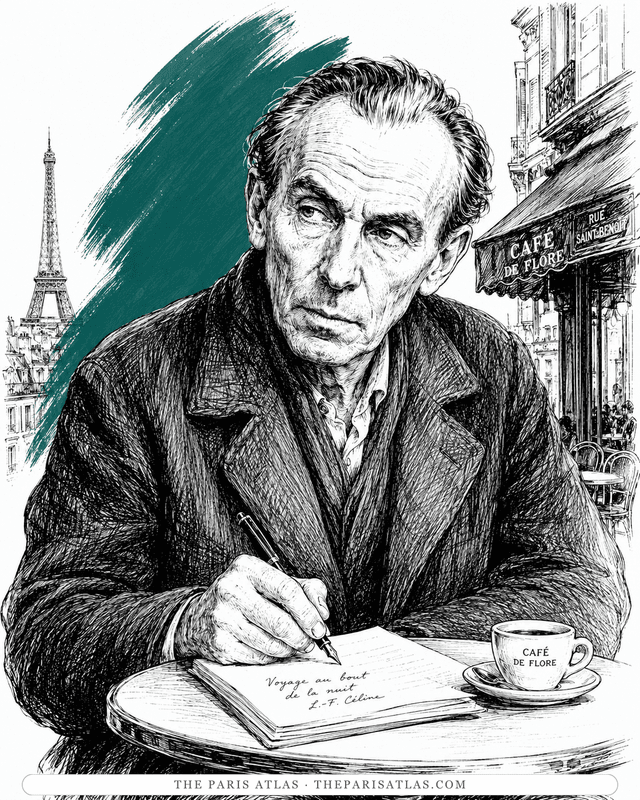
The doctor of the Paris slums who wrote the century's blackest, funniest novel — and changed the sound of French prose.
View author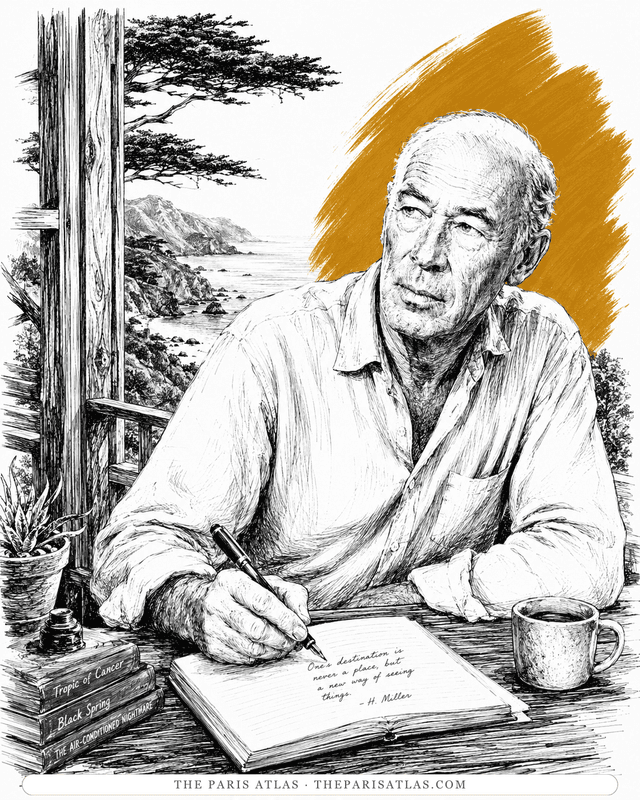
The Brooklyn dropout who arrived in Paris broke at thirty-eight and wrote the exuberant, banned books that ended American censorship.
View author
War correspondent who covered the Spanish Civil War, D-Day, and conflicts across five more decades; Hemingway's third wife, 1940–1945.
View authorThe sources below include the primary text, editions, scholarship, archival materials, and other records that informed this page. They document The Spider’s House, its publication, and its place in literary history.

Used for the 1955 release date, publisher, contemporary summary, and reception.
Used for the 1956 finalist status, current ISBN, and publisher description.
Used for the dates of the French protectorate and recognition of independence.
Used for Mohammed V’s deposition and the political divisions of 1954.
Used to verify the first British edition.

Used to verify the Quranic source of the title.
Used to cross-check the Ecco edition’s ISBN, page count, and digital metadata.
Used to cross-check ISBN-linked edition metadata.
Used to cross-check the bibliographic record by ISBN.
Used to cross-check the Ecco paperback's ISBN-linked catalogue record.
The primary text is the baseline reference for every book page. Additional references document publication history, interpretation, and historical context where that evidence is available.
 Explore more resources