

The Sheltering Sky
Bowles expands the collection’s interest in travel, physical vulnerability, and collapsing identity into a novel about an American couple in North Africa.
Read our take
by Paul Bowles
Seventeen stories in which travelers, families, missionaries, and outsiders discover how quickly the world can stop behaving as they expected.
The Delicate Prey and Other Stories is Paul Bowles’s first American story collection. Published in 1950, it gathers seventeen independent stories set across North Africa, Latin America, the Caribbean, New York, and a ship at sea. Missionaries, tourists, professors, expatriates, merchants, children, prisoners, lovers, and drifters enter situations they believe they understand. Bowles then quietly removes the protection they thought knowledge, money, language, or social position would give them.
There is no single protagonist or continuous storyline. The stories are connected by Bowles’s interest in motive, cultural misunderstanding, isolation, chance, and the speed with which ordinary life can become frightening. He once described his stories as a kind of detective fiction in which readers must detect why people behave as they do. He rarely supplies a final answer.[1]
The best-known stories are genuinely disturbing. “A Distant Episode” destroys a professor’s faith in language and cultural expertise. “Pages from Cold Point” enters a coercive and incestuous father-son relationship. The title story contains extreme violence. The collection should not, however, be mistaken for seventeen versions of the same nightmare.[1]
Bowles can also be tender and unexpectedly funny. “The Fourth Day Out from Santa Cruz” lets an overlooked ship’s boy become visible to the crew. “By the Water” ends with one young man saving another. “The Scorpion” turns fear of death into a strange willingness to accept change. Those differences make the collection a better introduction to Bowles than its reputation for cruelty might suggest.[1]
“At Paso Rojo” — Sisters Lucha and Chalía visit their brother Don Federico at his Costa Rican ranch after their mother’s death. Chalía is restless, resentful, and attracted to Roberto, a young Indigenous ranch worker. Instead of acting openly, she creates a situation that ruins him in her brother’s eyes. The story becomes a study of class power and the satisfaction of destroying another person’s trust.[1]
“Pastor Dowe at Tacaté” — Pastor Dowe is a Protestant missionary in an Indigenous Mexican village. He slowly realizes that attendance at his services does not mean conversion: villagers enjoy his music and accept his gifts while keeping their own religious life. When the community expects him to marry Martha, he refuses and leaves, finally understanding that he was never as central to village life as he imagined.[1]
“Call at Corazón” — An unnamed American couple travel through Central America on their honeymoon and quickly discover that marriage has not made them happy. The husband buys a monkey against his wife’s wishes, she retaliates through flirtation and sexual provocation, and the trip becomes a contest in which each tries to hurt the other.[1]
“Under the Sky” — Jacinto, a mountain crafts seller who regularly descends to a brutally hot town, becomes fixated on a blond foreign woman traveling with her husband. His desire and resentment spill onto a local female acquaintance whom he takes to a cemetery and sexually assaults. When he returns the next year, shame finally breaks through, though a stranger who sees him crying misunderstands the cause.[1]
“Señor Ong and Señor Ha” — Nicho is a boy growing up in a town transformed by development and new money. He leaves school to work in Don Anastasio’s shop and becomes suspicious of Señor Ong, a wealthy newcomer tied to drugs and corruption. With help from Luz, Nicho gathers information that leads to Ong’s arrest. His victory is compromised because he keeps part of what he finds and begins learning to use the same power he exposed.[1]
“The Circular Valley” — An abandoned monastery in a remote valley is inhabited by Atlájala, a bodiless consciousness able to enter living creatures. Atlájala moves from animal life toward human consciousness and becomes involved with a woman in an adulterous relationship. The story uses possession, sensation, and jealousy to ask what having a self actually means.[1]
“The Echo” — Aileen travels to Colombia to visit her expatriate mother, who lives with a forceful companion named Prue. Aileen expects a reunion and instead discovers that her mother has built a life in which she is the outsider. Prue humiliates her until Aileen explodes in violence and leaves, her scream echoing through the gorge below the house.[1]
“The Scorpion” — An elderly woman lives almost alone in a cave and resists her son’s attempt to bring her into town. After dreaming that a scorpion enters her body, the terrifying image unexpectedly becomes a feeling of release. She wakes willing to go with him. Bowles turns an image of death into permission to stop resisting change.[1]
“The Fourth Day Out from Santa Cruz” — Ramón is a young scullery boy aboard a ship whose crew barely notices him. An exhausted bird follows the vessel, and the sailors bet on whether it can land. Ramón brings the ship’s cat into the drama, and his presence suddenly matters. The crew finally acknowledges him and invites him into their social world.[1]
“Pages from Cold Point” — Norton, a retired professor, moves to a Caribbean island with his sixteen-year-old son Racky after his wife’s death. Racky becomes sexually involved with local boys and men and uses secrets as leverage. The father-son relationship crosses into incest, while Norton narrates desire, coercion, and helplessness through disturbing self-justification. Sending Racky away does not restore moral order.[1]
“You Are Not I” — Ethel escapes from a mental institution during confusion caused by a nearby accident and is mistakenly taken to her sister’s home. She follows a frightening private logic, including placing stones in the mouths of injured or dead people. After she is returned, Ethel becomes convinced that she exchanged identities with her sister and that the wrong woman is confined.[1]
“How Many Midnights” — June prepares an apartment for a romantic evening with Van, the man she expects to marry. He never arrives. Waiting expands into anxiety, fantasy, humiliation, and a walk through snowy New York. Bowles makes absence itself feel dangerous as June’s confidence in the relationship and in her judgment dissolves.[1]
“A Thousand Days for Mokhtar” — Mokhtar is a lonely widower whose life revolves around the sea and dominoes at the Café Ghazel. He dreams that he kills a butcher named Bouchta. When Bouchta collapses during an argument the next day, a qadi treats the dream as evidence and sentences Mokhtar to a thousand days in prison. Prison unexpectedly relieves the loneliness that made freedom unbearable.[1]
“Tea on the Mountain” — An unnamed American writer living in Tangier becomes involved with young Moroccan men, especially Mijd, while preparing to leave for Paris. She can enter and leave this world with a foreigner’s freedom; Mijd cannot. He imagines letters and a future bond while she knows she is departing, exposing the imbalance between a visitor’s experience and a local person’s continuing life.[1]
“By the Water” — Amar travels to a colder city seeking distant relatives and relies on a streetwise boy after trouble at a public bath. They flee together and reach the sea. When Amar is injured and nearly drowns, the boy keeps his head above water and saves him. It is one of the collection’s clearest examples of human connection surviving danger.[1]
“The Delicate Prey” — Three Filala leather merchants, two older men and their young nephew Driss, cross the desert and meet Moungari. Moungari murders the uncles and subjects Driss to sexual violence and torture before killing him. He later tries to sell the stolen leather, but Filala men identify what happened, capture him, and kill him in revenge. The story denies readers any comforting idea that violence produces clean justice.[1]
“A Distant Episode” — An unnamed linguistics professor returns to a North African settlement hoping to visit an old acquaintance and study local speech. His expertise makes him confident he can travel safely. Instead, he is betrayed into the desert and captured by Reguibat nomads, who cut out his tongue, force him into an absurd costume, and make him perform as a dancing clown. The scholar who came to study language is stripped of speech, identity, and social position.[1]
The collection ends with “A Distant Episode,” and the Professor’s escape does not restore him. He has lost his tongue, professional identity, and connection to the world in which education and European status once appeared to guarantee control.
Near the end, a French soldier sees the transformed Professor running away. The soldier neither rescues him nor fully understands what he sees. The Professor disappears into the desert, psychologically destroyed and effectively unrecognizable as the man who entered it.
That ending gives the collection its final shape. Again and again, Bowles places people who believe identity is secure — tourist, missionary, professor, husband, parent, civilized outsider — where those labels stop protecting them. Sometimes the result is comic or tender. More often it is brutal.
Bowles does not build these stories around a single lesson. A confident outsider can misunderstand another culture, but local knowledge does not guarantee safety either. A cruel act may be punished, ignored, misunderstood, or followed by unexpected tenderness. What links the stories is the pressure they place on the explanations people use to feel secure.
“A Distant Episode” provides the starkest example. The Professor’s training in language makes him feel prepared, but analyzing speech is not the same as understanding every person or power structure he encounters. Bowles turns that difference into a literal loss of language.
“The Fourth Day Out from Santa Cruz” shows the other register. Ramón becomes visible because the bird gives the crew a shared concern. The situation could turn cruel, but attention creates companionship instead. Reading the stories together reveals that Bowles is interested not only in collapse, but in the uncertain conditions under which connection becomes possible.
The collection has no shared cast. The focal profiles below give central figures room for full character pages, while this guide preserves every person, group, significant animal, and remembered absence named in the seventeen story summaries.
Bowles’s sentences are usually cleaner and calmer than the events they describe. That contrast is his signature. A character can be walking through a beautiful landscape, having an ordinary conversation, or making a small social mistake, and the prose keeps the same controlled temperature when the situation suddenly becomes violent or surreal.
He is unusually attentive to physical place. Heat, altitude, insects, stone, water, dust, vegetation, and distance are not scenery placed behind the characters. They change what people can do and how they think. Someone enters a landscape assuming the mind will remain in charge and discovers that the body and environment have their own logic.
Bowles rarely explains motive in the reassuring way conventional realism does. People behave cruelly, sexually, irrationally, or generously, and readers must decide how much can really be known about why. That is why even the shortest stories linger: the event ends before the question does.
There is no single screen adaptation of the collection, but individual stories have attracted filmmakers. Sara Driver adapted “You Are Not I” into a striking 1981 film, with Jim Jarmusch involved in the production and screenplay. Driver has explained that the ending and the experience of being inside Ethel’s mind compelled her to film it.
“A Distant Episode” has also influenced later cinema and visual art. Ben Rivers’s 2015 film The Sky Trembles and the Earth Is Afraid and the Two Eyes Are Not Brothers draws on Bowles’s story without functioning as a straightforward scene-by-scene adaptation.
His cold eye, dark humor, physical landscapes, and sudden shifts into danger become even sharper when he has only a few pages to work with.
The collection includes psychological horror, marital comedy, supernatural fiction, colonial encounters, sexual transgression, and several unexpectedly tender stories.
Even readers who never become Bowles completists should know the story that most perfectly turns confidence in cultural knowledge into a nightmare.

The restless visitor who turns attraction and class power into deliberate harm.

A young ranch worker whose trust and employment are exposed to Chalía’s manipulation.

A missionary whose well-attended services conceal how little conversion has occurred.

The young woman placed at the center of Pastor Dowe’s final misunderstanding.

An unnamed honeymooner who turns travel and marriage into a contest of jealousy.

An unnamed bride who answers her husband’s pettiness with calculated provocation.

A crafts seller whose fixation, violence, and delayed shame shape the story.

A clever boy who exposes corruption and begins absorbing its lessons.

The bodiless consciousness that enters living creatures and learns sensation from within them.

A young visitor who expects a mother-daughter reunion and finds a household organized against her.

The mother’s forceful companion, whose taunts make Aileen’s visit unbearable.

A solitary cave-dweller whose fear of leaving changes after a dream.

An overlooked scullery boy whose concern for a bird brings him into the crew’s notice.

A retired professor who narrates his corrupt relationship with his teenage son through self-justification.

Norton’s sixteen-year-old son, who uses sexual knowledge and secrets as leverage.

A narrator whose absolute private logic makes reality and delusion difficult to separate.

A young woman whose romantic preparation becomes a night of absence and humiliation.

A lonely widower punished for a dream who finds unexpected relief in prison.

A novelist who can leave Tangier for Paris while her Moroccan companions remain.

A young Moroccan student who imagines a continuing bond with the departing writer.

A traveler seeking relatives who survives danger through an unexpected friendship.

The streetwise companion who guides Amar through danger and saves him.

The young Filala merchant whose desert journey becomes the title story’s central victimization.

The traveler who attacks the Filala merchants and tries to profit from their leather.

A linguist whose confidence in language and expertise is destroyed in the final story.
1947
“A Distant Episode,” written earlier in the decade, appears in Partisan Review and becomes one of Bowles’s most widely anthologized stories.
1949
“Pages from Cold Point” appears in Wake: The Creative Magazine, and “The Delicate Prey” appears in the Paris literary magazine Zero.
August 1950
John Lehmann publishes the British selection A Little Stone without “Pages from Cold Point” and “The Delicate Prey” because of censorship concerns.
November 1950
Random House publishes the complete seventeen-story American collection as The Delicate Prey and Other Stories.
1968
The stories previously omitted because of British censorship concerns become available in Britain.
2002
Library of America includes the complete collection in Paul Bowles: Collected Stories & Later Writings.

Bowles expands the collection’s interest in travel, physical vulnerability, and collapsing identity into a novel about an American couple in North Africa.
Read our take
Another outsider enters Tangier believing he can improvise a new life, then discovers that freedom without self-knowledge is dangerous.
Read our take
Bowles again writes Morocco through outsiders and local lives, this time during the pressures of the independence struggle.
Read our takeNo. It is a collection of seventeen independent short stories first published together in the United States in 1950.
“A Distant Episode,” “The Delicate Prey,” and “Pages from Cold Point” are among the most discussed. “You Are Not I,” “The Circular Valley,” and “The Scorpion” also show important parts of Bowles’s range.
Bowles’s first British story collection appeared under that title in 1950. It omitted “Pages from Cold Point” and “The Delicate Prey” because of censorship concerns, so it is not exactly the same book as the American collection.
No. North Africa is central, but Bowles also uses Latin American and Caribbean settings, a ship at sea, and New York in “How Many Midnights.”
Bowles was interested in how quickly the structures people trust can disappear. Violence often arrives not as moral punishment but as evidence that the world is less orderly than the characters assumed.
Not in the ordinary sense. It is first-person fiction about a father and son and includes incestuous and coercive sexuality. A first-person narrator should not be confused with the author confessing his own life.
Start with “A Distant Episode” for Bowles at his coldest and most characteristic. Choose “The Scorpion” or “By the Water” if you first want to see his stranger or more humane side.
Explore authors with a similar voice, perspective, and influence.

The doctor of the Paris slums who wrote the century's blackest, funniest novel — and changed the sound of French prose.
View author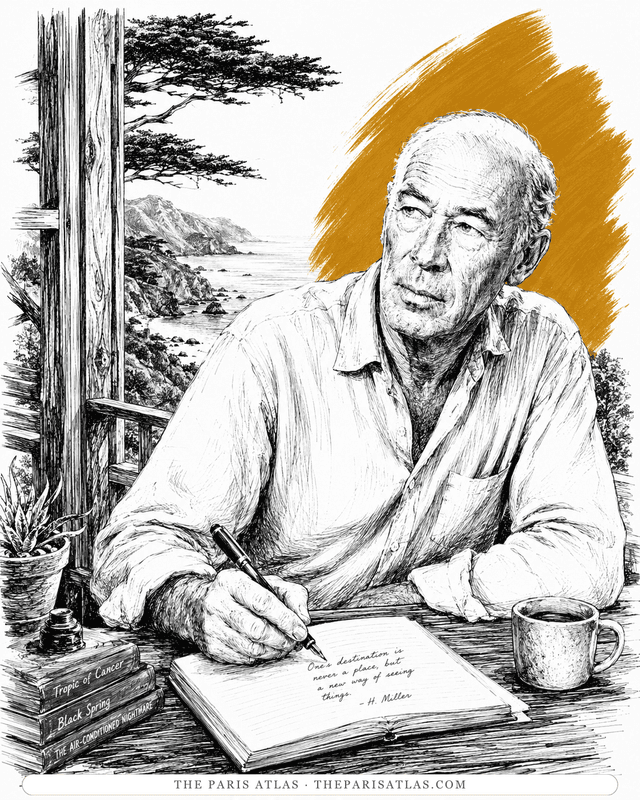
The Brooklyn dropout who arrived in Paris broke at thirty-eight and wrote the exuberant, banned books that ended American censorship.
View author
War correspondent who covered the Spanish Civil War, D-Day, and conflicts across five more decades; Hemingway's third wife, 1940–1945.
View authorThe sources below include the primary text, editions, scholarship, archival materials, and other records that informed this page. They document The Delicate Prey and Other Stories, its publication, and its place in literary history.


Library of America author page used for Bowles’s biography and the position of the stories in his career.
Reference overview retained from the supplied research basis for the story’s publication and subject context.
Reference overview retained from the supplied research basis for the collection and title story.
Reference overview retained from the supplied research basis for the final story and publication history.
Criterion interview used for Sara Driver’s account of adapting You Are Not I.
The primary text is the baseline reference for every book page. Additional references document publication history, interpretation, and historical context where that evidence is available.
 Explore more resources