
Animal Farm
Orwell compresses Soviet revolutionary history into allegory; Solzhenitsyn shows what state power feels like at the level of one body and one ration.
Read our take
One prisoner's ordinary day reveals the human reality inside a revolutionary state turned labor camp.
Solzhenitsyn follows work, cold, hunger, rules, humiliation, and small victories through a single day in a Soviet labor camp.
Ivan Denisovich Shukhov is serving a ten-year sentence in a Soviet forced-labor camp for a crime he did not commit. During the Second World War, he escaped from German captivity and returned to Soviet lines. Investigators decided that survival itself made him suspicious. Faced with a choice between signing a false confession and likely execution, he confessed to being a spy and was sent into the Gulag.
The novel follows one winter day from the morning wake-up signal to lights-out. Shukhov wakes feeling ill, fails to rise on time, avoids a harsher punishment, and is sent with his work squad to build walls at an unfinished power station in extreme cold. The story pays close attention to what can keep a prisoner alive: a warm place near a stove, an extra spoonful of porridge, a hidden tool, a trusted foreman, and the discipline of doing work properly even when the state has stolen its meaning.
There is no escape plan and no dramatic overthrow of the camp. Solzhenitsyn shows a system through its smallest routines and lets Shukhov measure the day by standards that would sound absurd anywhere else. He is not beaten, he receives extra food, his illness does not worsen, and no contraband is discovered during the search. In a place built to reduce people to numbers, this counts as an unusually good day.
The wake-up hammer sounds before dawn, but Shukhov remains in bed because he feels feverish. A guard nicknamed the Tartar catches him and threatens three days in the punishment cells with work. Instead, the Tartar takes him to the guards’ room and makes him wash the floor. Shukhov completes the task carefully enough to avoid further trouble, then visits the infirmary. The young medical orderly Kolya Vdovushkin records a slight temperature but says the daily quota of men excused from labor has already been filled.
Shukhov returns to his barracks and eats a thin breakfast of skilly and porridge. He hides part of his bread inside his mattress for later. His work group, the 104th, fears being assigned to an exposed settlement site where there is no shelter from the wind, but their experienced foreman Tyurin has arranged for them to work at an unfinished power station instead. Before departure, guards search the prisoners for forbidden clothing. Captain Buynovsky protests that the search violates Soviet law and receives a sentence of ten days in the punishment cells.
The prisoners march across the frozen steppe under guard. At the power station, the squad first has to make the abandoned structure survivable. Shukhov, the Latvian bricklayer Kilgas, young Gopchik, deaf Senka, and the others cover windows, repair a stove, prepare mortar, and improvise tools. Tyurin tells the story of how he was expelled from the Red Army and persecuted because his father had been labeled a kulak. His authority matters because the entire squad’s food ration depends on the work norm he negotiates.
At lunch, the prisoners crowd around the serving hatch while Pavlo, Tyurin’s deputy, manages the squad’s bowls. Through quick counting and camp skill, the group secures extra portions. Shukhov eats slowly and treats every spoonful as something that must be fully experienced. Buynovsky receives one of the extra bowls because he is new to camp life and already weakening. Fetyukov begs and scavenges, behavior the others despise because it exposes how hunger can strip away dignity.
The squad returns to work with real intensity. Shukhov takes pride in laying a straight wall and becomes absorbed in the practical problem of keeping mortar from freezing. The construction superintendent Der discovers that the prisoners have used prefabricated roofing material to block the windows and threatens Tyurin with punishment. Tyurin and the squad stand together until Der backs down. When the work signal sounds, Shukhov and Senka stay behind long enough to finish the top of the wall and hide Shukhov’s favored trowel for another day.
The guards repeatedly count the returning prisoners. One man from another squad, called the Moldavian, has fallen asleep at the work site and delays everyone, making him a target of rage from prisoners who may freeze while waiting. At the camp gate, Shukhov remembers a small piece of hacksaw blade he picked up and concealed in his mitten. A guard searches him but does not find it. The metal could become a useful knife, though possession of it could also bring severe punishment.
Back inside, Shukhov waits in the parcel line for Tsezar Markovich, a privileged intellectual prisoner who receives food from home. He saves Tsezar’s place, protects his parcel during an unexpected second count, and is rewarded with biscuits, sugar, and a piece of sausage. Captain Buynovsky is finally taken to the punishment cells despite the squad’s sympathy. In the barracks, Alyoshka the Baptist speaks with Shukhov about prayer, freedom, and the soul. Shukhov gives Alyoshka one of his biscuits before settling down to sleep.
Shukhov lies in his bunk and reviews the day according to camp arithmetic. The threatened punishment became only a floor-cleaning job. The infirmary did not help him, but his fever passed. Tyurin kept the squad away from the worst work site, the wall went well, and Shukhov recovered his hidden trowel for future use.
He also managed several small gains without being caught. He ate extra food at lunch, smuggled the piece of metal through the search, earned a share of Tsezar’s parcel, bought tobacco, and kept his hidden bread. None of these victories changes his sentence, but each restores a small area of choice inside a system designed to eliminate it.
Alyoshka urges him to pray for spiritual freedom rather than more rations. Shukhov does not accept the argument completely, yet he gives the Baptist a biscuit without expecting payment. The gesture is modest, but in a camp where hunger encourages everyone to guard every crumb, generosity becomes a form of freedom the authorities cannot allocate.
Shukhov falls asleep content. The narrator calls it an almost happy, unclouded day and then widens the frame: it is only one of 3,653 days in his sentence, including three extra days for leap years. The final number prevents the reader from mistaking endurance for justice. A good day remains one day inside ten stolen years.
Shukhov survives through attention rather than heroics. He knows when to bow, when to work hard, how to hide bread, how slowly to eat, and which favors may bring a return. The camp has forced intelligence into tiny decisions. Solzhenitsyn shows survival as a craft learned under pressure, not as proof that the system is bearable.
Officials call prisoners by numbers, count them repeatedly, search their bodies, and tie food to production quotas. Shukhov protects dignity by refusing to lick bowls, by working well, and by keeping some control over how he eats and helps others. These choices are small because the camp has made the space for dignity small.
The state uses labor as punishment and extraction, yet Shukhov still takes pride in a straight wall. That pride does not redeem forced labor. It shows that skill can remain meaningful to the worker even when the institution exploiting it is criminal. The most alive moments occur when the squad briefly works for the wall and for one another rather than for the camp report.
The camp encourages competition for food, warmth, and privilege. Squad 104 survives because Tyurin turns individual labor into mutual dependence. A good foreman protects rations and assignments; good workers protect the foreman’s position. Their solidarity is practical rather than sentimental, but it creates a human unit inside the prison’s bureaucracy.
Food governs nearly every hour. Tsezar’s parcel creates privilege, Fetyukov’s begging creates contempt, and an extra bowl can alter a man’s day. Solzhenitsyn does not treat hunger as a background hardship. It changes thought, status, friendship, and the line between prudence and humiliation.
Alyoshka believes prison can free a person from material attachment, while Shukhov thinks first about bread, tools, and bodily survival. The novel does not simply declare one man correct. Shukhov’s gift of a biscuit suggests that spiritual freedom may appear through action before it becomes a belief.
The book’s power comes from presenting this day as routine. No exceptional atrocity is required. Cold, false charges, inadequate food, arbitrary punishment, and exhausting labor have become the normal structure of time. The final count of 3,653 days makes repetition itself the horror.
Solzhenitsyn keeps the narration close to Shukhov without writing a conventional first-person memoir. The third-person voice uses his practical vocabulary, camp slang, judgments, and sense of time. Readers learn the system as Shukhov experiences it: not through a lecture on the Gulag, but through the location of a spoon, the thickness of porridge, the direction of the wind, and the danger attached to a scrap of metal.
The prose is restrained and intensely physical. Cold stiffens clothing, mortar freezes, soup must be eaten before it loses heat, and a few minutes near a stove can reorganize a whole day. The book rarely pauses to announce that the conditions are monstrous. Precision makes the accusation.
English translations differ substantially. Several 1963 versions were produced quickly from the Soviet magazine text. The H. T. Willetts translation, published in 1991, is the only English version authorized by Solzhenitsyn and is based on the canonical, uncensored Russian text. Names, slang, and tone vary across editions, so character spellings such as Tsezar/Caesar and Tyurin/Tiurin may differ without referring to different people.
The correct English title is One Day in the Life of Ivan Denisovich, not A Day in the Life of Ivan Denisovich. The original Russian title is Odin den’ Ivana Denisovicha. The form is often described as a novella or short novel.
Six major English translations are commonly identified: Ralph Parker; Max Hayward and Ronald Hingley; Bela Von Block; Thomas P. Whitney; Gillon Aitken; and H. T. Willetts. The early translations appeared rapidly in 1963 and were based on the Soviet publication text. Willetts’s 1991 version is the only translation authorized by Solzhenitsyn and the only one based on the canonical, uncensored Russian text, according to the Solzhenitsyn Center.
Names and camp terms vary among translations. Readers should check the translator and should not combine quotations or spellings from different versions without noting the change.
NBC broadcast a 1963 television dramatization starring Jason Robards Jr. The rapid adaptation reflects the international impact of the book only months after its Soviet publication. Availability is limited, and the production should be documented through television archives before making detailed claims about scene fidelity.
Caspar Wrede directed the 1970 British-Norwegian feature film, with a screenplay by Ronald Harwood and Tom Courtenay as Shukhov. The film uses cold Norwegian locations and follows the single-day structure closely, but visual performance cannot reproduce all of Shukhov’s practical interior calculations.
The 1970 film was politically controversial. Finland banned public exhibition for years because officials feared damage to relations with the Soviet Union. The history of that ban belongs to the film’s reception, not to the plot of Solzhenitsyn’s book.
It moves from Orwell's pigs making rules to the people forced to live under them.
Following one day makes the camp’s repeated demands and small variations easy to grasp.
Work, food, warmth, and dignity become concrete decisions instead of abstract descriptions of suffering.

Shukhov, prisoner S-854, is a Russian peasant, carpenter, and former soldier serving ten years for supposed espionage after escaping German captivity.

Tyurin is the foreman of squad 104.

Pavlo is Tyurin’s Ukrainian deputy.

Alyoshka is a Baptist prisoner who secretly keeps a small Bible in the barracks.

Tsezar, sometimes translated as Caesar, is an educated prisoner connected with film and cultural life.

Fetyukov is a former office worker who scavenges cigarette ends, begs for scraps, and abandons the codes of dignity valued by the squad.

Buynovsky is a former Soviet naval captain and a relative newcomer to the camp.

Kilgas is a Latvian prisoner and skilled bricklayer who works beside Shukhov.

Senka is a deaf prisoner whose hearing was damaged during wartime combat.

Gopchik is a young Ukrainian prisoner jailed for carrying food to nationalist fighters.

Kolya is the young medical orderly in the infirmary.

The Tartar is the guard who catches Shukhov in bed after wake-up.

Volkovoy is a feared security officer whose surname suggests “wolf.” He supervises searches and treats prisoners with open menace.

Der is the civilian or prisoner construction superintendent who monitors the power-station site.

The unnamed Moldavian prisoner falls asleep at the work site and fails to appear at the return count.

The two Estonian prisoners are so close and cooperative that Shukhov often thinks of them as a pair.

Shukhov’s wife remains at home and appears through letters and memory rather than direct action.
1945–1953
Solzhenitsyn serves in Soviet prisons, labor camps, and a special research prison, giving him direct knowledge of the system later transformed into fiction.
May 1959
Living in Ryazan, he writes the work under the title Shch-854, using Shukhov’s prisoner number.
Autumn 1961
He submits the manuscript to the Moscow literary journal Novy Mir after Nikita Khrushchev’s renewed attack on Stalin’s cult of personality.
November 1962
Novy Mir publishes the novella after editor Aleksandr Tvardovsky’s campaign and Khrushchev’s personal approval.
1963
Multiple competing English translations appear almost immediately.
Late 1960s–1974
Soviet authorities withdraw the work from libraries and ultimately ban Solzhenitsyn’s published writings.
1970
Caspar Wrede’s feature-film adaptation is released, starring Tom Courtenay.
1991
Farrar, Straus and Giroux publishes H. T. Willetts’s authorized translation from the canonical Russian text.
2020
Vintage reissues the Willetts translation in the United Kingdom, reflecting its status as the preferred complete English text.
Orwell compresses Soviet revolutionary history into allegory; Solzhenitsyn shows what state power feels like at the level of one body and one ration.
Read our take
Rubashov is an elite revolutionary forced into confession; Shukhov is an ordinary soldier caught by the same logic of presumed guilt.
Read our take
Both depict institutions that can make falsehood official, but Solzhenitsyn works from remembered camp routine rather than speculative future government.
Read our take
Shukhov’s charge is absurd but historically specific, showing a real political system that turned Kafka-like accusation into routine administration.
Read our take
Both show bureaucracy controlling the body while denying responsibility for the suffering it produces.
Read our takeSoviet authorities accuse him of espionage because he was briefly captured by German forces during the Second World War and then escaped. He is innocent but signs a confession because denying the charge could lead to execution.
Ten years. He has already served roughly eight when the novel takes place. The ending counts the sentence as 3,653 days because three leap years add three extra days.
Yes. It begins before dawn and ends after lights-out. Memories and short life histories expand the frame, but the present action remains within a single winter day.
He avoids serious punishment, does not become sicker, works at a sheltered site, eats extra food, keeps useful contraband, and receives food from Tsezar. His standard reveals how severely the camp has narrowed the meaning of good fortune.
It is Shukhov’s work brigade. The camp calculates rations and production through squads, so each man’s survival is tied to the group’s performance and to Tyurin’s ability to negotiate assignments.
The camp exploits his labor, but skill remains part of his identity. Working well gives him concentration, self-respect, and cooperation with other prisoners. The pride belongs to Shukhov, not to the state that forces the work.
He is sentenced to ten days in the punishment cells after protesting a search. Guards take him away near the end of the day. The book does not show whether he survives the punishment.
Alyoshka offers a religious idea of freedom that does not depend on food, release, or material comfort. Shukhov remains skeptical, but his gift of a biscuit shows that the conversation affects his actions.
Shukhov is fictional, but Solzhenitsyn drew on his own years in the Gulag and on the experiences of other prisoners. The camp routines and survival details come from direct knowledge transformed into a tightly constructed story.
The H. T. Willetts translation is the safest recommendation for a complete, authorized English text. Other versions remain historically important, but readers should know which translator they are reading.
Explore authors with a similar voice, perspective, and influence.
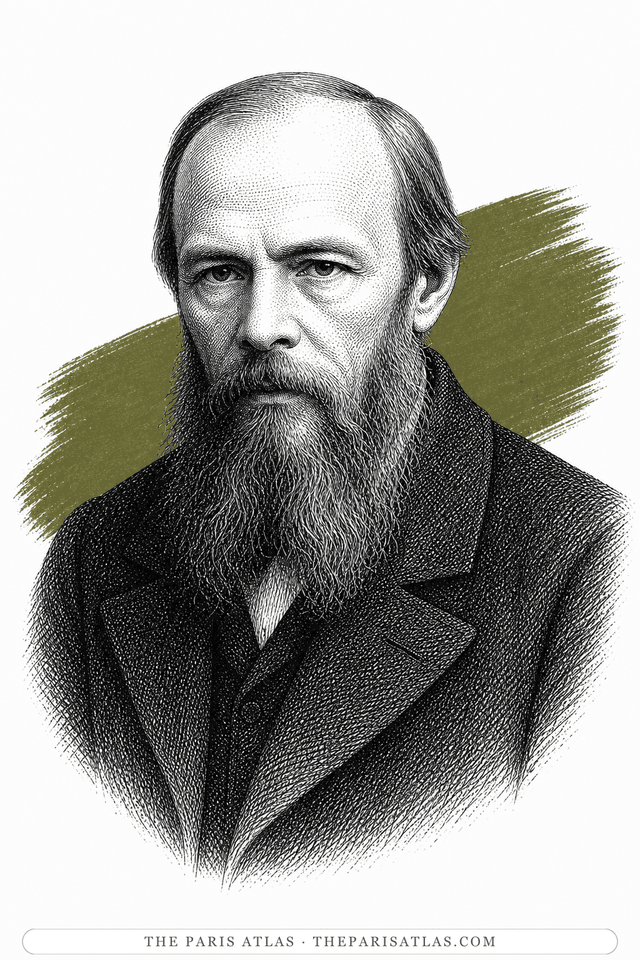
The Russian novelist who came to Paris twice in the 1860s, hated it with unusual precision, and wrote the result up as Winter Notes on Summer Impressions, a short, savage account of the French bourgeoisie that stands as the sharpest case ever made against the city by a writer passing through it.
View author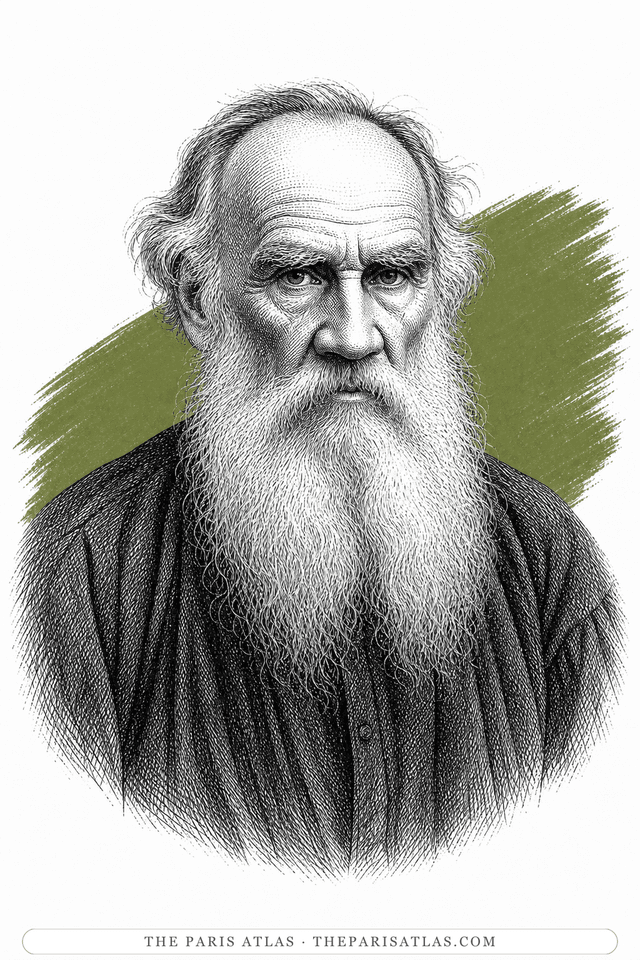
Russian novelist who wrote War and Peace and Anna Karenina, then renounced the life that produced them. He spent six weeks in Paris in 1857, and on one April morning went to watch a man beheaded in the street — an hour he said destroyed his belief in progress and in the state, and which he was still writing about twenty-two years later.
View author
The Missouri newspaperman who became America's most famous writer, and whose first book made its reputation partly out of Paris: in 1867 he arrived with a shipload of American tourists, renamed his guide Ferguson, watched the high-kicking can-can through his fingers and wrote it all down. He kept coming back — and was living in Paris in the mid-1890s, broke, while finishing the novel he considered his best, Personal Recollections of Joan of Arc.
View authorThe sources below include the primary text, editions, scholarship, archival materials, and other records that informed this page. They document One Day in the Life of Ivan Denisovich, its publication, and its place in literary history.


Open Library ISBN catalogue used to verify the title, ISBN, and publication metadata.
Google Books catalogue record used to cross-check the title and edition metadata.
Internet Archive ISBN catalogue used to cross-check the edition and its availability in library holdings.
Library of Congress books catalogue used to cross-check the bibliographic record by ISBN.

Aleksandr Solzhenitsyn Center; verifies the 1959 composition, 1961 submission, November 1962 publication, censorship history, and preferred translation.
Official translation list; verifies six English translations and the authorized H. T. Willetts edition.
Author timeline; verifies composition, submission, publication, and broader biographical context.
Official bibliography; verifies Russian and English edition history.
Encyclopaedia Britannica overview; verifies publication significance and basic form.
Detailed plot cross-check for the single-day sequence and ending.
Character cross-check for squad members, roles, and variant spellings.
Film cast, production, and Finnish-ban cross-check; use alongside established film records.
The primary text is the baseline reference for every book page. Additional references document publication history, interpretation, and historical context where that evidence is available.
 Explore more resources