
The Duke of Buckingham
George Villiers, the English king's favourite, who crosses to Paris in disguise to see the queen and wears her diamonds on his doublet.
To see Anne of Austria, at whatever cost to two kingdoms.
The book

At a glance
- First minister of Charles I of England
- Stabbed at Portsmouth on 23 August 1628
- George Villiers, 1st Duke of Buckingham · 1592–1628 · Brooksby, Leicestershire
Who they are in the book
Spoiler-freeGeorge Villiers, Duke of Buckingham, was the favourite and chief minister of Charles I of England, and he was stabbed to death at Portsmouth in August 1628 by a discontented officer named John Felton. Dumas keeps the date and the killer and gives the death a cause: Buckingham's love for the French queen, and Milady's five days with Felton. He is the one man in the book who can make a war to get a look at a woman, and the narrator half admires him for it.
How The Duke of Buckingham Is Portrayed
- Before the glass, Chapter XIIWaiting in the Louvre he settles his hair, twists his moustache and smiles at himself with pride and hope. When a door in the tapestry opens he sees the queen in the mirror and cries out.
- Three years of love, Chapter XIIHe tells the queen he has loved her for three years on a lost ribbon and a stray look, and describes the green satin gown and the diamonds she wore the first time he saw her.
- The studs and the jeweller, Chapter XXITwo of the twelve studs are missing, cut at a ball at Windsor. He calls his jeweller O'Reilly into his chapel and has replacements made against the clock.
- Portsmouth, Chapter LIXFelton pushes past him with a knife and plunges it into his side. He dies asking Laporte whether he comes from the queen, and Felton, hearing that Milady's ship has sailed without him, lowers his head.
Milady, imprisoned by Lord de Winter, turns her gaoler Felton against him. Felton stabs him at Portsmouth on 23 August 1628, the day he was to sail to relieve La Rochelle. His murder is the charge Lord de Winter brings at Milady's trial.
If you like The Three Musketeers


If you like Alexandre Dumas
Explore authors with a similar voice, perspective, and influence.

Mark Twain
The Missouri newspaperman who became America's most famous writer, and whose first book made its reputation partly out of Paris: in 1867 he arrived with a shipload of American tourists, renamed his guide Ferguson, watched the high-kicking can-can through his fingers and wrote it all down. He kept coming back — and was living in Paris in the mid-1890s, broke, while finishing the novel he considered his best, Personal Recollections of Joan of Arc.
View author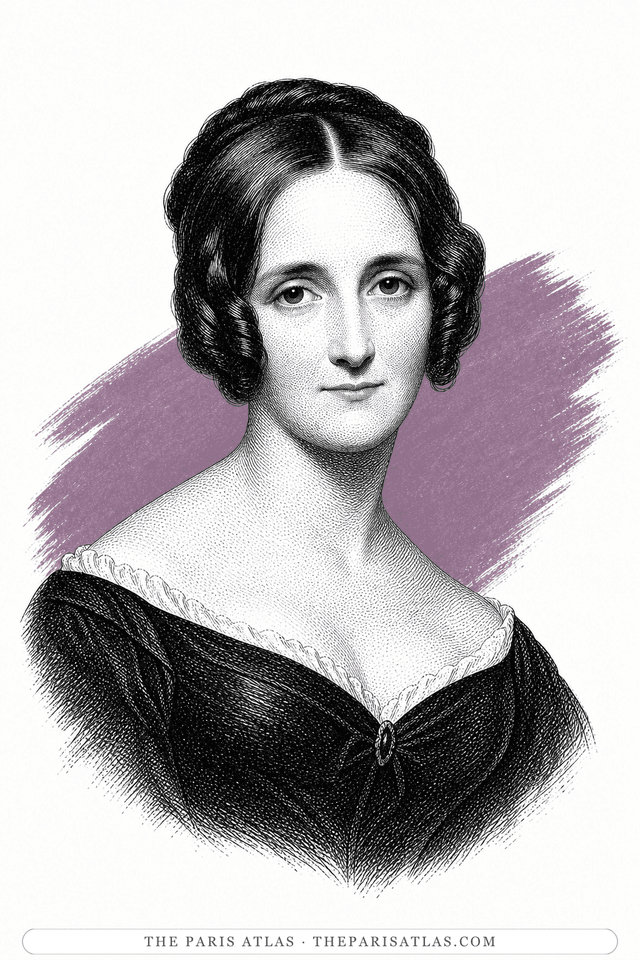
Mary Shelley
The author of Frankenstein, who first saw Paris at sixteen as a runaway. In the summer of 1814 she crossed from England to Calais with the poet Percy Bysshe Shelley and her stepsister Claire Clairmont, spent a week trapped in an expensive Paris hotel with no money, then bought a donkey and walked south-east across a France still wrecked by the Napoleonic wars. That journey became her first published book. Two years later, on a lake in Switzerland, she began her second.
View author
Louis-Ferdinand Céline
The doctor of the Paris slums who wrote the century's blackest, funniest novel — and changed the sound of French prose.
View author