
Cardinal Richelieu
Louis XIII's first minister, thirty-six or thirty-seven and already grey, who runs the state and the plot from behind a table.
To keep France in his hands, which means the queen humbled, Buckingham removed and four inconvenient swordsmen bound to him.
The book

At a glance
- Thirty-six or thirty-seven in 1625
- The Palais-Cardinal, later the Palais-Royal
- Milady de Winter and the Comte de Rochefort
- The siege of La Rochelle, 1627 to 1628
- Armand Jean du Plessis, Cardinal de Richelieu · 1585–1642 · Paris
Who they are in the book
Spoiler-freeArmand Jean du Plessis, Cardinal de Richelieu, was the real ruler of France under Louis XIII, and the novel presents him at the height of his powers rather than as the sick old man of the portraits. D'Artagnan first sees him through the eyes of the mercer Bonacieux: a man of middle height with piercing eyes, a soldier's bearing, a pointed beard and dusty riding boots, standing before a map of La Rochelle.
He wants the queen compromised, Buckingham dead and the four friends in his service, and he pursues all three with the same patience. Dumas gives him wit, a tragedy in five acts, and the last word: the commission he writes for the man who has just told him Milady is dead.
How Cardinal Richelieu Is Portrayed
- The portrait, Chapter XIVA man of middle height, haughty and proud, with piercing eyes, a large brow and a thin face lengthened by a pointed royal beard. Though scarcely thirty-six or thirty-seven, his hair, moustache and beard are going grey. He has been on horseback that day; his buff boots are still dusty.
- The letter to Milady, Chapter XIVThe chapter ends on his order: be at the first ball Buckingham attends, get near him, cut two of the twelve diamond studs from his doublet, and report.
- The poet, Chapter XXXIXSummoned to the Palais-Cardinal, d'Artagnan is shown into a room where a man is writing. The manuscript is titled Mirame, a Tragedy in Five Acts. The poet raises his head and d'Artagnan recognises the cardinal.
- The stovepipe, Chapters XLIV and XLVIn an upstairs room at the Red Dovecot he tells Milady to see that Buckingham dies. He signs a paper stating that the bearer has done what he has done by the cardinal's order and for the good of the state. Athos, listening through the stove pipe below, takes the paper from her within the hour.
- Four men must be mine, Chapter LIRiding back to camp after the four have outwitted him again, he murmurs into his moustache that these four men must positively be his.
- The commission, Chapter LXVIIHe has d'Artagnan arrested, hears that Milady is dead, reads his own paper, tears it slowly, and writes a lieutenant's commission with the name blank. He calls the young man a brave youth and taps him on the shoulder.
Cardinal Richelieu quotes
It is by my order and for the good of the state that the bearer of this has done what he has done.
These four men must positively be mine.
He never learns that Milady was a branded criminal until d'Artagnan tells him, and the news relieves him of an accomplice he had begun to fear. He tears up the paper, makes d'Artagnan a lieutenant and orders Rochefort to count him a friend.
If you like The Three Musketeers


If you like Alexandre Dumas
Explore authors with a similar voice, perspective, and influence.

Mark Twain
The Missouri newspaperman who became America's most famous writer, and whose first book made its reputation partly out of Paris: in 1867 he arrived with a shipload of American tourists, renamed his guide Ferguson, watched the high-kicking can-can through his fingers and wrote it all down. He kept coming back — and was living in Paris in the mid-1890s, broke, while finishing the novel he considered his best, Personal Recollections of Joan of Arc.
View author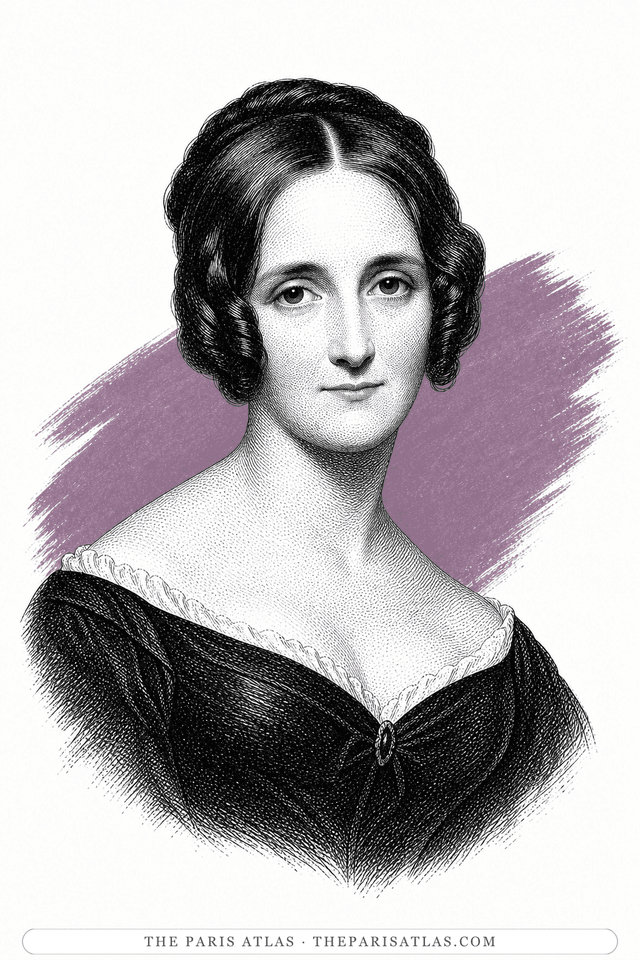
Mary Shelley
The author of Frankenstein, who first saw Paris at sixteen as a runaway. In the summer of 1814 she crossed from England to Calais with the poet Percy Bysshe Shelley and her stepsister Claire Clairmont, spent a week trapped in an expensive Paris hotel with no money, then bought a donkey and walked south-east across a France still wrecked by the Napoleonic wars. That journey became her first published book. Two years later, on a lake in Switzerland, she began her second.
View author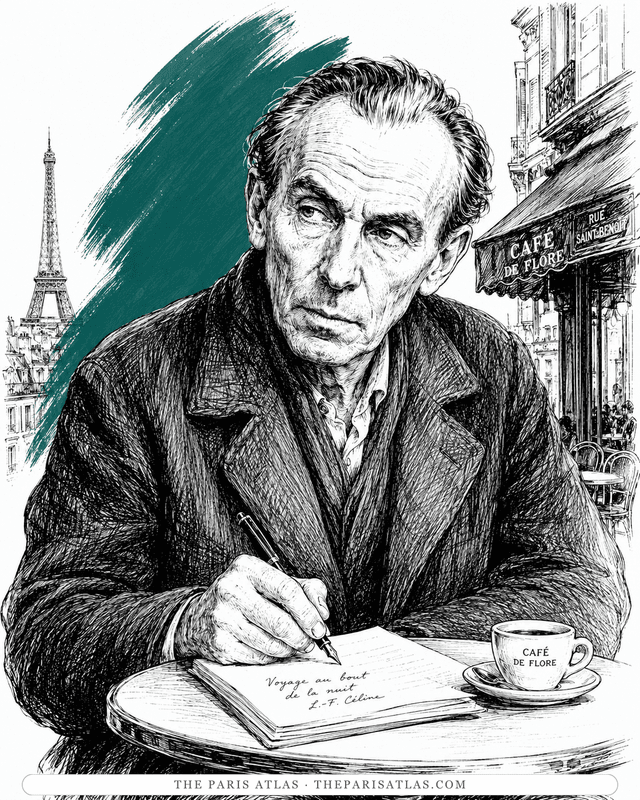
Louis-Ferdinand Céline
The doctor of the Paris slums who wrote the century's blackest, funniest novel — and changed the sound of French prose.
View author