
Animal Farm
Both use accessible storytelling to show how slogans, loyalty, and promises of equality can become instruments of control.
Read our take
by Todd Strasser
A classroom experiment shows how quickly discipline, slogans, symbols, and belonging can replace judgment.
A teacher creates an experiment to explain fascism and watches his students embrace group obedience much faster than expected.
A high school history class watches a film about the Holocaust, and the students ask their teacher a question he cannot answer well: how could so many ordinary Germans obey the Nazis or claim not to know what was happening? Ben Ross decides that explanation is not enough. He creates a classroom exercise built around posture, discipline, unity, and obedience.
The students enjoy the experiment almost immediately. Grades improve, awkward students are included, and the school’s losing football team believes the new discipline may make it stronger. Ben adds a name, a salute, membership cards, monitors, and the slogan “Strength Through Discipline, Strength Through Community, Strength Through Action.” What began as a lesson becomes a movement that rewards belonging and treats doubt as betrayal.
The Wave is a short young-adult novel written by Todd Strasser, originally under the name Morton Rhue. It novelizes the 1981 television film inspired by teacher Ron Jones’s 1967 “Third Wave” classroom experiment. The book is not a documentary record of that real class. Its characters, school, dialogue, timeline, and dramatic ending are fictionalized to make the warning clear: authoritarian behavior does not require unusual villains. It can grow from ordinary people enjoying order, purpose, and the relief of no longer standing alone.
Ben Ross teaches history at Gordon High School. After showing his class graphic footage from Nazi concentration camps, he explains that many Germans later claimed they had not known what the regime was doing. His students are dissatisfied. Laurie Saunders, a thoughtful senior and editor of the school newspaper, asks how an entire population could surrender judgment so completely. Ben continues researching after school and becomes frustrated by the limits of an ordinary lecture.
The next day, Ben writes “Strength Through Discipline” on the board. He teaches students a rigid seated posture and drills them to enter the room, take their seats, and answer questions in short, formal responses. The class becomes unusually focused and efficient. Ben is impressed by the result and by his own ability to command the room. Robert Billings, a lonely student who is usually mocked and ignored, participates more eagerly than anyone.
Ben expands the experiment under the name the Wave. He adds “Strength Through Community,” gives the class a wave symbol and salute, and instructs members to recruit others. Students receive membership cards; several cards mark their holders as monitors responsible for reporting rule-breaking. The movement spreads beyond Ben’s class. David Collins, Laurie’s boyfriend and a running back, brings it to the football team. Robert’s posture, clothing, and schoolwork improve because the Wave gives him a place where he is no longer treated as the class failure.
Laurie initially appreciates some of the changes but becomes uneasy when students repeat slogans instead of thinking. An anonymous student submits a letter to The Gordon Grapevine describing pressure and intimidation during recruitment. Amy Smith, Laurie’s best friend, embraces the Wave partly because its promise of equality relieves her constant feeling that she is competing with Laurie. Ben also becomes more absorbed, accepting Robert as his unofficial bodyguard and adding “Strength Through Action.”
The negative evidence grows. A Jewish student is beaten after refusing to join. Brad tries to keep Laurie out of the football stands unless she performs the salute. The football team still loses badly despite its new sense of unity. Laurie, Carl Block, Alex Cooper, and other newspaper students publish a special issue documenting threats, conformity, and violence. Wave members denounce Laurie as an enemy, and David breaks with her because he believes her criticism is hurting the group.
David later confronts Laurie and demands that she stop attacking the Wave. When she refuses, he shoves her violently to the ground. The sight of what he has done breaks the movement’s hold on him. He apologizes, and they go together to Ben’s house. Ben’s wife Christy has already warned him that the experiment is controlling him as much as the students. Ben promises Laurie and David that he will end it, but asks them to trust the final lesson he has planned.
The next day, Ben announces a mandatory rally for Wave members. He claims that the movement exists in schools across the country and that its national leader will appear on television to launch a political youth organization. The students fill the auditorium in uniforms of posture, salute, and expectation. When the screen remains blank, Ben reveals an image of Adolf Hitler and tells them that this is the leader their behavior has prepared them to follow.
Ben tells the students there is no national Wave organization. He created the announcement to make them feel, for a few minutes, the excitement of belonging to a mass movement and waiting for a leader. He then confronts them with photographs of Nazi rallies and explains that they traded independent judgment for discipline, community, and action.
The students leave in shock, discarding membership cards and symbols. Laurie and David remain together, and Amy embraces Laurie. Students who had defended the movement now have to recognize how easily they bullied, informed on, or excluded other people while believing they were improving the school.
Robert is the person most devastated by the ending. Before the Wave, he was isolated and humiliated. Inside it, he gained friends, purpose, and a respected role beside Ben. When the auditorium empties, he remains behind crying because the community that briefly made him matter has vanished.
Ben finds Robert and does not abandon him to the lesson. He invites him to get something to eat and talk. The ending does not pretend that exposing the lie repairs every injury. It closes by recognizing that authoritarian groups recruit through real emotional needs, and that ending the group requires care for the people who depended on it most.
The Wave succeeds because it gives students something they genuinely want. Robert gains acceptance. Amy escapes comparison. The football players feel united. Ben feels effective. The novel’s warning would be weaker if the movement offered only fear; its danger begins in the pleasure of being included.
The first classroom drills appear harmless and even useful. Students sit straighter, answer faster, and complete work more neatly. The problem is not posture itself. It is the way efficiency becomes proof that Ben deserves greater authority and that questioning him is selfish.
The Wave claims to erase cliques and status. It does help Robert, at least temporarily. Yet its equality requires everyone to use the same salute, slogans, and public behavior. Difference is not respected; it is treated as a threat to unity.
“Strength Through Discipline,” “Strength Through Community,” and “Strength Through Action” sound positive because each word can describe something valuable. Repetition strips the words of qualification. The slogans become answers that end discussion rather than ideas students can examine.
Ben begins with a serious educational purpose, but he enjoys the experiment’s success and delays ending it. He creates monitors, secrecy, and a rally even after warning signs appear. The final lesson is powerful, yet the novel does not erase his responsibility for the fear and violence produced along the way.
Laurie can see the danger, but speaking against it costs her friends, boyfriend, and safety. Carl and Alex help because dissent needs institutions as well as private doubt. The school newspaper matters because it gives isolated concerns a public form.
The book does not claim that a week-long school experiment reproduces the Holocaust. It shows a narrower point: obedience, surveillance, exclusion, and leader worship can feel normal when introduced in small steps. Students who believe they could never act like fascists begin punishing dissent within days.
Strasser writes in short chapters with plain sentences and quick shifts among Ben, Laurie, David, Robert, and the school community. The prose is designed for speed and clarity. It does not imitate fascist rhetoric so much as show how simple repeated language can organize a group before people have examined what the words demand.
The book is openly didactic. Its characters sometimes state the lesson directly, and the auditorium ending is constructed for maximum dramatic clarity. That directness suits its origin as a television novelization and its long use in classrooms. Readers looking for psychological complexity on the scale of a long adult novel may find it simplified, but the compression makes the movement’s rapid growth easy to see.
The title should not be presented as a verbatim memoir of Ron Jones’s 1967 experiment. Todd Strasser novelized Johnny Dawkins’s teleplay for the 1981 television film, which had already fictionalized the historical event. The book’s Ben Ross, Laurie, David, Robert, Gordon High, specific violence, and televised final rally belong to the dramatic version.
The 1981 Dell paperback originally credited Morton Rhue, Todd Strasser’s pseudonym. Later English editions often use Strasser’s real name. The change in byline does not indicate a different author or a substantially different novel.
The book has been translated widely. Hans-Georg Noack’s German Die Welle became particularly successful and is often the edition through which European readers encounter the story. Other common titles include La Vague in French and La Ola in Spanish. Edition pages should record the translator and distinguish prose translations from graphic-novel versions.
Because the novel follows the 1981 television script, claims about the historical Third Wave should be verified against Ron Jones and former students rather than inferred from fictional characters. Some accounts date the real experiment to 1967, while older book copy occasionally says 1969. The official historical project identifies spring 1967.
The relationship between book and screen is unusual: the 1981 ABC television film came first, and Strasser’s book is its novelization. Bruce Davison played teacher Ben Ross. The film won the 1982 Primetime Emmy for Outstanding Children’s Program and remains closely associated with classroom use of the novel.
Dennis Gansel’s 2008 German film Die Welle moves the experiment to contemporary Germany, changes character names and events, and gives the story a far more violent ending. It should not be described as a faithful film of Strasser’s exact plot, although the novel and film share the same historical source.
The 2019 Netflix Germany series We Are the Wave is a loose political reworking rather than a direct adaptation. The documentaries Lesson Plan (2010) and The Invisible Line (2019) address the real Third Wave experiment and are better sources for historical testimony than the fictional novel or films.
Ordinary people surrender judgment because belonging feels easier than resistance.
The school setting makes the experiment’s appeal and spread easy to follow.
The students’ response invites readers to ask when solidarity becomes a reason to stop questioning.

Ben Ross is the Gordon High history teacher who creates the Wave.

Laurie is a senior, an excellent student, and editor in chief of The Gordon Grapevine.

David is Laurie’s boyfriend and a running back on Gordon High’s football team.

Robert is an isolated student who has been bullied and compared unfavorably with his successful older brother Jeff.

Amy is Laurie’s close friend and intellectual peer.

Christy is Ben’s wife and a music teacher at Gordon High.

Brian is the football team’s starting quarterback and one of the Wave’s strongest student supporters.

Brad begins as one of Robert’s principal tormentors.

Eric is a football player and one of the students who initially insists he would never have followed the Nazis.

Carl is an investigative reporter for The Gordon Grapevine and one of the school’s practical jokers.

Alex is the newspaper’s music reviewer and Carl’s close friend.

Principal Owens is Gordon High’s intimidating but generally fair administrator.

Laurie’s mother distrusts the Wave early and worries that it rewards obedience rather than education.
Laurie’s father initially thinks the Wave may be an exaggerated school fad.

Coach Schiller leads the Gordon High football team.

Jeff is Robert’s older brother, a former model student and athlete who never appears directly in the main action.

The unnamed Jewish student refuses or resists Wave pressure and is beaten by members who use an antisemitic slur.
1967
History teacher Ron Jones conducts the real Third Wave experiment at Cubberley High School in Palo Alto, California.
1976
Jones publishes an account of the experiment, helping establish the version later dramatized for television.
4 October 1981
ABC broadcasts the television film The Wave, produced by Norman Lear and based on Johnny Dawkins’s teleplay.
1981
Dell publishes Todd Strasser’s novelization under the pseudonym Morton Rhue.
1982
The television film receives major recognition, including the Primetime Emmy for Outstanding Children’s Program.
1985
Hans-Georg Noack’s German translation, Die Welle, appears and becomes especially influential in German schools.
2008
Dennis Gansel releases the German film Die Welle, a modern reimagining of the experiment rather than a direct adaptation of every novel detail.
2010
Lesson Plan, a documentary involving former students from the original Third Wave class, is released.
2013
A widely available Ember edition is published under Todd Strasser’s name.
2019
The German series We Are the Wave uses the premise as loose inspiration; The Invisible Line documents the historical experiment.
Both use accessible storytelling to show how slogans, loyalty, and promises of equality can become instruments of control.
Read our take
Both place young people inside a small social system and watch belonging, fear, and power change their behavior.
Read our take
Orwell depicts a mature totalitarian state; Strasser shows authoritarian habits being learned in a school within days.
Read our take
Koestler examines the long-term logic of ideological obedience; Strasser dramatizes its first emotional attractions.
Read our take
Both ask why ordinary people may cooperate with systems that reduce thought rather than merely being forced by them.
Read our takeIt is inspired by Ron Jones’s 1967 Third Wave classroom experiment in Palo Alto. The novel itself is fictionalized and follows the 1981 television film. Ben Ross, Laurie, David, Robert, Gordon High, and many specific incidents are dramatic creations.
His students ask how ordinary Germans could obey the Nazis or ignore persecution. Ben wants them to experience the appeal of discipline and belonging rather than receive another abstract explanation. He underestimates how quickly the exercise will become socially real.
The movement develops three linked slogans: “Strength Through Discipline,” “Strength Through Community,” and “Strength Through Action.” Each sounds positive alone, but together they become a program of obedience and enforced unity.
Before the experiment, Robert is bullied, ignored, and constantly compared with his successful brother. The Wave gives him equal status, friends, a role, and Ben’s attention. He has more to lose when it ends than students who already belonged elsewhere.
She sees that students are replacing judgment with slogans and using group loyalty to intimidate nonmembers. Anonymous testimony, the assault on a Jewish student, and restrictions at the football game confirm that the movement is no longer a classroom exercise.
David tries to force Laurie to stop criticizing the Wave and shoves her to the ground. The violence makes him recognize that a movement he thought promoted teamwork has taught him to treat disagreement as an enemy action.
He stages a rally and claims a national Wave leader will appear on television. Instead, he shows Adolf Hitler and tells the students their obedience has prepared them to follow such a leader.
He is devastated because the Wave was the first community to give him respect. Ben finds him crying after the rally and offers to take him out for food and talk, suggesting that the teacher now understands Robert needs more than a public lesson.
No. Die Welle updates the premise to modern Germany and changes the characters, setting, development, and ending. It is inspired by the same historical experiment rather than a scene-by-scene adaptation of Strasser’s novel.
It is commonly taught to middle- and high-school students because the prose is accessible and the political mechanism is clear. It includes Holocaust imagery, bullying, antisemitism, coercion, and physical aggression, so guided discussion is valuable.
Explore authors with a similar voice, perspective, and influence.

The Missouri newspaperman who became America's most famous writer, and whose first book made its reputation partly out of Paris: in 1867 he arrived with a shipload of American tourists, renamed his guide Ferguson, watched the high-kicking can-can through his fingers and wrote it all down. He kept coming back — and was living in Paris in the mid-1890s, broke, while finishing the novel he considered his best, Personal Recollections of Joan of Arc.
View author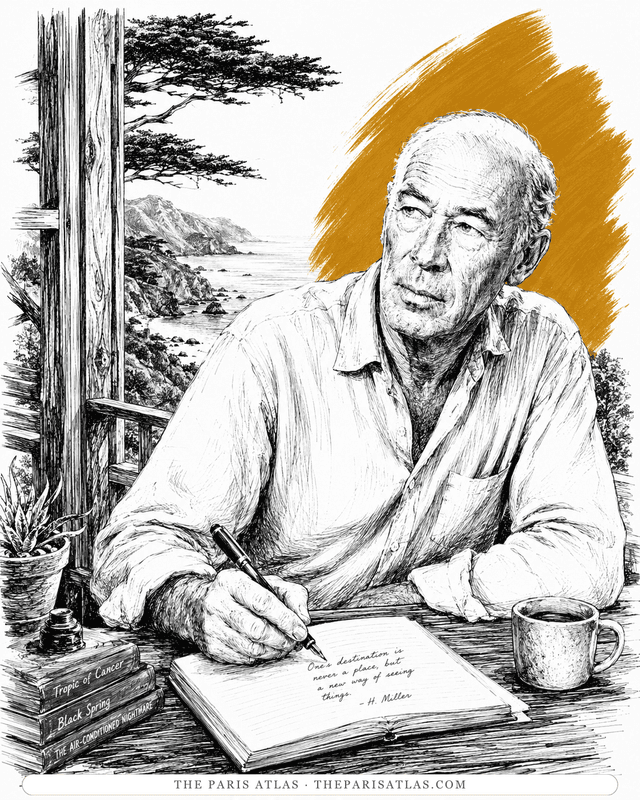
The Brooklyn dropout who arrived in Paris broke at thirty-eight and wrote the exuberant, banned books that ended American censorship.
View author
French writer and philosopher whose novels, memoirs, and social analysis examined freedom, gender, responsibility, aging, and the material conditions that shape a life.
View authorThe sources below include the primary text, editions, scholarship, archival materials, and other records that informed this page. They document The Wave, its publication, and its place in literary history.


Open Library ISBN catalogue used to verify the title, ISBN, and publication metadata.
Google Books catalogue record used to cross-check the title and edition metadata.
Internet Archive ISBN catalogue used to cross-check the edition and its availability in library holdings.
Library of Congress books catalogue used to cross-check the bibliographic record by ISBN.

Official resource created around the original participants; verifies the 1967 experiment and chronology of major books, films, and documentaries.
Official history page; distinguishes Ron Jones’s experiment, the 1981 television film, and Todd Strasser’s later novelization.
Official film history; verifies the 1981 ABC broadcast, Norman Lear production, awards, and the book’s relationship to the movie.
Official print history; verifies Strasser/Morton Rhue authorship and the novelization’s international classroom afterlife.
Current publisher page; verifies author, premise, and modern edition.
Scholarly interview/history explaining how Todd Strasser became Morton Rhue and documenting the Dell and German publication history.
Plot and character cross-check, including the newspaper, violence, final rally, and Robert’s ending.
Bibliographic and adaptation index; cross-check against official Wave and publisher sources.
The primary text is the baseline reference for every book page. Additional references document publication history, interpretation, and historical context where that evidence is available.
 Explore more resources