
Charles I of England
The king the four friends fail to save, who speaks his last word to Athos through the boards of the scaffold.
The book

At a glance
- King of England, prisoner of the Scots and then of Cromwell
- Charles I, 1600–1649
Who they are in the book
Spoiler-freeCharles Stuart is the real king of England, in the novel already beaten in the field and in the hands of the Scots army when Athos and Aramis reach him. Dumas makes him dignified, unlucky and stubborn, a man who refuses to run because he has fought too long, and who meets his death with more composure than anyone around him.
How Charles I of England Is Portrayed
- Sold by the ScotsIn Chapter LV he tells his new French officers that the Scots, among whom he was born, have sold him to Parliament, and that the shame of a treble treason will fall on their heads.
- Cromwell's prisonerChapter LVI ends with couriers riding across England and Europe to announce that Charles Stuart is the prisoner of Oliver Cromwell.
- The scaffold outside the windowIn Chapter LXV he is woken at Whitehall by hammering and learns from his servant Parry that the scaffold is being built level with his window.
- Remember!In Chapter LXVI he tells the executioner to strike only when he says the word, speaks through the boards to Athos about a million in gold at Newcastle, and calls out "Remember!" as the axe falls.
Charles I of England quotes
this is not a moment for recrimination, but a time to show yourself a king and a gentleman. Up, sire! up! for you have here at least three men who will not betray you.
I leave you to brave the tempest; I go before you to a kingdom which knows no storms. Farewell.
He is beheaded at Whitehall in Chapter LXVI. The masked man who takes the axe is Mordaunt; the four friends had already spirited away the real executioner.
If you like Twenty Years After


If you like Alexandre Dumas
Explore authors with a similar voice, perspective, and influence.

Mark Twain
The Missouri newspaperman who became America's most famous writer, and whose first book made its reputation partly out of Paris: in 1867 he arrived with a shipload of American tourists, renamed his guide Ferguson, watched the high-kicking can-can through his fingers and wrote it all down. He kept coming back — and was living in Paris in the mid-1890s, broke, while finishing the novel he considered his best, Personal Recollections of Joan of Arc.
View author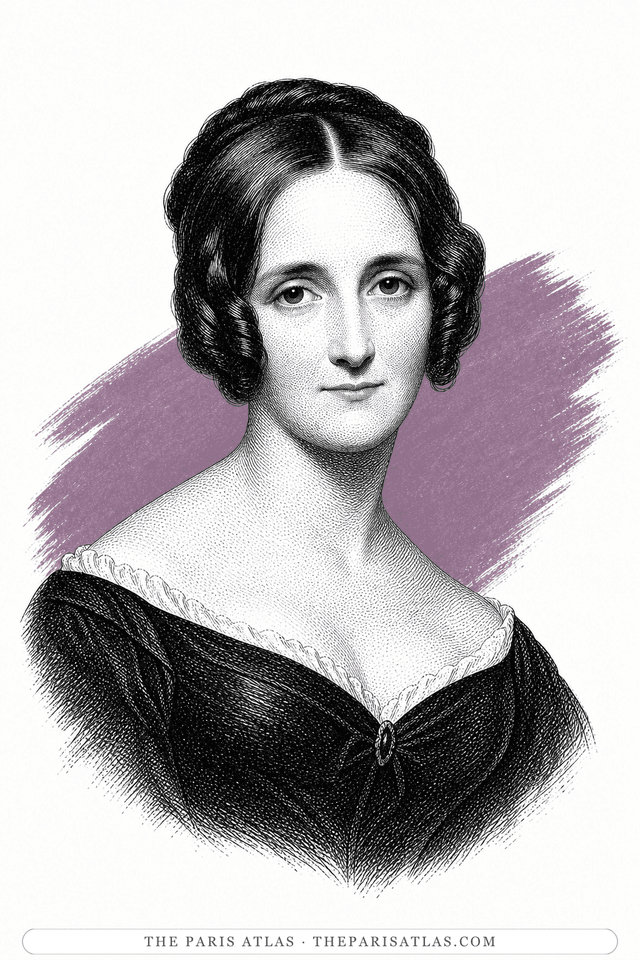
Mary Shelley
The author of Frankenstein, who first saw Paris at sixteen as a runaway. In the summer of 1814 she crossed from England to Calais with the poet Percy Bysshe Shelley and her stepsister Claire Clairmont, spent a week trapped in an expensive Paris hotel with no money, then bought a donkey and walked south-east across a France still wrecked by the Napoleonic wars. That journey became her first published book. Two years later, on a lake in Switzerland, she began her second.
View author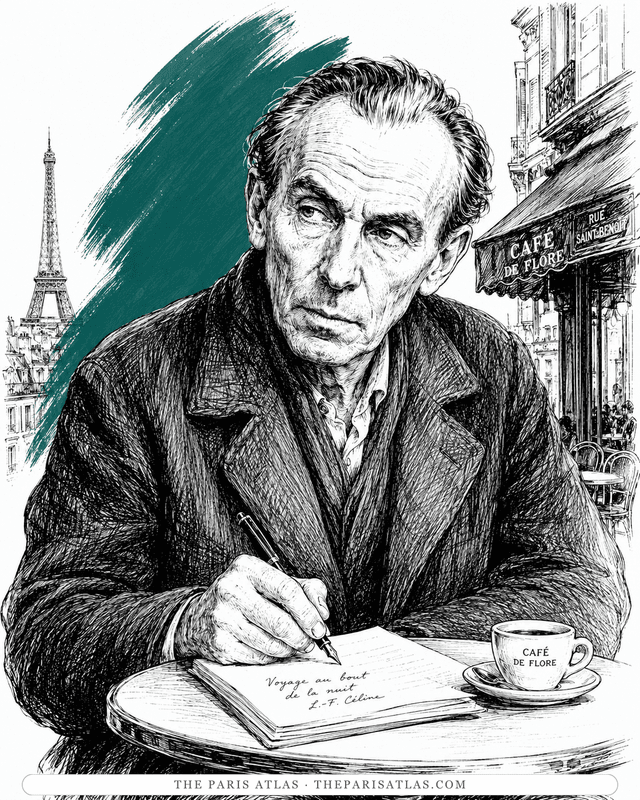
Louis-Ferdinand Céline
The doctor of the Paris slums who wrote the century's blackest, funniest novel — and changed the sound of French prose.
View author