
Tropic of Cancer
Another broke writer turning humiliation, appetite, and self-belief into literature.
Read our take
by John Fante
John Fante’s novel of a broke, arrogant young writer chasing literary glory and love in Depression-era Los Angeles.
Arturo Bandini lives in a cheap Los Angeles hotel, survives on almost nothing, and is convinced he is destined to become a great writer. His hunger, pride, humiliation, desire, and volatile relationship with Camilla Lopez make the novel a foundational story about turning an undignified life into literature.
Arturo Bandini comes to Los Angeles convinced that he is going to become a great writer. The evidence is limited. He has published one short story, lives in a cheap hotel, worries constantly about money, and spends as much time imagining his future fame as actually writing.[1]
Then he meets Camilla Lopez, a Mexican American waitress at the Columbia Buffet. Arturo is immediately attracted to her and almost immediately cruel to her. Their relationship becomes a cycle of desire, humiliation, jealousy, pride, and tenderness. Camilla is obsessed with another man, Sammy, and neither she nor Arturo can turn affection into something stable.[1]
Ask the Dust is semi-autobiographical and draws on Fante’s years as a young writer in Depression-era Los Angeles. Arturo can be arrogant, prejudiced, insecure, romantic, vicious, hilarious, and painfully vulnerable within a few pages. Fante’s fast, clean prose shows the difference between Arturo’s grand self-image and the genuine hunger beneath it.[1]
Arturo Bandini lives at the Alta Loma Hotel in Los Angeles and survives on very little money while trying to become a writer. He idolizes editor J. C. Hackmuth, who published his story “The Little Dog Laughed.” Arturo repeatedly rereads the acceptance letter as proof that he is destined for literary greatness.[1]
At the Columbia Buffet, Arturo meets Camilla Lopez, a young Mexican American waitress. He wants her attention but responds to his insecurity by insulting her appearance and ethnicity. She mocks him in return. Their attraction grows through hostility, and Arturo becomes obsessed with winning her even as he repeatedly hurts her.[1]
Camilla is in love with Sammy, a bartender and aspiring writer who lives in the desert. Sammy treats her badly and does not return her devotion. Arturo becomes jealous and tries to compete with him emotionally and artistically. Arturo also becomes involved with Vera Rivken, an older woman whose physical scars and vulnerability force him to confront his cruelty and sexual anxiety.[1]
An earthquake kills Vera, leaving Arturo shaken. His writing career begins to improve, and he receives money and eventually publishes a novel. Camilla becomes increasingly unstable and dependent on marijuana. Her relationship with Arturo briefly becomes more intimate, but her fixation on Sammy and her deteriorating condition make stability impossible.[1]
Arturo tries to help Camilla after she is hospitalized and later searches for her when she disappears. He follows her into the desert, where Sammy has been living, but cannot repair the situation. Camilla vanishes into the desert landscape.[1]
Arturo searches for Camilla but cannot find her. Her disappearance is not a romantic escape. It follows a long period of instability, drug use, unreturned love, and Arturo’s unsuccessful attempts to help someone whose life he never fully understood.
He takes a copy of his newly published book into the desert near Sammy’s place. Rather than handing the novel to Camilla, he throws it toward the land where she disappeared.
The gesture joins Arturo’s two great obsessions: becoming a writer and being loved by Camilla. The published book proves his professional success, but it cannot solve the human loss at the center of the story.
Arturo needs to believe he is a great writer before the world has much reason to agree. That confidence keeps him working and helps him endure poverty, but it also inflates his ego.
The opening makes unpaid rent sound like a decisive turning point, then Arturo announces that he has solved it by going to sleep. The joke lies between the finished sentence and the unfinished business: a narrator can close an episode even when a tenant cannot pay his bill. His account gives him control that his circumstances deny him. Fante establishes the appeal and the danger of that gift together, allowing Arturo to turn an evasion into a small narrative triumph.
Arturo often attacks the people he wants most. His insults toward Camilla are tied to his fear that she can reject him.
Their exchanges can be funny and lively, but the harm is real. Attraction does not make either person capable of trust or steady care.
Arturo is the son of Italian immigrants and wants access to an American identity that he then tries to deny Camilla. His prejudice grows from his own insecurity, but Camilla still bears its effects.
Los Angeles offers sunshine, cheap rooms, fantasy, and reinvention, but it does not care whether Arturo succeeds. Dust, heat, streets, and cheap cafés keep the novel grounded.
On the first walk through Los Angeles, the view outside the Biltmore turns into a fantasy of belonging inside it. A stranger in silver fox becomes Arturo's admiring companion, while a pipe-shop window supplies the accessories of the famous author he imagines himself to be. The narration passes from observation into invention with scarcely a pause. That movement makes the city more than indifferent scenery: its clothes, cars and shopfronts furnish the roles Arturo tries on before he has earned the life they promise.
Arturo’s sexual life is burdened by shame and religious imagination. Desire repeatedly collides with fear, disgust, and idealization.
Publication brings Arturo the achievement he wanted. By the ending, however, literary success cannot compensate for Camilla’s disappearance.
Fante’s first-person prose is lean, fast, comic, and emotionally exposed. Arturo’s swagger is constantly punctured by his insecurity. Fante shows the gap between who Arturo thinks he is and what the reader can see without long explanations.
The style strongly influenced Charles Bukowski, who later championed Fante’s work. Readers who like Henry Miller’s autobiographical intensity may appreciate Fante for a related reason, but Fante is much tighter. He can move from bragging to humiliation to tenderness in a few sentences.
Fante wrote the book in English. The Black Sparrow Press revival is historically important because Charles Bukowski’s introduction helped bring Fante back into public view. Modern Harper and Canongate editions are widely available.
Robert Towne directed the 2006 film Ask the Dust, starring Colin Farrell as Arturo and Salma Hayek as Camilla. The film compresses and changes character material, so it should not be used to settle details of the novel.
Bandini’s poverty, ego, hunger, and absolute belief in his talent make him one of Miller’s closest fictional relatives.
Arturo’s fast, funny account reveals his insecurity and cruelty even when he believes he is presenting himself as a future genius.
Cheap rooms, cafés, heat, dust, and long streets make artistic ambition feel physical rather than abstract.

The young Italian American narrator who wants literary fame and romantic validation but repeatedly harms his relationships.

The Mexican American waitress whom Arturo loves and repeatedly hurts.

The desert-dwelling bartender and aspiring writer whom Camilla loves and Arturo treats as a rival.

The physically scarred woman whose vulnerability forces Arturo to confront his sexual fear and cruelty.

The editor whose acceptance of one story becomes Arturo’s proof that literary success is possible.

The people around Arturo’s cheap lodging who give his precarious Los Angeles life a social setting.
1939
Stackpole Sons publishes the first edition.
1980
Black Sparrow Press reissues the novel with an introduction by Charles Bukowski, helping revive Fante’s reputation.
2006
Robert Towne directs a film adaptation starring Colin Farrell and Salma Hayek.
2010s onward
Harper Perennial, Canongate, and other publishers keep the novel widely available.

Another broke writer turning humiliation, appetite, and self-belief into literature.
Read our take

Another autobiographical American novel powered by voice and restless self-invention.
Read our take


Arturo is a fictional alter ego based closely on Fante’s background, ambition, Catholic upbringing, and early years as a writer in Los Angeles.
Fante drew from life, but Camilla should be treated as fictional unless a specific biographical claim is supported by a reliable Fante source.
His cruelty grows from insecurity, desire, prejudice, and fear of rejection. Camilla repeatedly experiences the harm caused by those motives.
She disappears into the desert after her mental condition and drug use deteriorate. Arturo cannot find her.
Yes, materially. By the end he has published a novel, but the achievement feels hollow beside Camilla’s disappearance.
Fante presents the city as a place of aspiration and loneliness. Arturo believes Los Angeles can transform him, but the city remains indifferent.
Arturo uses racist language and directs prejudice toward Camilla. The novel also exposes the contradiction of an insecure immigrant son using racial hierarchy to assert superiority.
Charles Bukowski recognized in Fante a direct, autobiographical, funny style about poverty, bad behavior, artistic ambition, and Los Angeles life.
Explore authors with a similar voice, perspective, and influence.
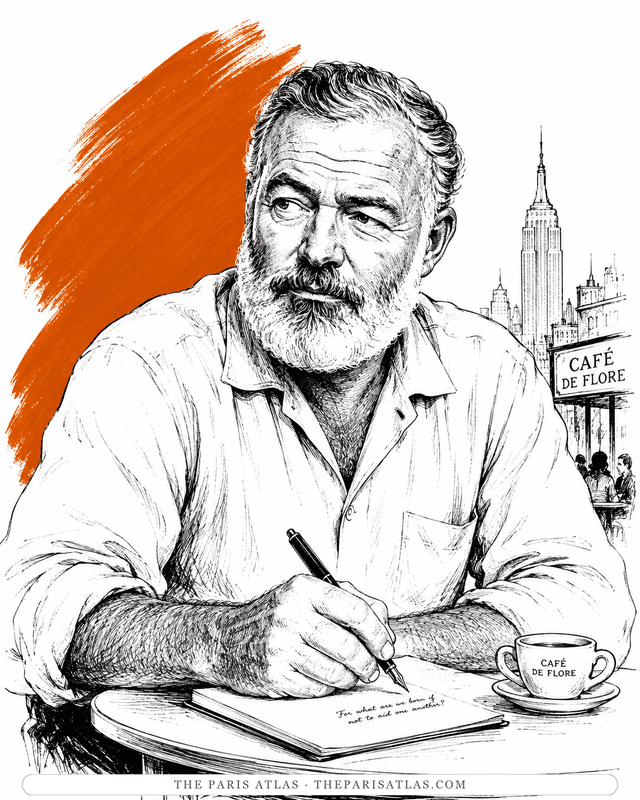
Author of The Sun Also Rises and A Moveable Feast; his pared-down style, developed in 1920s Paris, became the most imitated in American prose.
View author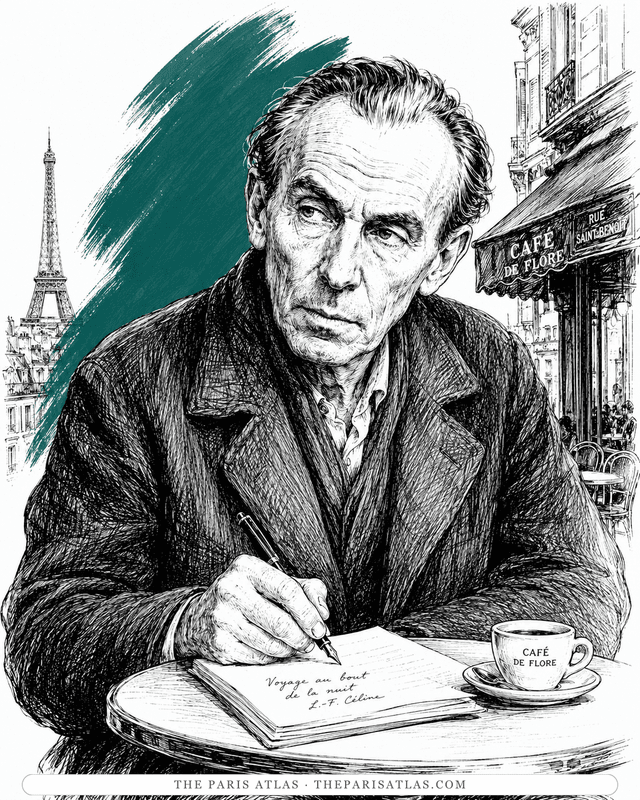
The doctor of the Paris slums who wrote the century's blackest, funniest novel — and changed the sound of French prose.
View author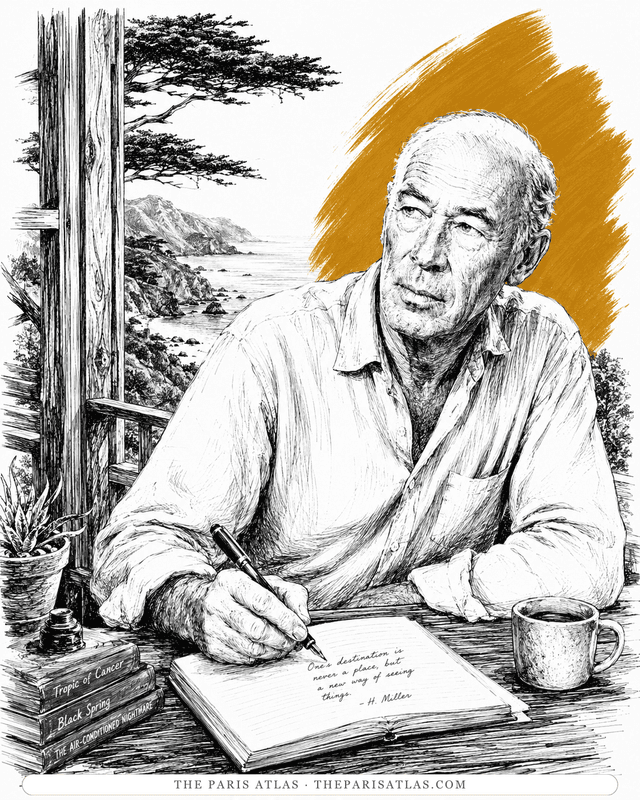
The Brooklyn dropout who arrived in Paris broke at thirty-eight and wrote the exuberant, banned books that ended American censorship.
View authorThe sources below include the primary text, editions, scholarship, archival materials, and other records that informed this page. They document Ask the Dust, its publication, and its place in literary history.

Primary text included as part of the documented record for Ask the Dust.

Publisher record for a modern edition and its Charles Bukowski introduction.
Library catalog evidence for the Black Sparrow Press edition.
Critical account of the novel’s publication, rediscovery, and reception.
The primary text is the baseline reference for every book page. Additional references document publication history, interpretation, and historical context where that evidence is available.
 Explore more resources